


Coalescent Filter
In the landscape of industrial separation technology, the coalescent filter represents a sophisticated solution for the removal of sub-micron liquid droplets and aerosols from gas streams or the separation of immiscible liquids. Unlike standard particulate filtration, which relies on physical sieving to trap solid contaminants, coalescence is a dynamic process that leverages the physical properties of fluids to merge finely dispersed droplets into larger masses that can be gravitationally separated. For engineers and procurement specialists managing high-stakes environments like chemical processing, hydraulic systems, and compressed air networks, understanding the technical nuances of a coalescent filter is essential for maintaining system integrity and process purity.
Understanding Coalescence in Industrial Filtration
A coalescent filter is designed to handle two primary types of separation: gas-liquid and liquid-liquid. In gas-liquid applications, the filter removes oil mists, water aerosols, and other liquid contaminants from a gas stream (such as compressed air or natural gas). In liquid-liquid applications, it separates two non-mixing liquids, such as removing water from diesel fuel or jet fuel, or recovering oil from aqueous process streams.
The fundamental objective of the coalescent filter is to overcome the stable suspension of droplets. In many industrial processes, mechanical agitation, pumping, or pressure changes create emulsions or fine mists where droplets are too small to settle out by gravity alone. The filter media provides the necessary surface area and physical environment to force these droplets to collide and fuse. Once the droplets reach a critical mass, they are heavy enough to fall out of the flow path, effectively purifying the primary fluid.
The Working Principle of a Coalescent Filter
The operation of a high-performance coalescent filter involves three distinct stages: capture, coalescence, and drainage. These stages occur within a multi-layered media structure, often supported by precision-engineered stainless steel components to ensure structural stability under high pressure.
1. The Capture Stage
As the contaminated fluid passes through the filter media, three physical mechanisms facilitate the capture of small droplets:
* Direct Impaction: Larger droplets with higher momentum strike the fibers of the filter media directly and adhere to them.
* Interception: Droplets that follow the fluid streamlines come close enough to a fiber to be captured by van der Waals forces.
* Diffusion (Brownian Motion): Extremely small sub-micron droplets move erratically due to molecular collisions, eventually making contact with the media fibers.
2. The Coalescence Stage
Once captured, the droplets reside on the surface of the fibers. As more droplets are trapped, they move along the fiber length and accumulate at the intersections of the media. Through surface tension and molecular attraction, these small droplets merge into larger ones. This process continues until the droplets grow large enough to bridge the gaps between fibers, creating a continuous liquid phase within the media.
3. The Drainage Stage
In a gas-liquid coalescer, the flow direction is typically from the inside of the element to the outside. As the enlarged droplets reach the outer surface of the filter (often referred to as the "drain layer"), they are pulled downward by gravity. The separated liquid collects in a sump or quiet zone at the bottom of the filter housing, where it can be manually or automatically discharged. The purified gas then exits the housing, free of liquid aerosols.
Material Selection and Structural Integrity
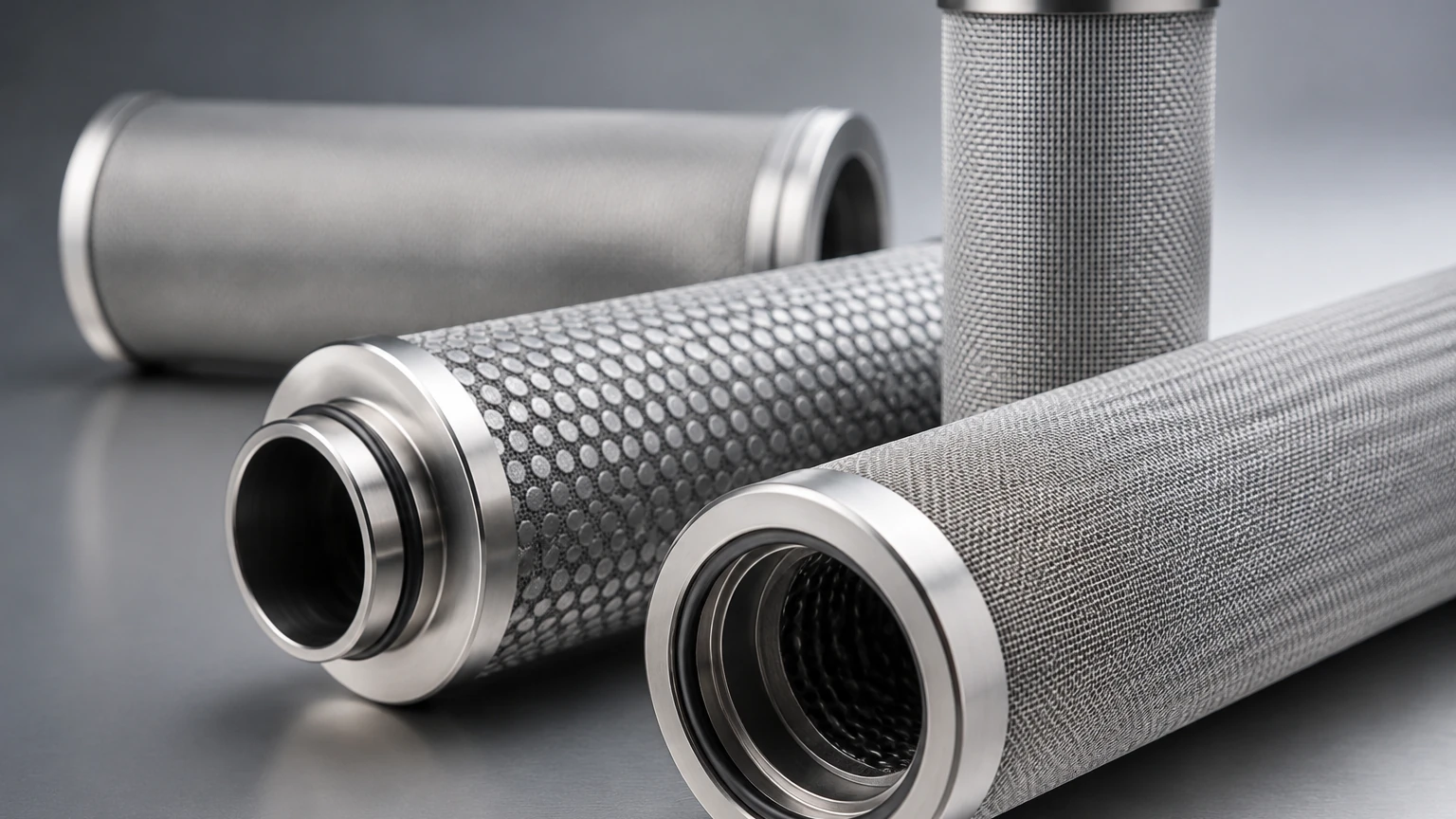
For industrial applications, the choice of materials for a coalescent filter is critical to its longevity and performance. While the primary coalescing media might consist of borosilicate glass fibers or specialized polymers, the structural components—such as inner and outer cores, end caps, and support layers—are frequently manufactured from stainless steel.
At Main Page, the emphasis on custom stainless steel filtration solutions highlights the importance of material compatibility. In aggressive chemical environments or high-temperature processes, 304 or 316L stainless steel is preferred for its corrosion resistance and mechanical strength. Stainless steel wire mesh serves as an excellent support structure, preventing the relatively fragile coalescing media from collapsing or migrating under high differential pressure. Furthermore, precision-perforated metal cores ensure uniform flow distribution, which is vital for maintaining the residence time required for effective coalescence.
Performance Metrics: Efficiency and Differential Pressure
When evaluating a coalescent filter, engineers must balance separation efficiency with the energy costs associated with pressure drop.
Separation Efficiency
Efficiency is typically measured by the filter's ability to remove aerosols of a specific size, often down to 0.3 or 0.01 microns. In gas streams, high-efficiency coalescers can achieve 99.99% removal of oil and water aerosols. For liquid-liquid separation, efficiency is often expressed as the "downstream concentration" of the dispersed phase, such as reducing water content in oil to less than 10 ppm.
Differential Pressure (Delta P)
The pressure drop across a coalescent filter is composed of the "dry" pressure drop (the resistance of the clean media) and the "wet" pressure drop (the resistance when the media is saturated with the liquid being separated). A well-designed filter maintains a stable wet pressure drop throughout its service life. An unexpected spike in differential pressure usually indicates particulate fouling rather than liquid saturation, as solid contaminants will plug the interstitial spaces of the coalescing media.
Industrial Applications and System Integration
The versatility of the coalescent filter makes it indispensable across various sectors:
* Compressed Air Systems: Protecting sensitive pneumatic tools, CNC machinery, and instrumentation from oil and water contamination. This is particularly critical in food and beverage or pharmaceutical production where compressed air may come into contact with the product.
* Chemical and Petrochemical Processing: Separating hydrocarbons from water streams or removing liquid catalysts from process gases. The use of stainless steel components ensures that the filters can withstand the harsh chemical nature of these fluids.
* Natural Gas Filtration: Removing liquid hydrocarbons and water from natural gas streams before they enter compressors or pipelines to prevent "slugging" and corrosion.
* Hydraulic and Lube Oil Systems: Removing water from oil to prevent oxidation, additive depletion, and component wear. Coalescence is often more efficient than vacuum dehydration for removing large volumes of free water.
Sizing and Selection Criteria for Engineering Teams
Selecting the correct coalescent filter requires more than just matching a pipe size. Engineers must consider several variables to ensure the separation process is effective and the filter life is maximized.
1. Flow Rate and Velocity: Coalescence is a velocity-sensitive process. If the fluid velocity is too high, the drag forces may strip the coalesced droplets from the media before they can drain, leading to "re-entrainment." Conversely, if the velocity is too low, the impaction mechanism may be less effective.
2. Fluid Properties: The surface tension, viscosity, and density of both the continuous and dispersed phases must be known. Fluids with low interfacial tension are much harder to separate and may require specialized media treatments.
3. Temperature and Pressure: These factors influence fluid density and viscosity. High temperatures can also affect the structural integrity of certain synthetic media, making stainless steel support structures even more critical.
4. Contaminant Loading: Coalescers are not designed to handle high concentrations of solid particulates. If the process fluid contains solids, a dedicated particulate pre-filter must be installed upstream to prevent the coalescer from blinding prematurely.
Maintenance Protocols and Service Life Optimization
To ensure the long-term reliability of a coalescent filter, a proactive maintenance strategy is required. Because the coalescing process itself does not "wear out" the media, the primary reason for replacement is particulate fouling or chemical degradation of the fibers.
* Monitoring Differential Pressure: Continuous monitoring of the pressure drop is the most effective way to determine when a filter element needs replacement. Most industrial housings are equipped with differential pressure gauges or transmitters.
* Regular Drainage: In gas-liquid systems, ensuring that the sump is drained regularly—either through manual valves or automatic float drains—is essential. If the liquid level rises too high, it will be re-entrained into the clean gas stream.
* Visual Inspection of Effluent: In liquid-liquid separation, periodic sampling of the downstream fluid can confirm that the filter is still meeting the required purity standards.
By focusing on high-quality construction and precise engineering, manufacturers like Kaifil provide the components necessary to build robust filtration systems. Whether it is a custom-designed wire mesh support or a complete stainless steel filter cartridge, the integrity of these components directly impacts the total cost of ownership and the operational efficiency of the industrial process.
In conclusion, the coalescent filter is a vital component in modern industrial infrastructure. By understanding the physics of droplet capture and the importance of material selection, engineering teams can implement separation solutions that protect downstream equipment, ensure product quality, and reduce maintenance downtime. For those looking to optimize their filtration processes, consulting with experts in custom metal filtration ensures that the solution is tailored to the specific demands of the application.
