


Coalescing Filter
In industrial process engineering, the removal of sub-micron liquid droplets and aerosols from gas or liquid streams is a critical requirement for protecting downstream equipment and ensuring product purity. A coalescing filter is a specialized separation device designed to perform this task by merging small droplets into larger ones, which can then be easily drained away by gravity. Unlike standard particulate filters that simply trap solid contaminants, coalescing technology addresses the complex challenge of phase separation in high-flow, high-pressure environments.
For engineers and procurement teams, selecting the right coalescing solution requires a deep understanding of fluid dynamics, material compatibility, and structural integrity. As a manufacturer of precision stainless steel filtration components, Kaifil provides the foundational engineering support and custom hardware necessary to implement effective coalescing systems across diverse industrial sectors.
Principles of Coalescence in Industrial Filtration
The operation of a coalescing filter is governed by three primary physical mechanisms: diffusion, interception, and inertial impaction. These mechanisms work in tandem to capture aerosols that are often as small as 0.01 to 0.3 microns.
1. Diffusion (Brownian Motion)
For extremely small particles (typically less than 0.1 microns), the random movement caused by collisions with gas molecules—known as Brownian motion—increases the probability that the particles will come into contact with the filter fibers. Once contact is made, the particles adhere to the fiber surface.
2. Interception
Interception occurs when a particle follows a fluid streamline but passes close enough to a filter fiber to touch it and become attached. This is the dominant mechanism for particles in the mid-size range (0.1 to 1.0 microns).
3. Inertial Impaction
Larger, heavier particles possess enough mass that they cannot follow the rapid changes in fluid direction as the stream moves through the filter media. Their momentum carries them directly into the fibers.
Once these droplets are captured on the fibers, they migrate toward the intersections of the media. As more droplets accumulate, they merge (coalesce) into larger drops. Eventually, these drops become heavy enough that the force of gravity overcomes the drag of the fluid flow, causing the liquid to run down the outside of the filter element and collect in a sump for removal.
Key Components and Material Selection
The performance of a coalescing filter is heavily dependent on the materials used in its construction. While the inner coalescing media often consists of borosilicate glass microfibers or specialized polymers, the structural components must be robust enough to withstand high differential pressures and corrosive environments.
Stainless Steel Support Structures
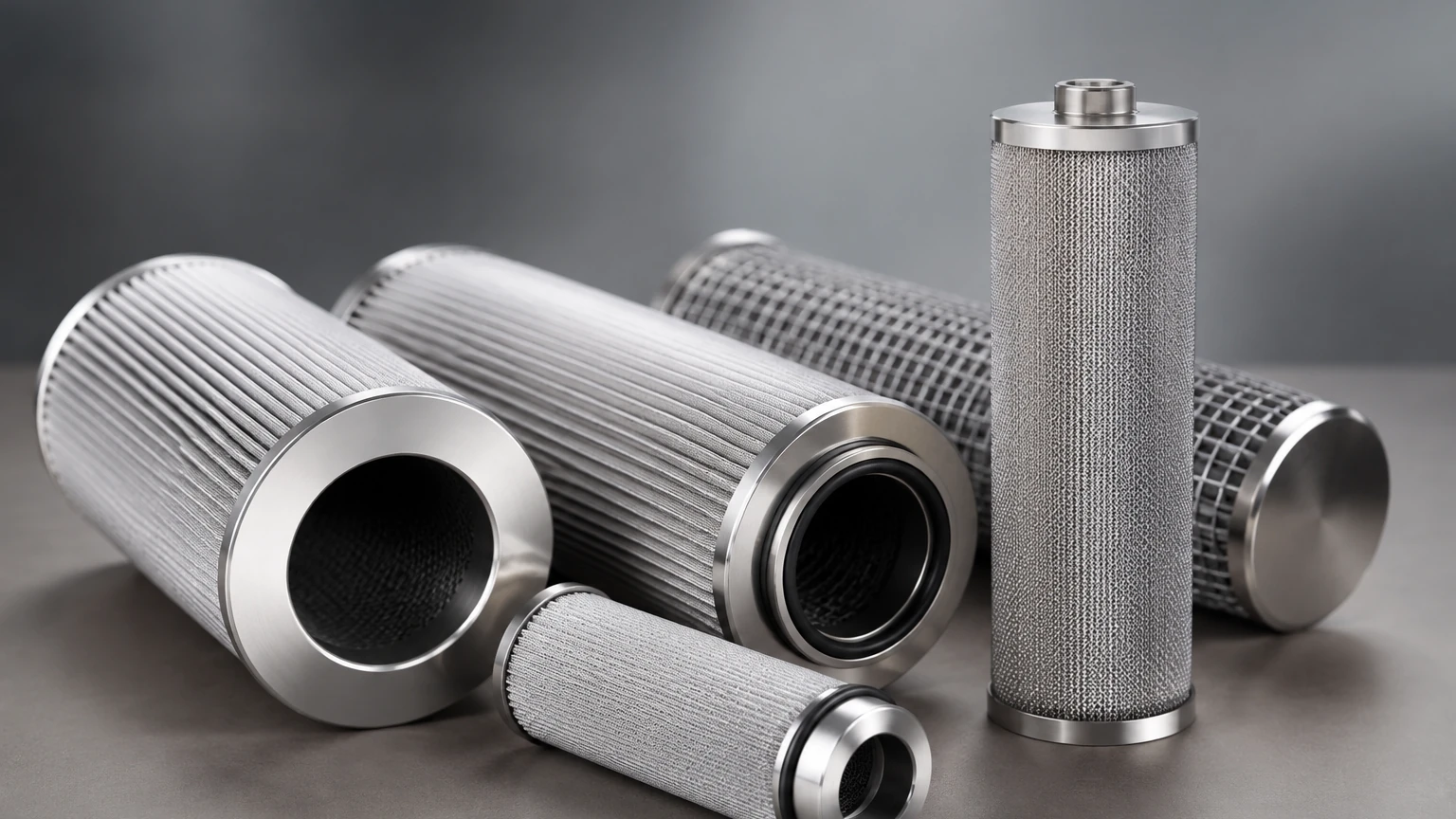
In demanding applications, such as chemical processing or high-temperature steam filtration, stainless steel is the material of choice. Kaifil specializes in manufacturing the internal and external support cores using perforated stainless steel or high-strength wire mesh. These components provide the necessary rigidity to prevent the coalescing media from collapsing under pressure while maintaining a high open area to minimize resistance to flow.
End Caps and Seals
Precision-machined end caps, often made from 304 or 316L stainless steel, ensure a leak-proof seal within the filter housing. The choice of sealing material (such as Viton, EPDM, or PTFE) must be carefully matched to the chemical composition of the fluid and the operating temperature to prevent bypass, which would compromise the efficiency of the entire system.
Performance Metrics and Evaluation Criteria
When evaluating a coalescing filter for an industrial application, engineers must look beyond simple micron ratings. The following metrics are essential for determining the total cost of ownership and system reliability:
Filtration Efficiency
Efficiency is typically expressed as a percentage of particles removed at a specific size. For high-performance coalescing filters, efficiencies of 99.99% or higher for 0.3-micron particles are common. It is vital to confirm whether the efficiency rating is "nominal" or "absolute."
Initial and Saturated Pressure Drop
Pressure drop (Delta P) represents the energy lost as fluid passes through the filter. In a coalescing filter, there are two distinct pressure drop values: the dry (initial) pressure drop and the wet (saturated) pressure drop. Because coalescing filters are designed to hold liquid, the saturated pressure drop is the more critical figure for system sizing, as it represents the filter's steady-state operating condition.
Oil Carryover
In gas applications, oil carryover is measured in parts per million (ppm) or milligrams per cubic meter (mg/m³). High-quality coalescing filters can reduce oil content to less than 0.01 ppm, which is essential for protecting sensitive pneumatic tools and analytical instruments.
Common Applications Across Industries
Coalescing filters are versatile tools used in any process where liquid-gas or liquid-liquid separation is required.
Compressed Air Systems
This is perhaps the most common application. Air compressors naturally introduce oil and water vapor into the air stream. A coalescing filter removes these contaminants, preventing corrosion in piping and ensuring that downstream pneumatic components operate without failure.
Natural Gas Processing
In the oil and gas industry, coalescing filters are used to remove liquid hydrocarbons and water from natural gas streams. This protects compressors from liquid slugging and prevents the formation of hydrates, which can block pipelines.
Chemical and Petrochemical Production
Process gases used in chemical synthesis must be free of liquid impurities to prevent catalyst poisoning. Stainless steel coalescing components are particularly valued here for their ability to resist aggressive chemical vapors and maintain structural integrity at elevated temperatures.
Vacuum Pump Protection
Vacuum pumps can be damaged by liquid intake. Coalescing filters installed on the inlet side protect the pump, while those on the exhaust side capture oil mist, preventing it from being released into the factory environment.
Engineering Considerations for Custom Coalescing Solutions
Off-the-shelf filtration products often fail to meet the specific requirements of unique industrial processes. Customization is frequently necessary to balance flow rates, space constraints, and specialized material requirements.
When designing a custom coalescing solution, engineers should consider the following:
* Flow Velocity: If the velocity through the media is too high, the coalesced droplets may be re-entrained into the gas stream (a phenomenon known as "carryover"). Proper sizing of the filter element surface area is critical.
* Housing Design: The housing must provide enough space in the sump area to allow for liquid accumulation without the liquid touching the filter element.
* Drainage Mechanisms: Automatic drains are often preferred over manual ones to ensure that the sump does not overflow, which would cause the filter to fail.
Kaifil works closely with OEM partners to develop these customized components, ensuring that the internal support structures and mesh configurations are optimized for the specific fluid dynamics of the application. For more information on how custom metal components can improve your filtration system, you can Review product options and application support on our main site.
Maintenance and Replacement Cycles
Unlike particulate filters, which are replaced when they become clogged with solids and the pressure drop rises, a coalescing filter may reach a steady-state pressure drop and stay there for a long period. However, the media will eventually degrade or become fouled by solid particulates that the pre-filter failed to catch.
Monitoring Delta P
A consistent rise in pressure drop beyond the manufacturer's recommended limit (typically 8-10 psi for many industrial systems) indicates that the filter is becoming blocked by solids. At this point, the energy costs associated with the pressure drop usually outweigh the cost of a replacement element.
Signs of Failure
The most obvious sign of coalescing filter failure is the presence of liquid downstream. This can be caused by:
* Media Rupture: Often due to pressure spikes or improper installation.
* O-ring Failure: Allowing fluid to bypass the media entirely.
* Sump Overflow: If the drain is blocked, the collected liquid will eventually be pulled back into the air stream.
Conclusion
The coalescing filter is an indispensable component in modern industrial filtration, providing a high-efficiency solution for removing liquid aerosols that would otherwise cause equipment damage and process contamination. By selecting high-quality materials—specifically stainless steel components for durability and chemical resistance—and adhering to rigorous engineering standards, facilities can achieve superior air and gas purity with manageable operating costs.
For technical professionals seeking to optimize their filtration systems, understanding the nuances of coalescence is the first step toward better performance. Whether you are designing a new system or upgrading an existing one, focusing on precise material selection and customized engineering will ensure long-term reliability. To explore the full range of stainless steel filtration capabilities and technical specifications, visit the Kaifil Main Page.
