


Compressed Air Filter Types
In industrial environments, compressed air is often referred to as the "fourth utility." However, unlike water, electricity, or gas, compressed air is generated on-site, and its quality is entirely dependent on the filtration and drying systems integrated into the compressor circuit. Raw compressed air is inherently contaminated with water vapor, oil aerosols, and atmospheric particulates. Without the correct implementation of various compressed air filter types, these contaminants can lead to equipment corrosion, pneumatic valve failure, and compromised product integrity.
Selecting the appropriate filtration technology requires an understanding of the specific contaminants present and the purity levels required by the application, often dictated by ISO 8573-1:2010 standards. This guide examines the technical specifications, mechanical principles, and engineering considerations for the primary types of compressed air filters used in modern industrial sectors.
Understanding Contaminants and ISO 8573-1 Standards
Before evaluating compressed air filter types, engineers must define the required air quality. The ISO 8573-1:2010 standard classifies air purity based on three main categories: particles, water, and oil. Each category is assigned a class from 0 to 9, where Class 0 represents the most stringent, custom-specified requirements.
1. Solid Particulates: These include dust, scale from piping, and metal wear particles. In precision manufacturing, even sub-micron particles can cause significant mechanical wear.
2. Water (Liquid and Vapor): Compression concentrates the moisture naturally present in the atmosphere. While dryers handle vapor, filters are responsible for removing liquid water droplets.
3. Oil (Aerosols and Vapors): Originating from the compressor lubricant or the ambient intake air, oil can contaminate end-products, particularly in the food, beverage, and pharmaceutical industries.
Primary Compressed Air Filter Types and Their Mechanisms
Industrial filtration is rarely a single-stage process. Instead, it relies on a series of filters designed to remove specific contaminants at different stages of the air distribution system.
1. Water Separators (Cyclonic Filters)
Water separators are typically the first line of defense, installed immediately downstream of the aftercooler. They utilize centrifugal force to remove bulk liquid water and large solids. As the air enters the cylindrical housing, internal vanes create a high-velocity vortex. The heavier liquid droplets are flung against the housing wall, where they collect and drain away. While highly effective at removing bulk liquids (up to 99% efficiency for large droplets), they are not designed to remove fine aerosols or sub-micron particles.
2. Coalescing Filters
Coalescing filters are perhaps the most critical components in a compressed air system for removing oil aerosols and fine water droplets. They operate on three physical principles:
* Direct Interception: Larger particles are caught by the fibers of the filter media.
* Inertial Impaction: Heavier particles fail to follow the air stream around fibers and instead collide with them.
* Diffusion (Brownian Motion): Extremely small particles move erratically and eventually collide with the filter fibers.
In a coalescing filter, air typically flows from the inside of the element to the outside. As small droplets pass through the deep-bed media (often borosilicate microglass), they collide and merge (coalesce) into larger drops. These drops are then pushed to the outer surface of the element, where they gravitate to the bottom of the filter bowl for drainage. These filters are rated by their ability to remove particles down to 0.01 microns and reduce oil carryover to as low as 0.01 mg/m³.
3. Particulate and Dust Filters
Particulate filters, often called "dry" filters, are used to remove solid contaminants. They are frequently installed downstream of desiccant dryers to capture "desiccant fines"—small particles of drying agent that can migrate into the air stream. Unlike coalescing filters, the air flow in particulate filters is usually from the outside to the inside.
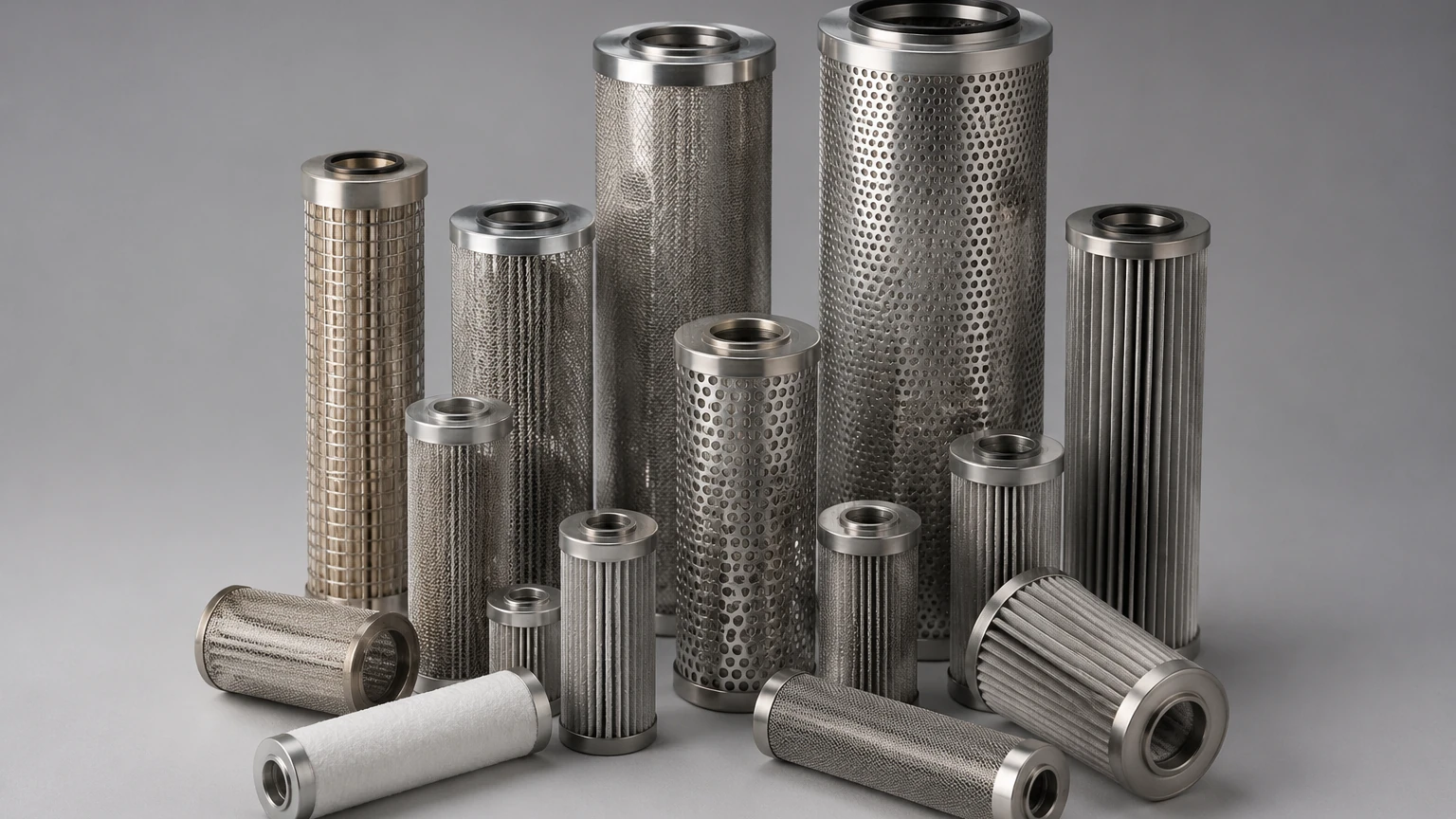
For high-temperature applications or harsh environments where synthetic media might degrade, stainless steel wire mesh or sintered metal filters are preferred. These components provide high mechanical strength and can be cleaned and reused, offering a lower total cost of ownership in heavy industrial settings.
4. Adsorption (Activated Carbon) Filters
Even after coalescing filtration, oil may still exist in the form of vapor, which contributes to odors and taste contamination. Adsorption filters utilize a large bed of activated carbon to attract and trap oil vapor molecules. It is important to note that adsorption filters do not remove liquid oil; they must be protected by a high-efficiency coalescing filter to prevent the carbon bed from becoming saturated and ineffective. These are essential in "technically oil-free" applications such as breathing air or food packaging.
The Role of Stainless Steel in Compressed Air Filtration
While many standard filters use disposable fiber-based media, certain industrial environments demand the durability of metal components. Stainless steel filtration solutions, such as those provided by Kaifil, are engineered for applications involving high pressures, extreme temperatures, or corrosive gases.
Advantages of Stainless Steel Media
* Temperature Resistance: Synthetic filters often have a maximum operating temperature of 60°C to 80°C. Stainless steel elements can withstand temperatures exceeding 250°C, making them ideal for heat-regenerated systems.
* Chemical Compatibility: In chemical processing or offshore environments, the air may contain trace amounts of corrosive gases. Stainless steel (304 or 316L) provides superior resistance to oxidation and chemical attack.
* Structural Integrity: Under high-pressure surges, fiber-based media may rupture or bypass. Precision-welded stainless steel mesh maintains its pore structure and filtration efficiency even under significant differential pressure.
* Cleanability: For many particulate applications, stainless steel cartridges can be cleaned via ultrasonic baths or backwashing, reducing the environmental impact and recurring costs associated with disposable elements.
Engineering Considerations for Filter Selection
When specifying compressed air filter types for a system, engineers must look beyond the micron rating. Several technical factors influence the long-term performance and efficiency of the filtration system.
Pressure Drop (Delta P)
Pressure drop is the loss of air pressure as it passes through the filter media. Every 1 bar (14.5 psi) of pressure drop typically requires a 7% increase in compressor energy to maintain the same system pressure. Therefore, selecting a filter with a low initial pressure drop and a high dirt-holding capacity is vital for energy efficiency. High-quality stainless steel mesh filters are often designed to maximize open area, minimizing resistance to flow while maintaining filtration accuracy.
Flow Rate and Velocity
Filters must be sized according to the maximum flow rate of the compressor, not the pipe size. If the air velocity through a coalescing filter is too high, it can cause "re-entrainment," where the air stream picks up the collected oil droplets from the outer surface of the filter and carries them downstream. Conversely, oversizing a filter can be an unnecessary capital expense, though it often results in lower pressure drops and longer element life.
Operating Pressure
As air pressure increases, the volume of the air decreases, which affects the velocity through the filter. Most filter ratings are based on a standard operating pressure (usually 7 bar or 100 psi). If your system operates at a higher or lower pressure, correction factors must be applied to ensure the filter performs as expected.
Maintenance and Performance Monitoring
Filtration is not a "fit and forget" technology. To maintain air quality and energy efficiency, a proactive maintenance schedule is required.
1. Differential Pressure Monitoring: Installing differential pressure gauges allows operators to see exactly when a filter element is becoming clogged. A common industry standard is to replace elements when the pressure drop reaches 0.35 to 0.5 bar.
2. Drain Maintenance: Automatic drains (timed or zero-loss) are essential for removing the liquids collected by water separators and coalescing filters. If a drain fails and the filter bowl fills with liquid, the filter will cease to function, and contaminants will flood the downstream system.
3. Element Replacement Cycles: Even if the pressure drop remains low, certain media (like activated carbon) have a finite lifespan based on adsorption capacity. These should be replaced on a timed interval, typically every 6 to 12 months, depending on the shift pattern and air quality.
Application-Specific Filtration Strategies
Different industries prioritize different compressed air filter types based on their specific risks:
* Food and Beverage: Focuses on "sterile air" where stainless steel housings and high-efficiency particulate air (HEPA) or ultra-low particulate air (ULPA) filters are used to prevent microbial contamination. Steam-sterilizable stainless steel filters are frequently used here.
* Pharmaceutical: Requires extremely high purity levels. Multi-stage filtration involving coalescing, adsorption, and sterile particulate filters is standard to meet Class 1 or Class 0 requirements.
* Automotive/Painting: Oil and silicone are the primary enemies. High-efficiency coalescing and adsorption filters are used to ensure "crater-free" paint finishes.
* General Manufacturing: Often uses a combination of water separators and general-purpose coalescing filters to protect pneumatic tools and machinery from wear and corrosion.
Conclusion
Selecting the right compressed air filter types is a balance between achieving the necessary air purity and managing operational costs. By understanding the physics of coalescing, the durability of stainless steel media, and the importance of monitoring pressure drop, engineering teams can design systems that protect downstream equipment while optimizing energy consumption.
For technical professionals seeking customized filtration components or high-performance stainless steel filter cartridges, consulting with a specialized manufacturer is the most effective way to ensure compatibility with specific industrial demands. To explore technical specifications for custom metal filtration components, Review product options and application support to align your system with the highest industry standards.
