


Compressed Air Filtration Food Industry
In the modern food and beverage manufacturing environment, compressed air is often referred to as the "fourth utility." It is as essential to production as electricity, water, and natural gas. However, unlike these other utilities, compressed air is generated on-site, meaning the responsibility for its quality and safety falls entirely on the facility's engineering and quality control teams. Within the compressed air filtration food industry, ensuring that this air is free from contaminants is not merely a matter of equipment longevity; it is a critical component of food safety and regulatory compliance.
Compressed air is used in a variety of applications, from powering pneumatic cylinders and sorting machines to direct product contact, such as aerating chocolate, cleaning containers, or conveying bulk ingredients. In each of these scenarios, any impurities in the air—such as oil, moisture, or particulate matter—can compromise the final product, leading to spoilage, recalls, and significant financial loss. This article explores the technical requirements, engineering considerations, and selection criteria for implementing robust filtration solutions in food-grade compressed air systems.
The Critical Role of Compressed Air in Food Safety
To understand the necessity of specialized filtration, one must first recognize how compressed air interacts with food products. The industry generally categorizes compressed air usage into two types: contact and non-contact.
1. Direct Contact: The air comes into direct contact with the food or the primary packaging. Examples include the use of air to blow out crumbs from a mold, nitrogen generation for modified atmosphere packaging (MAP), or the use of air to move flour through a pneumatic conveying system.
2. Indirect Contact: The air is exhausted into the general production environment or used in a way that it could potentially reach the food. This includes pneumatic actuators located above open processing lines.
In both instances, the compressed air filtration food industry must address the four primary contaminants: solid particles (dust, pipe scale), water (liquid and vapor), oil (liquid, aerosol, and vapor), and microorganisms. Because compressors take in large volumes of atmospheric air, they concentrate these contaminants. Without a multi-stage filtration strategy, the compressed air system becomes a delivery mechanism for pollutants.
Understanding Contaminant Sources and Risks
Engineering a filtration system requires a deep understanding of where contaminants originate. Atmospheric air typically contains millions of particles per cubic meter, including soot, pollen, and bacteria. When this air is compressed to 7 bar (100 psi), the concentration of these particles increases eightfold.
Solid Particulates
Particulates can originate from the ambient intake air or from within the system itself, such as rust and pipe scale from aging carbon steel piping. In food processing, these particles can cause mechanical failure in sensitive equipment or become physical hazards if they enter the food stream.
Water and Humidity
Compression generates heat, and as the air cools, moisture condenses. Liquid water in a compressed air line promotes the growth of bacteria and fungi. In the food industry, where hygiene is paramount, a damp compressed air system can become a breeding ground for pathogens that are difficult to eradicate once established in the distribution network.
Oil Contamination
Even "oil-free" compressors require filtration. While they do not introduce lubricating oil into the air stream, they still concentrate hydrocarbon vapors present in the ambient industrial environment. In oil-lubricated compressors, the risk is higher, as mechanical seals can fail, leading to bulk oil carryover. Oil in food-grade air results in off-flavors, odors, and potential chemical contamination.
Regulatory Standards: ISO 8573-1 and Beyond
To standardize air quality, the industry relies on ISO 8573-1:2010. This standard classifies air quality based on the maximum allowable concentration of contaminants in three categories: particles, water, and oil. For the food industry, the requirements are stringent.
* Solid Particles: For direct contact, Class 1 or Class 2 is typically required, limiting the size and number of particles.
* Water: Pressure Dew Point (PDP) is critical. Class 4 (PDP of +3°C) may be acceptable for some applications, but Class 2 (PDP of -40°C) is often preferred to ensure no liquid water can exist in the system to support microbial growth.
* Total Oil: For food contact, Class 1 is the standard, requiring less than 0.01 mg/m³ of total oil (liquid, aerosol, and vapor).
Compliance with these standards is often a prerequisite for certifications such as SQF, BRC, or FSSC 22000. Engineers must ensure that the selected filtration components are rated to meet these specific ISO classes consistently over their service life.
The Importance of Stainless Steel in Food-Grade Filtration
In the compressed air filtration food industry, the materials used in the construction of filter housings and elements are just as important as the filtration media itself. Stainless steel, particularly 304 and 316L grades, is the industry standard for several reasons.
Corrosion Resistance
Food processing environments are often subjected to frequent wash-downs with caustic chemicals. Stainless steel housings resist external corrosion and, more importantly, internal corrosion. Internal oxidation in a filter housing can release metal flakes into the air stream, defeating the purpose of the filter.
Durability and Pressure Integrity
Industrial compressed air systems operate under significant pressure, often between 6 and 10 bar. Stainless steel components provide the structural integrity required to handle these pressures safely while resisting the mechanical stresses of pressure pulsations.
Cleanability and Sterilization
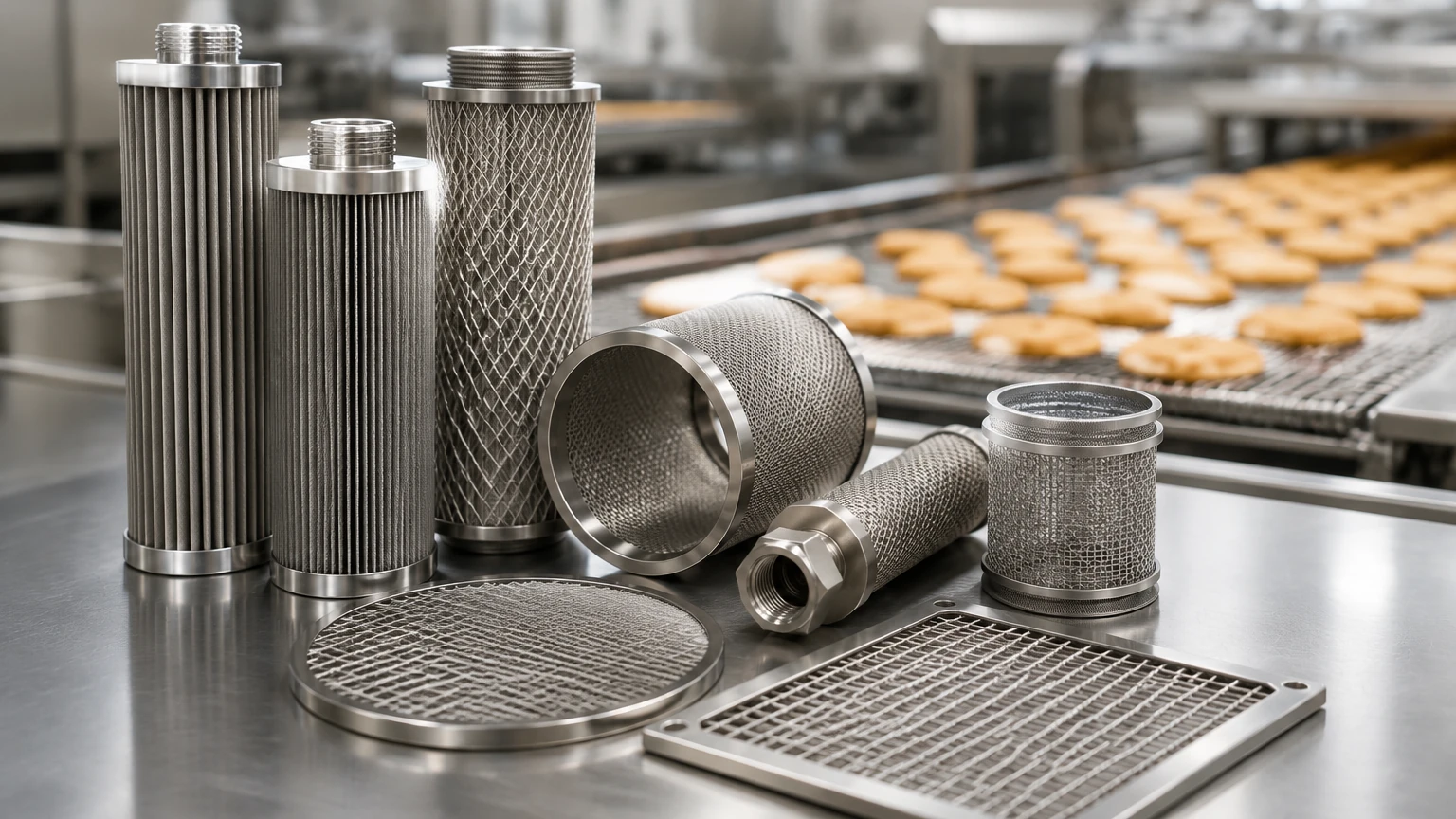
For final-stage sterile filtration, the filter elements must often be sterilized. Stainless steel wire mesh filters and sintered metal cartridges can withstand high-temperature Steam-in-Place (SIP) or Autoclave processes. Unlike polymer-based filters, which may degrade after repeated heat cycles, precision-engineered metal filters maintain their pore structure and filtration efficiency. For more information on specialized metal filtration components, you can visit the Main Page of the manufacturer.
Designing a Multi-Stage Filtration String
A single filter is rarely sufficient to meet food-grade air standards. Instead, a "train" of filters is used to progressively remove contaminants, which protects the more expensive high-efficiency filters from premature clogging.
1. Water Separators: Located immediately after the compressor’s aftercooler, these use centrifugal force to remove bulk liquid water and large particles.
2. Coalescing Filters: These are the workhorses of the system. They use borosilicate microglass or similar media to merge small oil and water aerosols into larger droplets that can be drained. In food plants, a two-stage coalescing setup (General Purpose followed by High Efficiency) is common.
3. Adsorption Dryers: To achieve the low dew points required to inhibit bacterial growth, desiccant dryers are used to remove water vapor.
4. Activated Carbon Towers/Filters: These remove hydrocarbon vapors and odors, ensuring the air is chemically pure and does not affect the taste or smell of the food.
5. Dust/Particulate Filters: Placed after desiccant dryers, these catch any "desiccant fines" (small particles of the drying agent) that may have escaped.
6. Sterile Filters: The final stage before direct contact. These filters are typically rated at 0.2 microns or better and are designed to capture 100% of microorganisms.
Engineering Selection Criteria for Filter Elements
When selecting filtration components for a food-grade application, engineers must look beyond the initial purchase price and evaluate technical performance metrics.
Filtration Accuracy (Micron Rating)
It is vital to distinguish between nominal and absolute micron ratings. A nominal rating is an average, while an absolute rating indicates the size of the largest particle that can pass through the filter. For food safety, absolute ratings are generally required for the final stages of filtration.
Pressure Drop (Delta P)
Every filter creates a restriction in the air stream. A high pressure drop means the compressor must work harder, increasing energy costs. Engineers should select filters with low initial pressure drop and monitor the "differential pressure" to determine when an element needs replacement. Using high-quality stainless steel wire mesh or pleated metal elements can often provide a higher surface area, reducing the rate of pressure drop increase.
Flow Rate and Velocity
Filters must be sized based on the maximum flow rate (SCFM or Nm³/h) at the minimum operating pressure. Sizing a filter too small leads to high air velocity, which can cause "carryover," where contaminants are pushed through the filter media by the force of the air.
Maintenance and Total Cost of Ownership
In the compressed air filtration food industry, maintenance is not optional. A clogged or saturated filter is a liability. For coalescing and particulate filters, replacement cycles are usually determined by pressure drop or a fixed time interval (e.g., every 6 to 12 months). For sterile filters, the integrity must be tested regularly, and elements should be replaced after a specific number of sterilization cycles.
Total cost of ownership (TCO) includes the initial cost, the cost of replacement elements, and the energy cost associated with pressure drop. While stainless steel and high-performance metal filters may have a higher upfront cost, their ability to be cleaned and their long-term durability in harsh food-processing environments often result in a lower TCO compared to disposable plastic alternatives.
Customization and OEM Solutions
Many food processing machines have unique space constraints or specific flow requirements that standard off-the-shelf filters cannot meet. This is where custom-engineered solutions become invaluable. Manufacturers like Kaifil specialize in developing custom stainless steel filtration components, including wire mesh filters and precision metal cartridges, tailored to specific industrial needs. Whether it is a unique fitting, a specific micron rating for a proprietary process, or a reinforced structure for high-vibration environments, customized filtration ensures that the system performs exactly as required.
By working closely with a manufacturer that understands the nuances of material selection and filtration physics, food processors can develop a system that not only meets regulatory standards but also enhances operational efficiency. From the initial material selection to the final production of precision components, the focus remains on delivering reliability in demanding industrial environments.
Conclusion
Maintaining air quality in the food industry is a continuous process that requires the right equipment, regular monitoring, and a clear understanding of the risks involved. By implementing a multi-stage filtration strategy using high-quality stainless steel components and adhering to ISO 8573-1 standards, manufacturers can protect their products, their brands, and their customers. As the compressed air filtration food industry continues to evolve with stricter safety regulations, the role of precision-engineered filtration will only become more central to successful food manufacturing operations.
