


Customized Folding Belt Vacuum Drum Filter
In industrial solid-liquid separation, the efficiency of a process often hinges on the ability to handle varying slurry characteristics while maintaining continuous operation. The customized folding belt vacuum drum filter represents a specialized solution for applications where standard rotary vacuum filters struggle with cake discharge or cloth blinding. By allowing the filter medium to leave the drum surface for cake removal and thorough washing, this equipment ensures a high level of reliability in demanding sectors such as chemical processing, pharmaceuticals, and food production.
For engineers and procurement teams, understanding the technical nuances of a customized folding belt vacuum drum filter is essential for optimizing throughput and reducing the total cost of ownership. This guide explores the engineering principles, material considerations, and customization parameters that define high-performance filtration systems.
Understanding the Mechanics of Folding Belt Vacuum Filtration
A rotary vacuum drum filter operates on the principle of pressure differential. The drum is partially submerged in a trough containing the slurry. As the drum rotates, a vacuum is applied to the internal chambers, drawing the liquid through the filter medium while solids accumulate on the exterior surface to form a "cake."
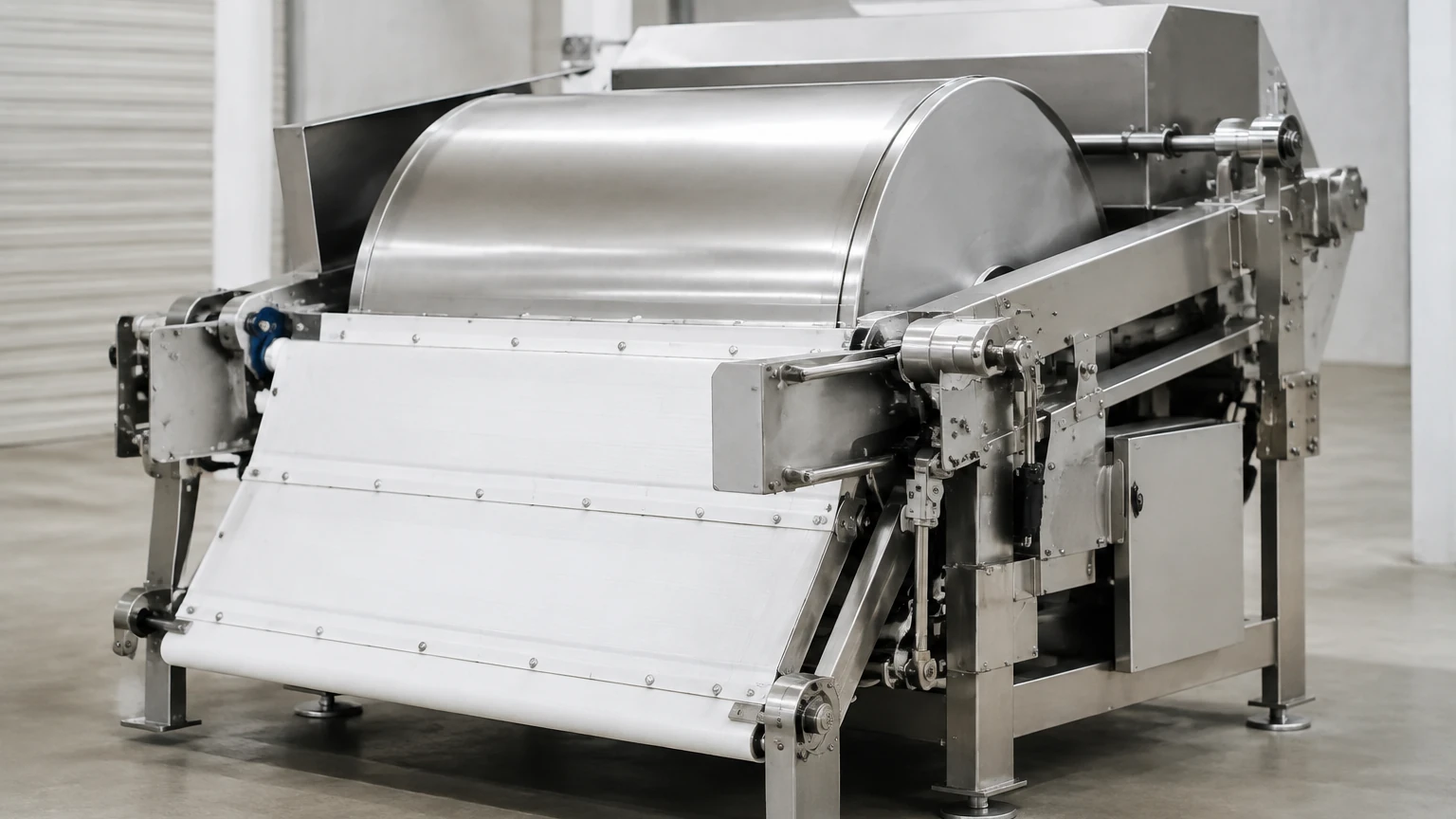
The "folding belt" or "belt discharge" variant distinguishes itself by the path the filter medium takes. Unlike a standard scraper discharge filter where the cloth remains fixed to the drum, the belt in a customized folding belt vacuum drum filter is guided away from the drum over a series of rollers. This design offers several technical advantages:
1. Enhanced Cake Discharge: Because the belt travels over a small-diameter discharge roller, the sudden change in radius helps crack and release the filter cake, even if it is thin or sticky.
2. Continuous Cloth Washing: Once the cake is discharged, the belt passes through a washing zone where high-pressure nozzles clean both sides of the mesh. This prevents "blinding"—the clogging of the filter pores—which is a common cause of performance degradation in fixed-drum systems.
3. Adjustable Tensioning: Automated tracking and tensioning systems ensure the belt remains aligned, preventing mechanical wear and ensuring a consistent seal against the vacuum zones of the drum.
The Role of Stainless Steel in Customized Filter Components
The choice of material for the filter medium and internal drum components is critical, particularly in corrosive or high-temperature environments. As a manufacturer specializing in precision metal filtration, Kaifil emphasizes the use of stainless steel for its durability and chemical resistance. When designing a customized folding belt vacuum drum filter, material selection is usually the first engineering hurdle.
Grade Selection
For most industrial applications, Type 304 or 316L stainless steel provides the necessary resistance to oxidation and organic acids. In more aggressive environments, such as those involving chlorides or high-acidity chemical processing, specialty alloys like 904L or Duplex stainless steels may be required to prevent pitting and stress corrosion cracking.
Wire Mesh vs. Synthetic Belts
While synthetic fabrics are common, many high-performance customized folding belt vacuum drum filters utilize stainless steel wire mesh or sintered mesh belts. Metal belts offer superior mechanical strength, allowing for higher tensioning without stretching. Furthermore, stainless steel mesh can withstand rigorous thermal cleaning cycles and provides a stable pore structure that does not deform under high vacuum pressure.
For more information on material options and technical specifications for industrial filtration, you can visit the Main Page to review product options and application support.
Key Customization Parameters for Industrial Applications
A "customized" solution is not merely a change in dimensions; it involves tailoring every aspect of the filter to the specific rheology of the slurry. Engineers must confirm several parameters during the design phase:
Filtration Accuracy (Micron Rating)
The pore size of the filter belt must be balanced between the required filtrate clarity and the desired flow rate. A pore size that is too small will lead to rapid blinding and low throughput, while a pore size that is too large will allow excessive solids to pass into the filtrate. Customization allows for the selection of specific weave patterns—such as plain, twill, or dutch weave—to achieve the exact micron rating needed for the particle size distribution of the slurry.
Drum Surface Area and Submergence
The effective filtration area is determined by the drum's diameter and length. However, the "submergence"—the percentage of the drum that is under the slurry in the trough—is also a critical variable. Customizing the trough depth and the vacuum zone configuration allows engineers to control the cake formation time versus the drying time.
Discharge Mechanism Details
Depending on the cake's consistency, the discharge zone may include additional features. For example, a customized folding belt vacuum drum filter for the pharmaceutical industry might include a specialized wash manifold to ensure zero cross-contamination between batches, whereas a mining application might focus on heavy-duty rollers to handle abrasive solids.
Performance Evaluation and Throughput Optimization
To evaluate the effectiveness of a customized folding belt vacuum drum filter, engineers typically focus on three primary metrics: filtration rate, cake moisture content, and filtrate purity.
1. Filtration Rate: Measured in gallons per minute per square foot (GPM/ft²) or liters per hour per square meter (L/h/m²). This is influenced by the vacuum level, drum speed, and the permeability of the filter belt. Customization of the internal piping and vacuum valves can minimize pressure drops, thereby maximizing the effective vacuum at the drum surface.
2. Cake Moisture: In many processes, the goal is to produce a cake that is as dry as possible to reduce downstream drying costs. By extending the "drying zone" of the drum rotation and optimizing the airflow through the cake, a customized design can significantly lower residual moisture.
3. Filtrate Purity: If the liquid is the value-added product, minimizing solids bypass is paramount. Precision-engineered stainless steel mesh ensures that the pore distribution is uniform across the entire width of the belt, providing consistent filtrate quality.
Maintenance, Durability, and Total Cost of Ownership
One of the most significant advantages of a customized folding belt vacuum drum filter is the reduction in long-term maintenance requirements. Standard filters often suffer from mechanical misalignment or premature cloth failure due to improper material selection.
Replacement Cycles
In a customized system, the filter belt is designed for the specific mechanical stresses of the application. Stainless steel belts, for instance, have a significantly longer service life than synthetic alternatives in high-temperature or abrasive environments. Engineers should evaluate the "Total Cost of Ownership" (TCO) by factoring in the cost of downtime and replacement labor, rather than just the initial purchase price of the filter medium.
Cleaning Protocols
Because the belt is continuously washed, the system maintains a steady-state filtration rate for longer periods. However, the design of the wash headers must be customized to the cleaning agent used—whether it is deionized water, steam, or chemical solvents. Proper nozzle placement and pressure regulation are essential to ensure the mesh is cleaned without causing mechanical erosion.
Engineering Checklist for Selecting a Customized Solution
Before finalizing the specifications for a customized folding belt vacuum drum filter, technical teams should confirm the following data points with the manufacturer:
* Slurry Characteristics: Particle size distribution (PSD), solids concentration (wt%), and liquid viscosity.
* Chemical Compatibility: pH range, presence of solvents, and operating temperature.
* Required Throughput: Both the volume of slurry to be processed and the required solids discharge rate.
* Cake Handling: Is the cake brittle, pasty, or fibrous? Does it require washing on the drum to remove impurities?
* Space Constraints: Does the installation site have height or floor space limitations that affect the drum diameter or the belt take-up assembly?
By addressing these factors, manufacturers like Kaifil can develop filtration components that integrate seamlessly into the broader process flow, ensuring that the filter does not become a bottleneck in production.
Conclusion
The customized folding belt vacuum drum filter is a sophisticated piece of process equipment that bridges the gap between high-volume throughput and precision separation. By moving away from "off-the-shelf" configurations and focusing on material integrity—particularly the use of advanced stainless steel filtration media—industrial operators can achieve higher efficiency and greater process stability.
Whether the application involves recovering valuable catalysts in a chemical plant or dewatering food-grade starches, the ability to customize the belt path, the mesh weave, and the structural materials ensures that the equipment meets the specific rigors of the environment. For engineers tasked with optimizing these systems, focusing on the technical synergy between the vacuum drum and the folding belt mechanism is the key to long-term operational success.
Download Customized Folding Belt Vacuum Drum Filter as a PDF
