


Cyclone Filtration System
In industrial fluid processing, the efficiency of a filtration strategy often depends on the ability to handle high solids loading without frequent downtime or excessive consumable costs. A cyclone filtration system, also known as a centrifugal separator or hydrocyclone in liquid applications, represents a mechanical separation method that utilizes centrifugal force to remove solid particles from a fluid stream. Unlike barrier filtration, which relies on a physical medium to trap debris, a cyclone system uses fluid dynamics to achieve separation based on density and particle size.
For engineers and procurement teams, understanding the integration of cyclone technology with high-precision secondary filtration is essential for optimizing system longevity. While the cyclone removes the bulk of heavy contaminants, precision components such as those found on the Kaifil Main Page are necessary to achieve final filtration accuracy and protect downstream equipment.
The Engineering Principles of Cyclone Separation
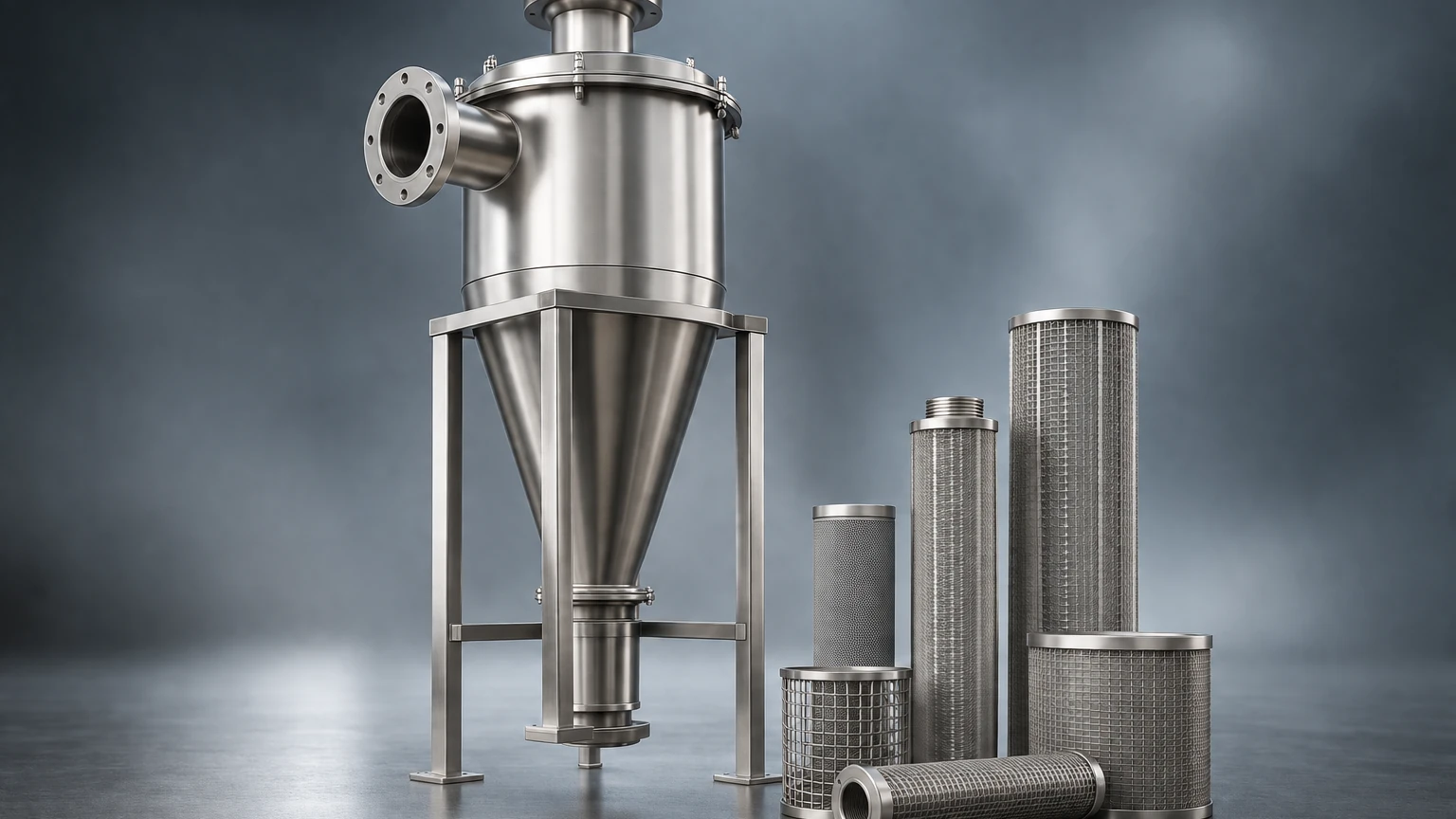
The operation of a cyclone filtration system is governed by the principles of centrifugal force, drag force, and gravity. The process begins when the contaminated fluid enters the cylindrical chamber tangentially at high velocity. This tangential entry creates a powerful rotating motion, or vortex, within the housing.
As the fluid spirals downward toward the conical section of the separator, the centrifugal force pushes heavier solid particles outward against the chamber walls. These particles lose velocity through friction with the wall and eventually settle into a collection chamber or underflow at the bottom. Meanwhile, the cleaned fluid, which is less dense and subject to the upward pressure of the inner vortex, reverses direction and exits through a central tube at the top, known as the vortex finder.
The Role of Particle Density and Size
The effectiveness of separation in a cyclone filtration system is highly dependent on the "cut point" ($d_{50}$), which is the particle size at which 50% of the solids are removed. Factors influencing this include:
* Fluid Viscosity: Higher viscosity fluids increase the drag force on particles, making it harder for centrifugal force to move them to the outer wall.
* Density Differential: The greater the difference in density between the solid contaminant and the carrier fluid, the more efficient the separation.
* Inlet Velocity: Increased velocity enhances centrifugal force but also increases the pressure drop across the system.
Material Selection and Structural Integrity
Because a cyclone filtration system operates at high velocities and often handles abrasive solids, the materials used in construction must withstand significant erosive forces. Stainless steel is the industry standard for high-performance cyclone components due to its mechanical strength and resistance to both corrosion and wear.
At Kaifil, the focus is on manufacturing precision stainless steel components that can be integrated into these demanding environments. Using grades such as 304 or 316L stainless steel ensures that the internal surfaces of the filtration system remain smooth and resistant to pitting. This is critical because any surface irregularity can disrupt the laminar flow of the vortex, leading to turbulence that reduces separation efficiency.
Integrating Cyclone Systems with Secondary Filtration
A common misconception in industrial design is that a cyclone filtration system can serve as a standalone solution for all filtration needs. In reality, cyclones are most effective as pre-filters. They are excellent at removing large, heavy particles (typically 50 microns and larger), which significantly reduces the load on secondary barrier filters.
Synergistic Filtration Architecture
To achieve high-purity results, engineers typically deploy a multi-stage approach:
1. Primary Stage (Cyclone): Removes 90-98% of heavy solids, protecting the secondary stage from premature clogging.
2. Secondary Stage (Stainless Steel Cartridges): Utilizes precision-engineered wire mesh or sintered metal cartridges to capture fine particles that the cyclone cannot separate due to their low mass or size.
By combining a cyclone filtration system with high-quality stainless steel filter elements, facilities can extend the service life of their filters by up to five times compared to using barrier filters alone. For those seeking specific cartridge designs or custom mesh specifications to pair with their cyclone systems, reviewing the technical data on the Main Page can provide insights into compatible filtration media.
Key Performance Metrics for Evaluation
When specifying a cyclone filtration system for an industrial application, several technical parameters must be evaluated to ensure the system meets the process requirements.
Pressure Drop ($ΔP$)
The pressure drop is the difference in pressure between the inlet and the outlet of the cyclone. While a higher pressure drop often correlates with higher separation efficiency (due to increased velocity), it also increases the energy consumption of the pumps. Engineers must find the optimal balance where the $d_{50}$ cut point meets the application's needs without exceeding the system's energy budget.
Flow Rate Capacity
Cyclones are sized based on flow rate. Unlike barrier filters, which can often handle variable flows by adding more surface area, a cyclone's efficiency is tied directly to the velocity of the fluid. If the flow rate drops below the design specification, the centrifugal force may be insufficient to separate the solids. Conversely, exceeding the design flow can cause excessive wear and turbulence.
Solid Loading Limits
One of the primary advantages of a cyclone filtration system is its ability to handle high concentrations of solids. However, there is a limit to how much material the underflow can discharge. Engineers must confirm that the solids-handling capacity of the collection chamber matches the expected contamination levels of the process fluid.
Applications Across Industrial Sectors
The versatility of the cyclone filtration system makes it a staple in various industries where fluid purity and equipment protection are paramount.
* Chemical Processing: Used to separate catalysts or remove precipitates from corrosive chemical streams. The use of stainless steel components is vital here to prevent chemical degradation of the filter housing.
* Food and Beverage: Employed in the initial stages of processing to remove sand, grit, or soil from wash water or raw product streams. The hygienic properties of stainless steel ensure compliance with food safety standards.
* Hydraulic and Cooling Systems: In large-scale industrial machinery, cyclones remove metal shavings and scale from cooling water or hydraulic oils, preventing damage to precision valves and pumps.
* Water Treatment: Used as a sand separator in well water systems or as a pre-treatment stage in wastewater plants to protect sensitive membranes from abrasion.
Customization and OEM Considerations
Standard cyclone units may not always fit the spatial or functional requirements of a specific industrial plant. Customization is often necessary, particularly regarding the inlet/outlet configurations and the integration of internal filtration media.
Kaifil specializes in providing OEM solutions that bridge the gap between standard separation and precision filtration. Whether it involves designing a custom stainless steel housing or developing a specific wire mesh internal to capture bypass fines, technical collaboration is key. When engineers specify a cyclone filtration system, they should confirm the following with their manufacturer:
* Micron Rating Requirements: What is the target particle size for the final effluent?
* Housing Dimensions: Does the unit fit within the existing footprint of the facility?
* Maintenance Access: How easily can the collection chamber be cleaned or the secondary filter cartridges be replaced?
* Material Compatibility: Is the stainless steel grade appropriate for the temperature and chemical composition of the fluid?
Maintenance and Total Cost of Ownership
One of the most significant benefits of a cyclone filtration system is the low maintenance requirement. Because there are no moving parts and the primary separation is mechanical, there are fewer components to fail. However, maintenance is still required for the collection area and any secondary filter elements.
Wear Monitoring
In applications involving abrasive slurries, the internal walls of the cyclone—particularly the conical section—can experience thinning over time. Regular ultrasonic thickness testing is recommended for high-load systems. Utilizing high-grade stainless steel from reputable manufacturers like Kaifil helps mitigate this wear, providing a longer service life and a lower total cost of ownership.
Cleaning Cycles
While the cyclone itself is largely self-cleaning, the secondary stainless steel wire mesh filters used in conjunction with the system will eventually require cleaning. The advantage of stainless steel media is its cleanability; unlike disposable polymer filters, stainless steel cartridges can be backwashed, ultrasonically cleaned, or chemically treated to restore their original flow characteristics. This sustainability is a core factor in the long-term economic viability of the filtration system.
Conclusion
The implementation of a cyclone filtration system offers a robust solution for managing high solids loads in industrial processes. By leveraging centrifugal forces for bulk separation and precision stainless steel media for final polishing, companies can achieve high levels of fluid purity while protecting expensive downstream equipment.
Selecting the right components requires a deep understanding of fluid dynamics, material science, and the specific demands of the application. For technical professionals looking to optimize their filtration processes, exploring the specialized stainless steel solutions available on the Kaifil Main Page is a critical step in designing a system that is both efficient and durable. Through proper engineering and material selection, a cyclone-based approach provides a reliable, cost-effective, and high-performance filtration strategy for modern industry.
