


Cyclone Separator for Water
In industrial water treatment and process engineering, the efficient removal of suspended solids is a fundamental requirement for protecting downstream equipment and ensuring product quality. A cyclone separator for water, commonly referred to as a hydrocyclone, serves as a critical mechanical device that utilizes centrifugal force to separate particles from a liquid medium based on density differences. Unlike barrier-based filtration systems, these separators operate without moving parts or internal filter media, making them a robust choice for high-volume pre-filtration applications.
For engineers and procurement teams, understanding the fluid dynamics and engineering constraints of a cyclone separator for water is essential for optimizing the entire filtration train. While these units are highly effective at removing heavy sand, grit, and scale, they are often used in conjunction with precision components such as those found on the Kaifil Main Page to achieve the final required clarity. This article explores the technical principles, design considerations, and industrial applications of hydrocyclonic separation.
The Mechanics of Hydrocyclonic Separation
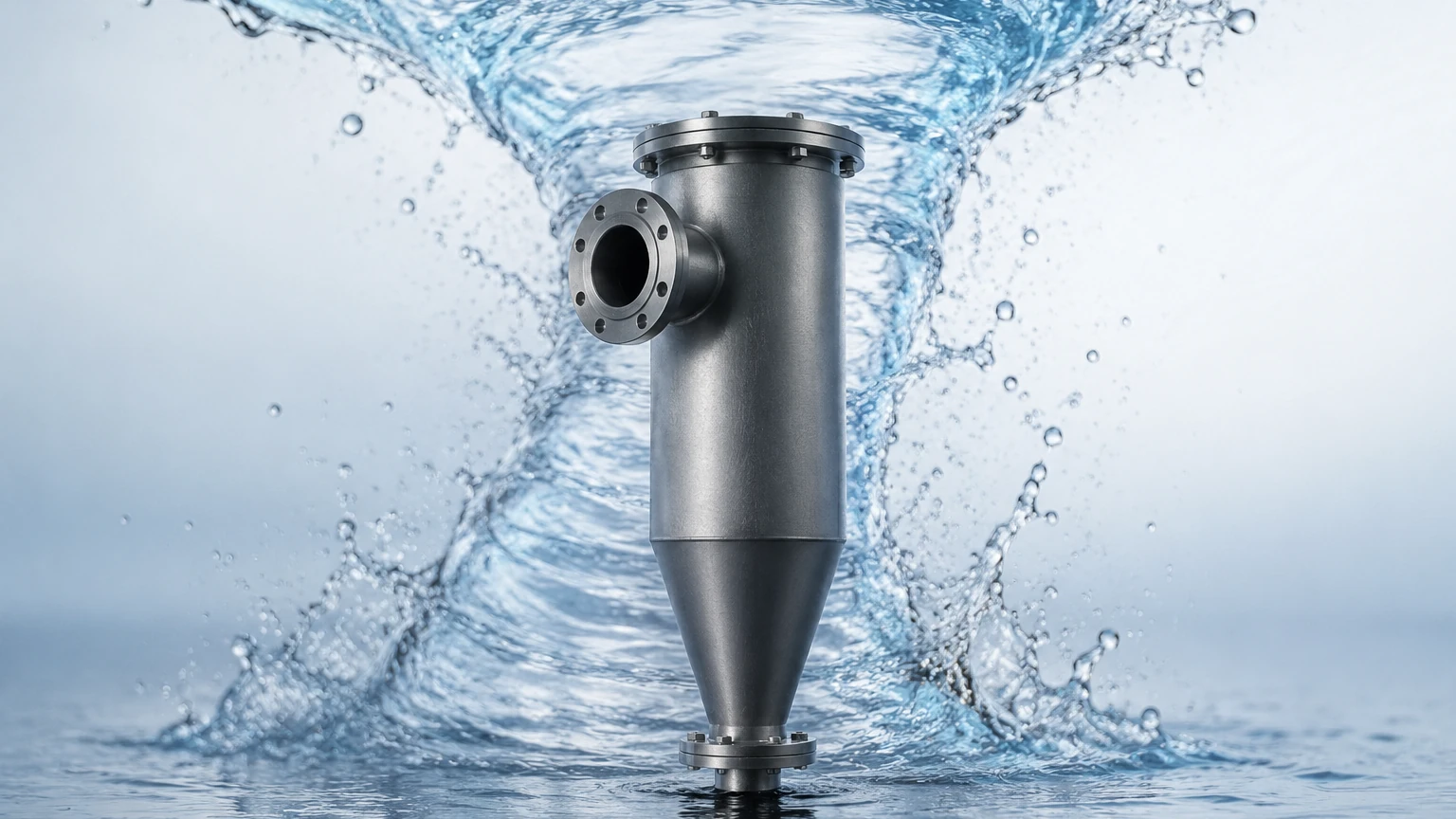
The operation of a cyclone separator for water is governed by the principles of centrifugal sedimentation. The process begins when pressurized water enters the cylindrical section of the separator through a tangential inlet. This tangential entry forces the water into a high-velocity rotational flow, creating a primary vortex that moves downward along the inner walls of the conical section.
As the water spins, the centrifugal force acts upon the suspended particles. Because the solids (such as sand, metal chips, or silt) typically have a higher density than the water, they are flung toward the outer wall. The friction against the wall causes these particles to lose velocity and slide down the taper of the cone into a collection chamber or underflow nozzle.
Simultaneously, a secondary, upward-moving inner vortex is formed at the center of the device. This inner vortex consists of the clarified water, which moves toward the top of the separator and exits through a vortex finder. The efficiency of this separation is highly dependent on the velocity of the fluid and the difference in density between the liquid and the solid contaminants.
Critical Engineering Parameters for Selection
Selecting the appropriate cyclone separator for water requires a detailed analysis of several technical variables. Engineers must balance the desired filtration efficiency against the energy costs associated with pressure drops.
Flow Rate and Velocity
Hydrocyclones are flow-dependent devices. Unlike a standard mesh filter where a lower flow rate might improve filtration, a cyclone separator requires a minimum velocity to generate the centrifugal force necessary for separation. If the flow rate is too low, the vortex will not be strong enough to drive particles to the outer wall. Conversely, excessive flow rates can lead to turbulence, which may re-entrain particles into the clean water stream.
Pressure Drop ($ΔP$)
The energy required to operate a cyclone separator for water is represented by the pressure drop between the inlet and the outlet. A higher pressure drop generally correlates with higher separation efficiency and a finer "cut point" (the particle size at which 50% of the solids are removed). In industrial settings, typical operating pressures range from 15 to 60 psi, depending on the specific gravity of the solids and the required throughput.
Cut Point and Separation Efficiency
The performance of a separator is often defined by its $d_{50}$ cut point. This is the particle size that has a 50% probability of being separated into the underflow. Factors influencing the cut point include the diameter of the cyclone (smaller diameters generally produce higher centrifugal forces and finer cut points) and the viscosity of the fluid. For water-based applications, hydrocyclones are typically effective for removing particles 40 to 75 microns and larger, though high-performance units can sometimes reach lower thresholds.
Material Selection and Durability
In industrial environments such as chemical processing or offshore water treatment, the materials used to construct a cyclone separator for water are paramount. Because the device relies on high-velocity fluid contact with the internal walls, abrasion and corrosion are significant risks.
Stainless Steel Construction
For most high-performance industrial applications, stainless steel (Grade 304 or 316L) is the standard. Stainless steel provides the necessary structural integrity to withstand high internal pressures while offering excellent resistance to corrosion from treated water or chemical additives. In the food and beverage and pharmaceutical sectors, 316L stainless steel is preferred due to its superior resistance to pitting and its ability to withstand stringent cleaning protocols.
Wear Liners and Coatings
In applications involving highly abrasive solids, such as mining or sand removal from well water, the internal surfaces of the cyclone may be lined with specialized materials like ceramic, urethane, or rubber. These liners protect the metal housing from the erosive force of the spinning solids, significantly extending the service life of the equipment. For precision-engineered systems, maintaining the internal geometry of the cone is vital, as any significant wear can disrupt the vortex and degrade separation performance.
Integrating Cyclones with Precision Filtration Systems
A cyclone separator for water is rarely a standalone solution for applications requiring high purity. Instead, it serves as the first line of defense in a multi-stage filtration strategy. By removing the bulk of the heavy solids, the cyclone protects more sensitive downstream equipment.
Protecting Fine Mesh and Cartridges
Downstream of a hydrocyclone, precision filters—such as stainless steel wire mesh or pleated cartridges—are used to capture the remaining fine particles. Without a cyclone pre-filter, these fine filters would become blinded or clogged very quickly, leading to frequent maintenance shutdowns and high replacement costs. Integrating a cyclone separator allows the secondary filters to focus on sub-micron or low-micron particles, significantly extending their replacement cycles.
System Configuration
In a typical industrial setup, the cyclone is installed directly after the pump. The underflow of the cyclone can be configured for continuous discharge or equipped with a manual or automated purge valve and a collection tank. This setup ensures that the majority of the solid load is handled by a non-clogging device, while the precision filtration components ensure the final water quality meets the required specifications for the process.
Maintenance and Operational Troubleshooting
One of the primary advantages of a cyclone separator for water is its low maintenance requirement. Since there are no moving parts to lubricate and no filter media to replace, the primary focus of maintenance is monitoring and inspection.
Monitoring Pressure Differentials
Operational health is best monitored via pressure gauges at the inlet and outlet. A sudden drop in the pressure differential usually indicates a decrease in flow rate, which will compromise separation efficiency. Conversely, an unexpected increase in pressure drop may indicate a partial blockage in the vortex finder or the underflow nozzle.
Addressing Clogging and Plugging
While hydrocyclones are designed to be non-clogging, large debris that exceeds the inlet or underflow dimensions can occasionally cause a blockage. This is particularly common in systems treating raw surface water or industrial wastewater with high concentrations of fibrous material. Regular inspection of the apex (the bottom of the cone) is necessary to ensure that the solids are discharging freely. If the apex becomes plugged, the solids will be forced upward into the clean water stream, a phenomenon known as "roping."
Total Cost of Ownership Considerations
When evaluating a cyclone separator for water, engineers must look beyond the initial capital expenditure. The total cost of ownership (TCO) is influenced by energy consumption, maintenance labor, and the impact on downstream components.
1. Energy Costs: Since the separator relies on pressure, the cost of pumping water through the unit is the primary operational expense. Sizing the unit correctly to avoid excessive pressure drops is key to energy efficiency.
2. Reduced Consumables: By effectively removing 90% or more of heavy solids, a cyclone separator drastically reduces the consumption of disposable filter bags or cartridges. In high-load applications, the payback period for a stainless steel cyclone can often be measured in months due to these savings.
3. Uptime: The lack of moving parts means fewer mechanical failures. For 24/7 industrial operations, the reliability of a hydrocyclone contributes significantly to overall plant uptime.
Conclusion
The cyclone separator for water remains a cornerstone of industrial fluid management. Its ability to handle high solids loads with minimal maintenance makes it an ideal pre-filtration solution across various sectors, from cooling towers to chemical manufacturing. By understanding the relationship between flow velocity, pressure drop, and particle density, engineering teams can implement separation systems that are both efficient and cost-effective.
When integrated with precision stainless steel filtration components, such as those available through the Main Page, a hydrocyclone ensures a robust and reliable water treatment process. Whether the goal is to protect high-pressure pumps, extend the life of fine filter cartridges, or meet environmental discharge standards, the proper application of cyclonic separation technology is a vital step in modern industrial water processing.
