


Cyclone Separators for Water
In industrial water treatment and fluid processing, the removal of suspended solids is a fundamental requirement for protecting downstream equipment, ensuring product purity, and maintaining system efficiency. Among the various technologies available, cyclone separators for water—often referred to as hydrocyclones—stand out as a primary solution for high-volume, continuous separation of sand, grit, and other heavy particulates. By leveraging centrifugal force rather than physical barrier filtration, these devices offer a low-maintenance approach to pre-filtration in demanding environments.
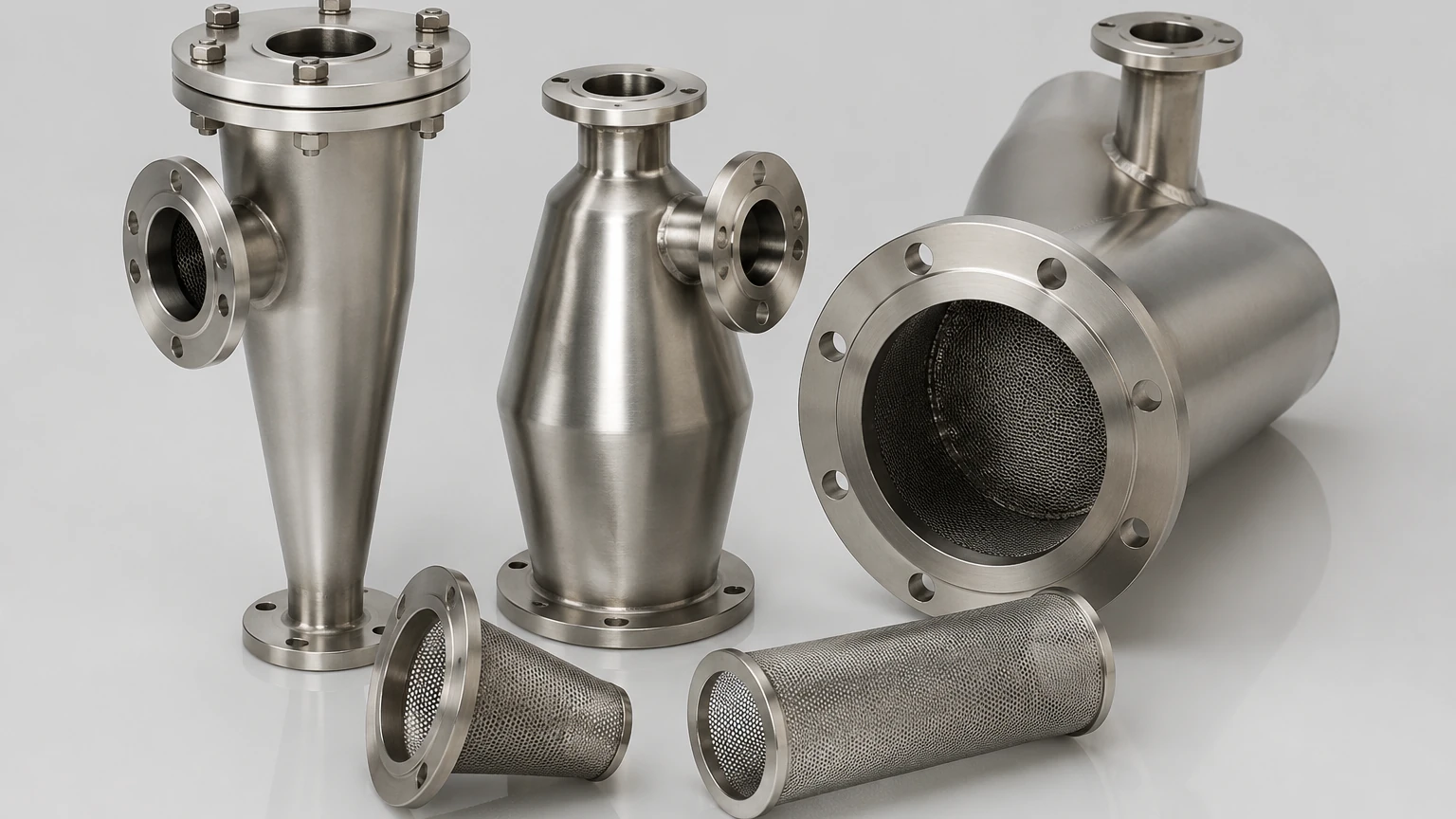
For engineers and procurement teams, understanding the mechanics, limitations, and integration strategies of cyclone separators is essential. While these units are highly effective for specific particle profiles, they are frequently used in conjunction with precision stainless steel wire mesh filters and cartridges to achieve comprehensive filtration results. This guide examines the technical engineering considerations of cyclone separators for water and how they fit into a broader industrial filtration strategy.
Principles of Centrifugal Separation in Water Treatment
The operation of cyclone separators for water is governed by fluid dynamics and the principle of centrifugal sedimentation. Unlike a traditional filter that traps particles on a mesh surface, a hydrocyclone uses the velocity of the incoming fluid to create a high-speed vortex.
When water enters the cylindrical chamber tangentially, it is forced into a downward spiral along the inner walls. This motion generates centrifugal forces that are significantly higher than gravity. Particles with a higher density than water are flung toward the outer wall, where they lose velocity due to friction and eventually descend into a collection chamber or apex at the bottom. Meanwhile, the cleaned water reaches the center of the vortex and is forced upward through a central tube, known as the vortex finder, to the outlet.
From an engineering perspective, the efficiency of this separation is determined by several factors: the diameter of the cyclone, the pressure drop across the unit, and the residence time of the fluid. Smaller diameter cyclones typically generate higher G-forces, allowing for the removal of finer particles, but they also result in a higher pressure drop and lower flow capacity. This trade-off is a critical consideration during the initial design phase.
Engineering Considerations for Cyclone Separators for Water
Selecting the correct cyclone separator requires a deep dive into the specific characteristics of the process stream. Because hydrocyclones are passive devices with no moving parts, their performance is entirely dependent on the stability of the operating parameters.
Flow Rate and Pressure Drop
Cyclone separators for water are flow-dependent. If the flow rate drops below the design specification, the centrifugal force decreases, and separation efficiency plummets. Conversely, exceeding the design flow rate increases the pressure drop ($ΔP$) across the system, which can lead to excessive energy consumption and accelerated wear on the internal surfaces. Engineers must ensure that the pump system can maintain a consistent head to drive the vortex effectively.
Particle Density and Size
The "cut point" (d50) is the particle size at which 50% of the solids are removed. For cyclone separators, this point is heavily influenced by the density difference between the solid and the liquid. While they excel at removing heavy materials like sand (specific gravity ~2.6), they are less effective at removing organic matter or light plastics that have a density close to that of water. In such cases, a secondary stage of precision metal filtration is often required to capture the remaining buoyant or fine particulates.
Material Selection and Erosion Resistance
Given the high velocities inside the chamber, erosion is a significant concern, particularly when handling abrasive solids. While some industrial separators use lined carbon steel, high-grade stainless steel (such as 304 or 316L) is the preferred choice for applications involving corrosive chemicals, food and beverage processing, or high-purity water. Stainless steel provides the necessary structural integrity and surface smoothness to minimize turbulence and resist the abrasive action of the rotating solids.
Comparative Analysis: Cyclone Separators vs. Stainless Steel Mesh Filters
It is common for technical professionals to weigh the benefits of centrifugal separation against barrier filtration. In many robust industrial systems, these two technologies are not competitors but complementary components of a multi-stage filtration solution.
Cyclone Separators:
* Pros: Continuous operation without backwashing or element replacement; handles high solids loading; no moving parts; compact footprint relative to flow rate.
* Cons: Limited efficiency for particles with low density; cannot achieve absolute filtration ratings; performance varies with flow fluctuations.
Stainless Steel Mesh Filters:
* Pros: Provides a definitive physical barrier; capable of absolute filtration down to micron levels; performance is independent of particle density.
* Cons: Requires cleaning or replacement of elements; higher maintenance in high-solids applications if used as a primary stage.
In practice, cyclone separators for water act as the "first line of defense." By removing the bulk of heavy grit and sand, they protect downstream stainless steel filter cartridges from premature clogging and mechanical damage. This hybrid approach optimizes the total cost of ownership (TCO) by extending the service life of precision filter media.
Key Evaluation Criteria for Industrial Applications
Before integrating a cyclone separator into a process line, engineers should confirm several performance expectations to avoid operational bottlenecks.
1. Solids Loading Capacity: How much sediment is expected per hour? Cyclone separators usually feature a purge valve or a collection tank. If the solids loading is extremely high, an automated purge system is necessary to prevent the apex from clogging, which would cause the separated solids to be re-entrained into the clean water stream.
2. Micron Rating Requirements: If the application requires a 10-micron absolute rating, a cyclone separator alone will likely be insufficient. Most hydrocyclones are effective down to 50–70 microns for heavy solids. For finer requirements, the separator should be followed by a precision-engineered wire mesh filter.
3. Space and Installation Constraints: Hydrocyclones must be installed vertically for the gravity-assisted collection of solids to function correctly. The piping layout must also allow for a straight run of pipe before the inlet to ensure a non-turbulent flow entering the chamber.
4. Maintenance Access: While they have no moving parts, the interior should be inspected periodically for signs of erosion or scale buildup, especially in hard water applications or chemical processing.
Common Risks and Performance Optimization
The most common failure mode for cyclone separators for water is not mechanical breakdown, but "vortex collapse" or "short-circuiting." This occurs when the pressure balance between the underflow (solids outlet) and the overflow (clean water outlet) is disrupted. If the underflow valve is left open too wide, too much water escapes with the solids, reducing the efficiency of the upward vortex. If it is closed too tightly, the solids back up into the main chamber.
To optimize performance, many facilities install pressure gauges on both the inlet and outlet. A steady differential pressure is the best indicator that the internal vortex is stable. Additionally, using high-quality stainless steel internal components ensures that the internal geometry remains true over years of service, preventing the turbulence that can degrade separation efficiency.
Customization and Integration Strategies
Every industrial environment presents unique challenges, from the high temperatures of a chemical reactor's cooling loop to the strict hygiene standards of a pharmaceutical facility. Customization is often the key to successful filtration.
For instance, in hydraulic systems, cyclone separators for water can be used to remove water-entrained grit before the fluid passes through high-pressure stainless steel mesh filters. In water treatment plants, they serve as pre-filters for membrane systems, significantly reducing the frequency of expensive membrane cleanings.
When sourcing these components, it is vital to work with a manufacturer that understands the nuances of metal fabrication and filtration physics. Custom-designed stainless steel housings and internal components allow for precise matching of the cyclone’s geometry to the specific flow characteristics of the application. For more information on how to integrate these solutions into your specific industrial process, you can Review product options and application support on our Main Page.
Conclusion: Achieving Total Filtration Efficiency
Cyclone separators for water are an invaluable tool for the bulk removal of heavy suspended solids, offering a robust, low-maintenance solution for high-flow industrial applications. However, their true value is realized when they are integrated into a well-engineered filtration train. By combining the centrifugal power of a hydrocyclone with the precision and reliability of stainless steel wire mesh filters and cartridges, engineers can achieve a level of fluid purity that protects equipment, reduces downtime, and ensures consistent process outcomes.
When evaluating your next filtration project, consider the density, size, and volume of the contaminants. If heavy particulates are a primary concern, a cyclone separator is the logical starting point. For the finer, absolute filtration needs that follow, the durability and precision of custom stainless steel components remain the industry standard for performance and longevity.
