


Rotary Drum Vacuum Filter
In the landscape of industrial liquid-solid separation, the rotary drum vacuum filter (RDVF) remains one of the most reliable and widely utilized technologies for continuous processing. Designed to handle slurries with high solids concentrations, these systems provide a mechanical solution for dewatering, cake washing, and clarification across diverse sectors including chemical processing, mining, food and beverage, and pharmaceutical manufacturing. For engineering teams, understanding the mechanical nuances, filtration media requirements, and operational variables of an RDVF is essential for optimizing throughput and ensuring the longevity of the equipment.
As a continuous filtration process, the rotary drum vacuum filter offers distinct advantages over batch systems like filter presses, particularly in applications where downtime must be minimized. However, the efficiency of the system is heavily dependent on the selection of the filter medium and the precision of the drum’s construction. This guide explores the engineering principles, selection criteria, and technical considerations for implementing and maintaining rotary drum vacuum filtration systems.
The Fundamental Working Principle of RDVFs
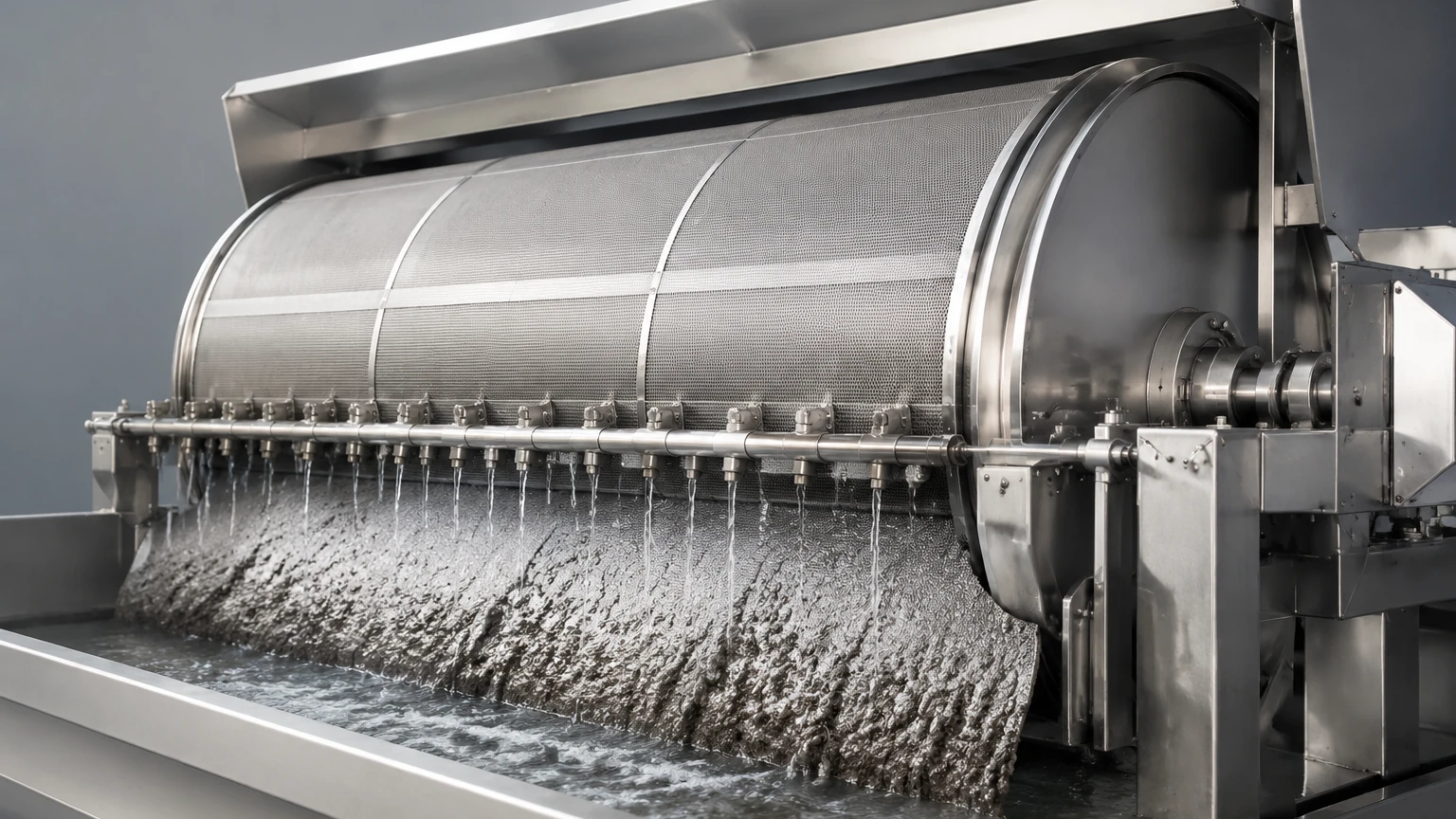
The operation of a rotary drum vacuum filter is based on the creation of a pressure differential across a rotating drum covered with a filter medium. The drum is partially submerged in a vat containing the slurry. As the drum rotates, a vacuum is applied to the interior, drawing the liquid (filtrate) through the filter medium while the solids are retained on the outer surface to form a "filter cake."
An RDVF cycle is typically divided into several functional zones:
1. Cake Formation Zone: The submerged portion of the drum where the vacuum pulls the slurry against the filter medium. The liquid passes into the drum's internal piping, and the solids begin to build up.
2. Cake Washing Zone (Optional): Once the drum emerges from the vat, wash liquid can be sprayed onto the cake to remove impurities or recover valuable solutes. The vacuum continues to pull this wash liquid through the cake.
3. Drying Zone: After washing, the vacuum continues to draw air through the cake to reduce its moisture content to the required level before discharge.
4. Discharge Zone: The filter cake is removed from the drum surface using various mechanical methods, such as scrapers, rollers, or strings.
5. Cloth Cleaning Zone: Before the drum section re-enters the slurry vat, the filter medium may be cleaned with high-pressure sprays to prevent blinding (clogging).
Engineering Components and Design Considerations
To specify a rotary drum vacuum filter, engineers must evaluate several critical components that influence performance and maintenance cycles.
The Drum and Internal Piping
The drum is the core structural element, usually constructed from stainless steel or specialized alloys to resist corrosion. It is divided into separate longitudinal sections, each connected by internal piping to a central rotary valve. This valve controls the application of vacuum and compressed air (for cake release) to specific sections of the drum as it rotates.
The Filter Medium
The choice of filter medium is perhaps the most critical decision in RDVF design. While synthetic cloths are common, many industrial applications require the durability and precision of stainless steel wire mesh. Metal filter media offer superior thermal stability, chemical resistance, and mechanical strength, which are vital when handling abrasive slurries or high-temperature processes. For custom filtration requirements, engineers often look to specialized manufacturers to provide precision-engineered mesh that matches the specific particle size distribution of their slurry. For more information on custom metal filtration components, you can visit the Main Page of a professional manufacturer.
The Agitator
To prevent the solids in the vat from settling, an agitator is used. The design of the agitator must be robust enough to keep the slurry homogenous without creating excessive turbulence that could disrupt the initial formation of the filter cake.
Discharge Methods for Rotary Drum Vacuum Filters
The method used to remove the cake from the drum significantly impacts the system's efficiency and the type of slurries it can handle. Common discharge mechanisms include:
* Scraper Discharge: A stationary blade (scraper) peels the cake off the drum. This is suitable for fast-filtering slurries that form a thick, non-sticky cake. A "blow-back" of compressed air is often used to lift the cake slightly before it reaches the scraper.
* Belt Discharge: The filter medium is a continuous belt that leaves the drum to pass over a series of rollers. This allows for the cake to be discharged more effectively and enables the belt to be washed on both sides before returning to the drum, which is ideal for slurries that tend to blind the filter cloth.
* Roller Discharge: Used for very thin, sticky cakes. A roller rotates in the opposite direction of the drum, causing the cake to transfer from the drum to the roller, where it is then scraped off.
* Precoat Discharge: For slurries with very fine particles or those that would immediately blind a standard filter cloth, a "precoat" of diatomaceous earth or perlite is applied to the drum. A knife slowly advances into the precoat layer, shaving off the filtered solids along with a thin layer of the precoat material.
Selection Criteria for Industrial Applications
When evaluating a rotary drum vacuum filter for a specific process, several variables must be analyzed to ensure the equipment meets production targets and operational budgets.
Slurry Characteristics
Engineers must determine the solids concentration, particle size distribution, and the viscosity of the liquid phase. Slurries with a wide range of particle sizes often form a more stable cake, whereas very uniform fine particles may require a precoat system. Additionally, the chemical compatibility of the slurry with the drum material and the filter medium must be verified to prevent premature failure.
Filtration Rate and Throughput
The filtration rate is measured in terms of the volume of filtrate produced per unit area of the drum per hour (L/m²/h). This rate is influenced by the vacuum level, the drum's rotation speed, and the percentage of the drum submerged in the vat. Increasing the submergence depth increases the cake formation time but reduces the drying time.
Cake Moisture and Wash Requirements
If the goal is to achieve a very dry cake, a longer drying zone is required, which may necessitate a slower drum speed or a larger drum diameter. If cake purity is the priority, the design must allow for sufficient wash spray headers and adequate residence time in the washing zone.
The Role of Stainless Steel Filter Media
In many demanding B2B environments, such as chemical plants or oil refineries, standard fabric filters may fail due to chemical degradation or mechanical wear. Stainless steel wire mesh filters provide a high-performance alternative. These components are engineered to provide precise filtration ratings, often down to the micron level, while maintaining the structural integrity needed to withstand the constant tension and vacuum cycles of an RDVF.
Using stainless steel mesh also facilitates easier cleaning. Unlike synthetic fibers, metal mesh does not absorb oils or fats, making it ideal for food-grade applications where hygiene and CIP (Clean-In-Place) capabilities are paramount. When selecting these components, engineers should confirm the alloy grade (e.g., 304, 316L, or 904L) to ensure it matches the corrosivity of the process fluid.
Common Operational Risks and Troubleshooting
Despite their robust design, rotary drum vacuum filters can encounter operational challenges that affect performance:
1. Vacuum Loss: This is often caused by leaks in the internal piping, wear in the rotary valve, or holes in the filter medium. Regular inspection of the seals and the integrity of the mesh is necessary.
2. Cloth Blinding: If the solids are not effectively removed or if the cleaning sprays are inadequate, the filter medium will clog, leading to a rapid drop in throughput. Engineers should consider adjusting the wash pressure or switching to a different mesh weave.
3. Uneven Cake Formation: This can result from poor agitation in the vat or a malfunctioning vacuum system. It leads to inefficient washing and drying, as the air and wash liquid will follow the path of least resistance through thinner sections of the cake.
4. Cake Cracking: During the drying phase, some cakes may shrink and crack, causing a loss of vacuum. This can sometimes be mitigated by using a compression roll to smooth the cake surface.
Conclusion for Purchasing and Engineering Teams
Implementing a rotary drum vacuum filter requires a balance between mechanical design and process chemistry. For purchasing teams, the total cost of ownership (TCO) should be the primary metric, considering not just the initial capital expenditure but also the cost of replacement filter media, energy consumption for the vacuum pumps, and maintenance labor.
Before finalizing a specification, engineers should confirm the following with their equipment or component suppliers:
* Material Compatibility: Ensure all wetted parts are resistant to the process slurry.
* Customization Options: Can the filter medium be customized to handle specific particle sizes or flow rates?
* Scalability: Is the drum size sufficient for peak production loads?
* Support: Does the manufacturer provide technical guidance on filter media selection and optimization?
By focusing on high-quality components and precise engineering, industrial facilities can leverage the rotary drum vacuum filter to achieve consistent, high-volume separation results. For those seeking reliable, custom-manufactured stainless steel filtration solutions to enhance their RDVF performance, exploring the capabilities of a specialized manufacturer is a critical next step. Review product options and application support on the Main Page to ensure your filtration system meets the rigorous demands of your specific industrial environment.
