


Cyclone Separators
In the landscape of industrial fluid and gas processing, the management of particulate matter is a fundamental requirement for protecting downstream equipment and ensuring product purity. Cyclone separators, often referred to as centrifugal separators, serve as a primary stage in many filtration sequences. By utilizing the principles of centrifugal force and inertia, these devices effectively remove solid particles or liquid droplets from a gas or liquid stream without the use of moving parts or replaceable filter media. For engineers and procurement teams, understanding the mechanical nuances and performance variables of cyclone separators is essential when integrating them into a comprehensive filtration system that may also include precision stainless steel components from manufacturers like Kaifil.
The Physics of Cyclonic Separation
The operation of cyclone separators is governed by fluid dynamics, specifically the interaction between centrifugal force, drag force, and gravity. The process begins when a fluid stream—either gas or liquid—enters the cylindrical chamber of the separator through a tangential inlet. This entry method forces the fluid into a high-velocity spiral or vortex.
The Double Vortex Mechanism
As the fluid rotates, it moves downward along the inner walls of the separator, forming what is known as the "outer vortex." The centrifugal force generated by this rotation pushes the heavier particles toward the outer wall. Because these particles have greater mass and inertia than the fluid molecules, they cannot follow the tight curvature of the fluid flow and instead strike the wall, losing their kinetic energy. Gravity then pulls these separated particles down the conical section of the separator into a collection hopper or apex.
Simultaneously, as the fluid reaches the bottom of the cone, it reverses direction and forms a smaller, tighter "inner vortex" that travels upward through the center of the chamber. This cleaned fluid then exits through a central discharge pipe at the top, often called the vortex finder. The efficiency of this separation is highly dependent on the velocity of the fluid and the physical properties of the particles being removed.
Key Engineering Components of Cyclone Separators
A well-engineered cyclone separator is defined by its geometry. Small changes in the dimensions of specific components can significantly alter the pressure drop and the collection efficiency of the unit.
1. The Inlet: The shape and size of the inlet determine the entry velocity. Tangential inlets are standard, but wrap-around or helical inlets are often used to reduce turbulence and improve the transition of the fluid into the vortex.
2. The Vortex Finder: This is the exit tube for the cleaned fluid. Its depth into the cylindrical body is critical; if it is too shallow, the incoming raw fluid may "short-circuit" and exit without being processed. If it is too deep, it may interfere with the formation of the inner vortex.
3. The Cylindrical Body and Conical Section: The ratio between the diameter of the cylinder and the length of the cone influences the residence time of the fluid. A longer cone generally provides more time for particles to migrate to the walls, enhancing the separation of smaller particles.
4. The Apex/Dust Outlet: This is the point where the separated solids exit. It must be designed to prevent the re-entrainment of particles back into the upward-moving inner vortex.
Performance Metrics: Efficiency and Pressure Drop
When evaluating cyclone separators for an industrial application, engineers focus on two primary metrics: the cut point and the pressure drop.
The Cut Point ($d_{50}$)
The cut point, or $d_{50}$, represents the particle size at which the separator is 50% efficient. Particles larger than the $d_{50}$ are collected with higher efficiency, while smaller particles are more likely to escape with the clean fluid. In many industrial contexts, cyclone separators are designed to remove particles in the 10 to 50-micron range. For applications requiring the removal of sub-micron particles, cyclone separators are typically used as pre-filters to protect more sensitive equipment, such as the Main Page of a secondary filtration system utilizing stainless steel wire mesh.
Pressure Drop ($ΔP$)
The pressure drop is the difference in static pressure between the inlet and the outlet. While higher velocities generally increase separation efficiency by generating stronger centrifugal forces, they also result in a higher pressure drop. This increases the energy consumption of the pumps or fans driving the system. Engineering a cyclone separator involves finding the "sweet spot" where the required filtration efficiency is achieved without creating an excessive energy burden on the facility.
Material Selection and Durability
Industrial environments often subject filtration equipment to abrasive particles, corrosive chemicals, and high temperatures. Consequently, the material of construction is a vital consideration for the longevity of cyclone separators.
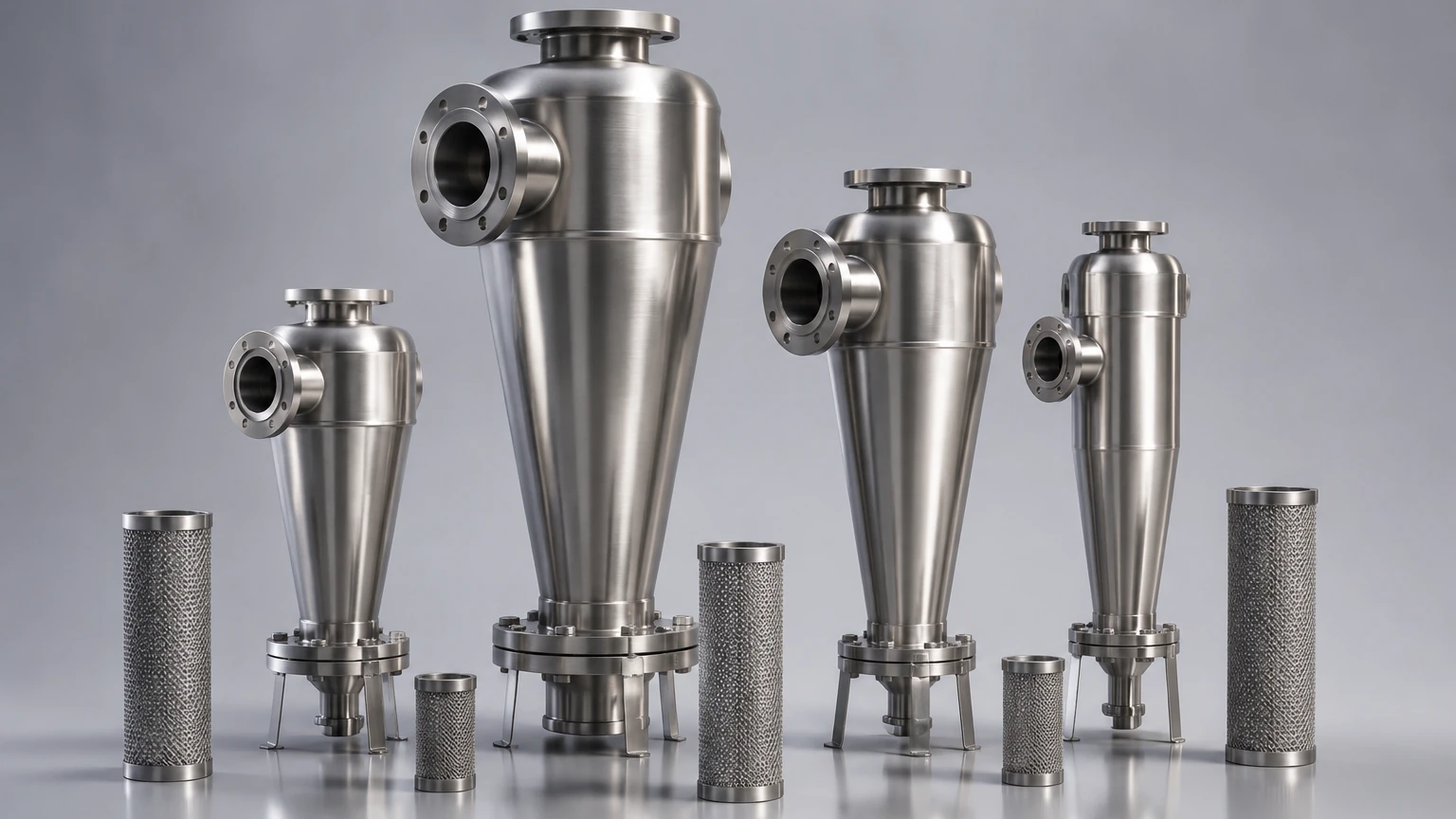
* Stainless Steel (304 and 316L): These materials are the industry standard for applications in the food and beverage, pharmaceutical, and chemical sectors. Stainless steel provides excellent corrosion resistance and can withstand the rigorous cleaning protocols required in sanitary environments. Furthermore, the smooth surface finish of stainless steel reduces the risk of particle buildup on the internal walls.
* Hardened Alloys and Liners: In mining or heavy industrial applications where the particles are highly abrasive, separators may be lined with ceramic or hardened steel to prevent the walls from thinning over time due to constant particle impact.
Integrating Cyclone Separators into Filtration Systems
In many B2B industrial scenarios, a cyclone separator is not a standalone solution but a critical component of a multi-stage filtration strategy. Its primary role is to reduce the "solids loading" on downstream filters.
Pre-filtration for Stainless Steel Cartridges
Precision filtration components, such as the sintered metal or wire mesh cartridges manufactured by Kaifil, are designed to capture very fine particles with high accuracy. However, if these filters are exposed to a high volume of large, heavy particles, they will clog rapidly, leading to frequent maintenance cycles and increased operational costs. By installing cyclone separators upstream, the majority of the heavy particulate matter is removed first. This allows the secondary stainless steel filters to operate more efficiently and significantly extends their service life.
Common Applications
* Chemical Processing: Removing catalysts or bulk reactants from gas streams before they reach sensitive analytical equipment or final stage filters.
* Food and Beverage: Separating husks, dust, or large debris from grain processing lines or liquid slurry streams.
* Hydraulic Systems: Acting as a primary cleaner for hydraulic fluids in heavy machinery to protect high-precision valves and pumps.
* Water Treatment: Removing sand and grit from raw water sources before the water enters fine-mesh membrane or cartridge filtration systems.
Maintenance and Operational Considerations
One of the greatest advantages of cyclone separators is their low maintenance requirement. Since there are no moving parts to wear out and no filter media to replace, maintenance is largely focused on monitoring and inspection.
Monitoring for Erosion
In systems handling abrasive materials, the internal walls of the cyclone—particularly in the conical section and near the inlet—should be periodically inspected for signs of thinning. Ultrasonic thickness testing is a common non-destructive method used to ensure the structural integrity of the unit.
Preventing Re-entrainment and Blockage
A common failure point in cyclonic separation is the blockage of the apex. If the collection hopper fills up and the solids are not discharged, the vortex will eventually pick up the collected material and carry it out through the clean fluid outlet. Automated discharge valves or rotary airlocks are often employed to ensure a continuous and reliable removal of separated solids.
Air Leakage
For gas-phase cyclone separators, any air leakage at the dust discharge point can disrupt the vortex and significantly reduce efficiency. Ensuring that the collection bin is airtight or that the discharge valve provides a positive seal is critical for maintaining performance.
Selecting the Right Solution
Choosing the correct cyclone separator requires a detailed understanding of the process fluid and the target particles. Engineers should be prepared to provide the following data to manufacturers:
* Fluid Properties: Flow rate (ACFM or $m^3/h$), temperature, pressure, and viscosity.
* Particle Properties: Particle size distribution (PSD), density, and abrasiveness.
* Efficiency Requirements: What is the target $d_{50}$ or the maximum allowable particle size in the effluent?
* System Constraints: Available space, allowable pressure drop, and connection types.
At the Main Page of a comprehensive filtration strategy, the goal is always to achieve the highest possible purity with the lowest possible operational impact. Cyclone separators provide the robust, reliable first line of defense necessary to make that goal a reality. By effectively managing the bulk of the particulate load, they enable precision stainless steel filters to perform their specialized tasks without the risk of premature failure.
Conclusion
Cyclone separators remain a cornerstone of industrial filtration due to their simplicity, durability, and cost-effectiveness. Whether they are used to recover valuable product in a chemical plant or to protect high-performance stainless steel mesh filters in a pharmaceutical facility, their role in maintaining system health is undeniable. For technical teams, the focus should remain on precise engineering, appropriate material selection, and a holistic view of the filtration train. When integrated correctly, cyclone separators provide a scalable and efficient solution for the most demanding industrial environments, ensuring that the final filtration stages can deliver the precision and reliability for which brands like Kaifil are known.
