


Demister Filter
In industrial processing, the separation of entrained liquid droplets from gas or vapor streams is a critical requirement for protecting downstream equipment, reducing product loss, and ensuring environmental compliance. A demister filter, also known as a mist eliminator, is a specialized component designed to facilitate this separation through mechanical impingement. As a professional manufacturer of custom stainless steel filtration solutions, Kaifil provides high-performance demister components engineered to meet the rigorous demands of chemical processing, oil and gas, and pharmaceutical industries.
Understanding the technical nuances of demister filter design is essential for engineers and purchasing teams. Selecting the correct mesh density, material, and structural configuration directly impacts the efficiency of the separation process and the overall operational costs of the system. For more information on our full range of industrial filtration capabilities, please visit our Main Page.
The Mechanics of Gas-Liquid Separation
The operation of a demister filter relies on the principle of inertial impaction. When a gas stream containing entrained liquid droplets passes through a knitted wire mesh structure, the gas easily navigates the tortuous path created by the wires. However, the liquid droplets, possessing greater inertia, cannot change direction as quickly as the gas. Consequently, they strike the surface of the wire mesh.
Once a droplet impacts the wire, it adheres to the surface and begins to coalesce with other droplets. As these droplets grow in size and mass, they eventually reach a point where the force of gravity exceeds the upward velocity of the gas stream and the surface tension holding them to the mesh. At this stage, the liquid drains away from the mesh into a collection sump or back into the process vessel. This three-stage process—impaction, coalescence, and drainage—is what allows a demister filter to achieve high separation efficiencies, often removing 99% or more of droplets larger than 5 to 10 microns.
Material Science in Demister Construction
Material selection is a primary engineering consideration when specifying a demister filter. The environment within a separator vessel is often corrosive, high-temperature, or subject to strict hygiene standards. Kaifil specializes in stainless steel filtration solutions, utilizing materials that provide the necessary durability and chemical resistance for industrial applications.
Stainless Steel 304 and 316L
Stainless steel 304 is the standard choice for general industrial applications where moderate corrosion resistance is required. However, for environments involving chlorides, acids, or pharmaceutical-grade requirements, 316L stainless steel is preferred due to its superior resistance to pitting and crevice corrosion. The low carbon content of 316L also ensures better weldability and structural integrity in the face of thermal cycling.
Specialized Alloys
In highly aggressive chemical environments, such as those involving concentrated sulfuric acid or caustic solutions, standard stainless steels may not suffice. In these instances, exotic alloys like Monel, Inconel, or Hastelloy may be employed. These materials ensure that the demister filter maintains its structural geometry and filtration efficiency over a long service life, preventing premature failure that could lead to costly downtime.
Design Parameters: Density, Surface Area, and Void Volume
The performance of a demister filter is governed by its physical characteristics, specifically the mesh density, specific surface area, and void volume. These parameters are meticulously engineered to balance separation efficiency with pressure drop.
1. Mesh Density: This refers to the mass of the wire mesh per unit volume (typically kg/m³). A higher density provides more targets for droplet impaction, increasing efficiency for smaller droplets, but it also increases the resistance to gas flow.
2. Specific Surface Area: This is the total surface area of the wire available for impaction per unit volume. A higher surface area generally correlates with higher removal efficiency.
3. Void Volume: This represents the percentage of free space within the filter. Most industrial demisters maintain a void volume of 97% to 99%. A high void volume is critical for minimizing pressure drop and allowing the gas to flow freely while providing enough space for the coalesced liquid to drain without being re-entrained by the gas stream.
Engineers must specify these values based on the physical properties of the gas and liquid, including density, viscosity, and surface tension, as well as the expected droplet size distribution.
Optimizing Gas Velocity and Pressure Drop
One of the most critical factors in the successful application of a demister filter is the gas velocity. If the velocity is too low, the droplets will have insufficient inertia to impact the wires, and they will simply follow the gas flow through the mesh. Conversely, if the velocity is too high, the gas will strip the coalesced liquid off the wires and carry it downstream, a phenomenon known as re-entrainment.
The "design velocity" is typically calculated using the Souders-Brown equation, which factors in the densities of both the gas and the liquid phases. Operating within the optimal velocity range ensures maximum efficiency while maintaining a manageable pressure drop. For most stainless steel mesh demisters, the pressure drop is remarkably low, often less than 250 Pa (1 inch of water column) under normal operating conditions. Monitoring this pressure drop is a key diagnostic tool for identifying fouling or mesh degradation.
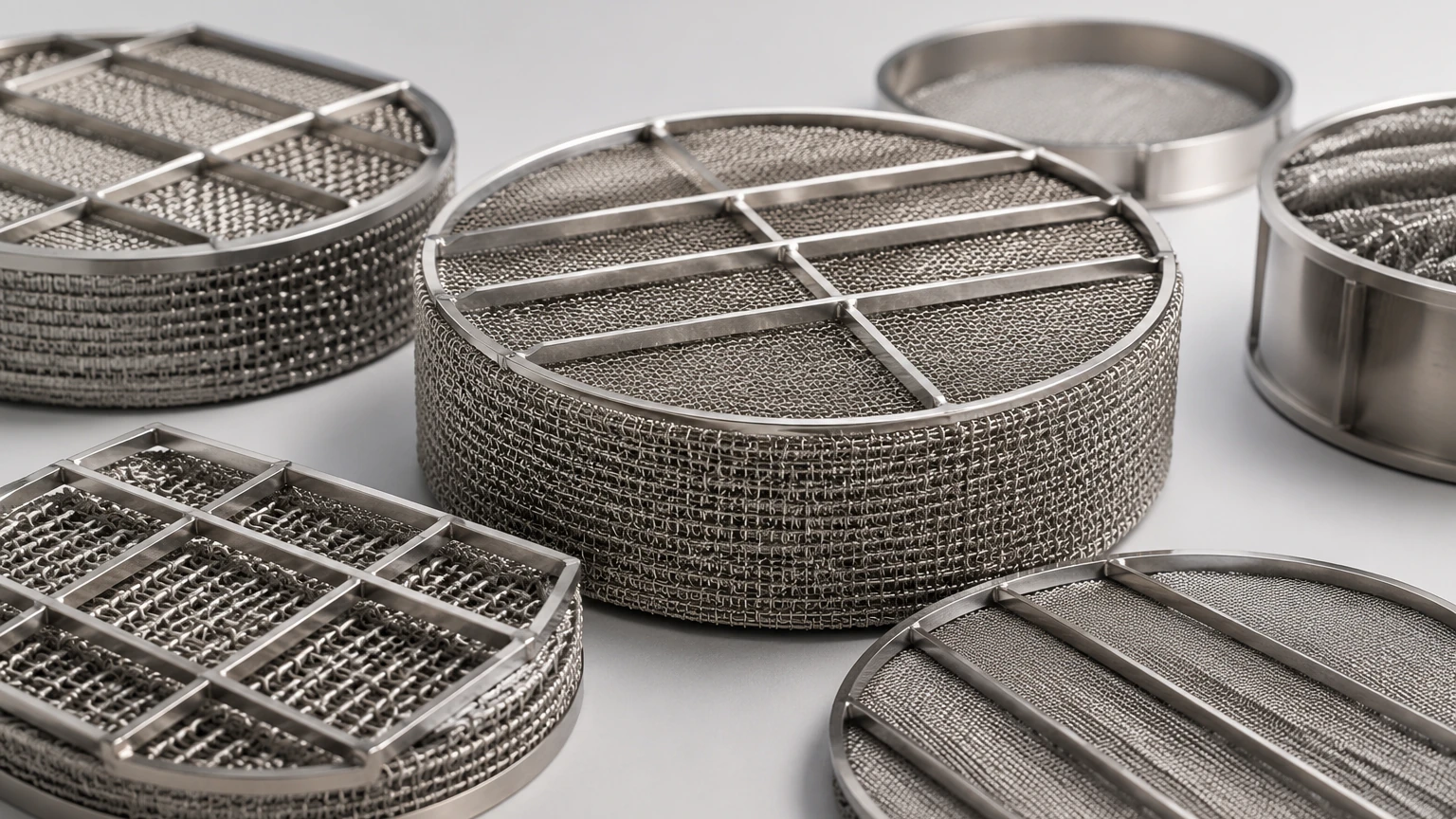
Customization and OEM Solutions from Kaifil
Industrial filtration is rarely a one-size-fits-all endeavor. Every vessel has unique dimensions, flow rates, and mounting requirements. Kaifil provides extensive customization options to ensure that the demister filter integrates seamlessly into the existing infrastructure.
Structural Configurations
Demisters can be manufactured in various shapes, including circular, rectangular, or ring-shaped (annular). For larger vessels, the demister is often constructed in sections or "manway-sized" pieces that can be easily passed through a standard manhole and assembled inside the vessel on support grids.
Support Grids and Housing
To withstand the force of the gas flow and the weight of the accumulated liquid, demister pads are typically held between top and bottom support grids. These grids are engineered to provide maximum structural rigidity with minimum blockage of the flow area. Kaifil can customize these supports to match specific vessel internals, ensuring a secure fit that prevents gas bypassing around the edges of the filter.
Wire Diameter and Knit Patterns
By varying the wire diameter and the knit pattern (standard, high-efficiency, or high-throughput), we can fine-tune the filter's performance. Finer wires provide more surface area for a given weight, which is ideal for capturing very fine mists, while heavier wires offer greater mechanical strength and resistance to erosion in high-velocity streams.
Installation and Maintenance Protocols
Proper installation is vital for the performance of a demister filter. The mesh must be installed perpendicular to the gas flow, and there must be no gaps between the mesh sections or between the mesh and the vessel wall. Any gap will become a path of least resistance, allowing untreated gas to bypass the filter.
Maintenance and Cleaning
While stainless steel demisters are designed for longevity, they can become fouled by solids or viscous liquids over time. An increase in pressure drop is the most common indicator that cleaning is required. Depending on the nature of the contaminant, demisters can often be cleaned in situ using steam, water jets, or chemical solvents. In cases where the fouling is severe or the wire has suffered mechanical damage or corrosion, the mesh sections should be replaced to restore the system's efficiency.
Replacement Cycles
In clean applications, a high-quality stainless steel demister can last for many years. However, in corrosive or high-solids environments, regular inspection during scheduled turnarounds is recommended. Replacing a demister filter before it fails is a cost-effective strategy to prevent damage to expensive downstream equipment like compressors, turbines, or vacuum pumps.
Selecting the Right Demister Filter for Your Process
When preparing to purchase or specify a demister filter, engineers should have the following data points ready to ensure the manufacturer can provide an accurate solution:
* Gas Flow Rate: Minimum, normal, and maximum operating rates.
* Operating Pressure and Temperature: These affect gas density and material selection.
* Fluid Properties: Densities and viscosities of both the gas and liquid phases.
* Droplet Size: The target micron size for removal.
* Vessel Geometry: Internal diameter and available space for the demister.
* Corrosion Allowance: Any specific chemical compatibility requirements.
By partnering with a manufacturer like Kaifil, you gain access to technical expertise that helps translate these process variables into a durable, high-performance filtration component. Our commitment to quality and precision manufacturing ensures that every demister filter we produce meets the exacting standards of the industrial sectors we serve.
For technical consultation or to request a quote for your specific filtration project, please refer to our Main Page to connect with our engineering team. We work closely with global customers to develop customized designs that optimize filtration performance and reduce total cost of ownership in demanding industrial environments.
