


Demister Pad
In industrial process engineering, the separation of liquid droplets from gas or vapor streams is a critical requirement for protecting downstream equipment, reducing product loss, and ensuring environmental compliance. A demister pad, also known as a mist eliminator, is a specialized filtration component designed to remove entrained liquid particles from a gas stream through the principle of inertial impaction. As a professional manufacturer of stainless steel filtration solutions, Kaifil provides precision-engineered demister pads that meet the rigorous demands of chemical processing, oil and gas, and pharmaceutical applications.
Understanding the technical nuances of demister pad design—ranging from material selection to gas velocity calculations—is essential for engineers and purchasing teams tasked with optimizing system performance and longevity.
Principles of Operation: Inertial Impaction and Coalescence
The fundamental function of a demister pad relies on the mechanical separation of phases. When a gas stream carrying entrained liquid droplets passes through a knitted wire mesh structure, the gas follows the path of least resistance through the tortuous voids of the mesh. However, the liquid droplets, possessing greater inertia than the gas molecules, cannot change direction as rapidly.
As the gas weaves through the mesh, the droplets strike the surface of the wires. This process is known as inertial impaction. Once a droplet makes contact with the wire, it adheres to the surface due to surface tension. As more droplets impact the same area, they coalesce—merging into larger, heavier drops. When the gravitational force acting on these accumulated drops exceeds the combined forces of the upward gas velocity and surface tension, the liquid drains away from the mesh and falls to the bottom of the vessel or collector.
For sub-micron particles, other mechanisms such as direct interception and Brownian diffusion come into play, though for standard industrial demister pads, inertial impaction remains the primary driver for efficiency in the 5 to 10-micron range and above.
Engineering Specifications and Material Selection
The performance of a demister pad is heavily influenced by its physical construction and the materials used. Selecting the correct material is not merely a matter of cost but a requirement for chemical compatibility and thermal stability.
Material Options
Stainless steel is the industry standard due to its balance of mechanical strength and corrosion resistance. Kaifil specializes in high-grade alloys to ensure durability in harsh environments:
- AISI 304/304L: Suitable for general-purpose applications where basic corrosion resistance is required.
- AISI 316/316L: Enhanced with molybdenum, this grade offers superior resistance to chlorides and organic acids, making it ideal for pharmaceutical and chemical processing.
- Specialty Alloys: For highly corrosive or high-temperature environments, materials such as Monel, Inconel, and Hastelloy are utilized to prevent premature mesh failure.
- Synthetic Polymers: In applications involving strong inorganic acids where metals might fail, materials like Polypropylene (PP) or PTFE are used, though they have lower temperature thresholds compared to metal components.
Mesh Density and Surface Area
The efficiency of a demister pad is proportional to the surface area of the wire mesh. However, increasing the surface area also increases the pressure drop across the unit. Engineers must balance these factors based on the specific particle size distribution of the mist. Typical mesh densities range from 100 kg/m³ to 200 kg/m³, with surface areas varying between 200 m²/m³ and 500 m²/m³ depending on the wire diameter and knitting pattern.
Performance Metrics: Efficiency vs. Pressure Drop
When evaluating a demister pad for a new or existing installation, two primary metrics define success: removal efficiency and pressure drop.
Removal Efficiency
A well-designed demister pad can typically achieve 99% removal efficiency for droplets larger than 5 to 10 microns. The efficiency is sensitive to the gas velocity. If the velocity is too low, droplets may follow the gas stream around the wires without impacting them. Conversely, if the velocity is too high, the gas may "re-entrain" the liquid, stripping the coalesced drops off the mesh before they can drain.
Pressure Drop
Maintaining a low pressure drop is essential for energy efficiency, especially in systems involving large-scale blowers or compressors. A clean demister pad usually operates with a pressure drop between 100 and 500 Pascals (Pa). An escalating pressure drop is often an indicator of fouling, scaling, or liquid flooding within the mesh, signaling the need for maintenance or replacement.
Design Considerations for Industrial Integration
Integrating a demister pad into a process vessel requires careful calculation of the "Design Gas Velocity." The industry standard for this calculation is the Souders-Brown equation:
$$V = K \sqrt{\frac{\rho_L –
ho_G}{\rho_G}}$$
Where:
- V is the design gas velocity.
- K is a capacity factor (typically ranging from 0.07 to 0.11 m/s depending on the mesh type and operating pressure).
- ρL is the liquid density.
- ρG is the gas density.
- K-factor adjustments are necessary for high-pressure systems or when dealing with liquids with low surface tension.
Pad Thickness and Configuration
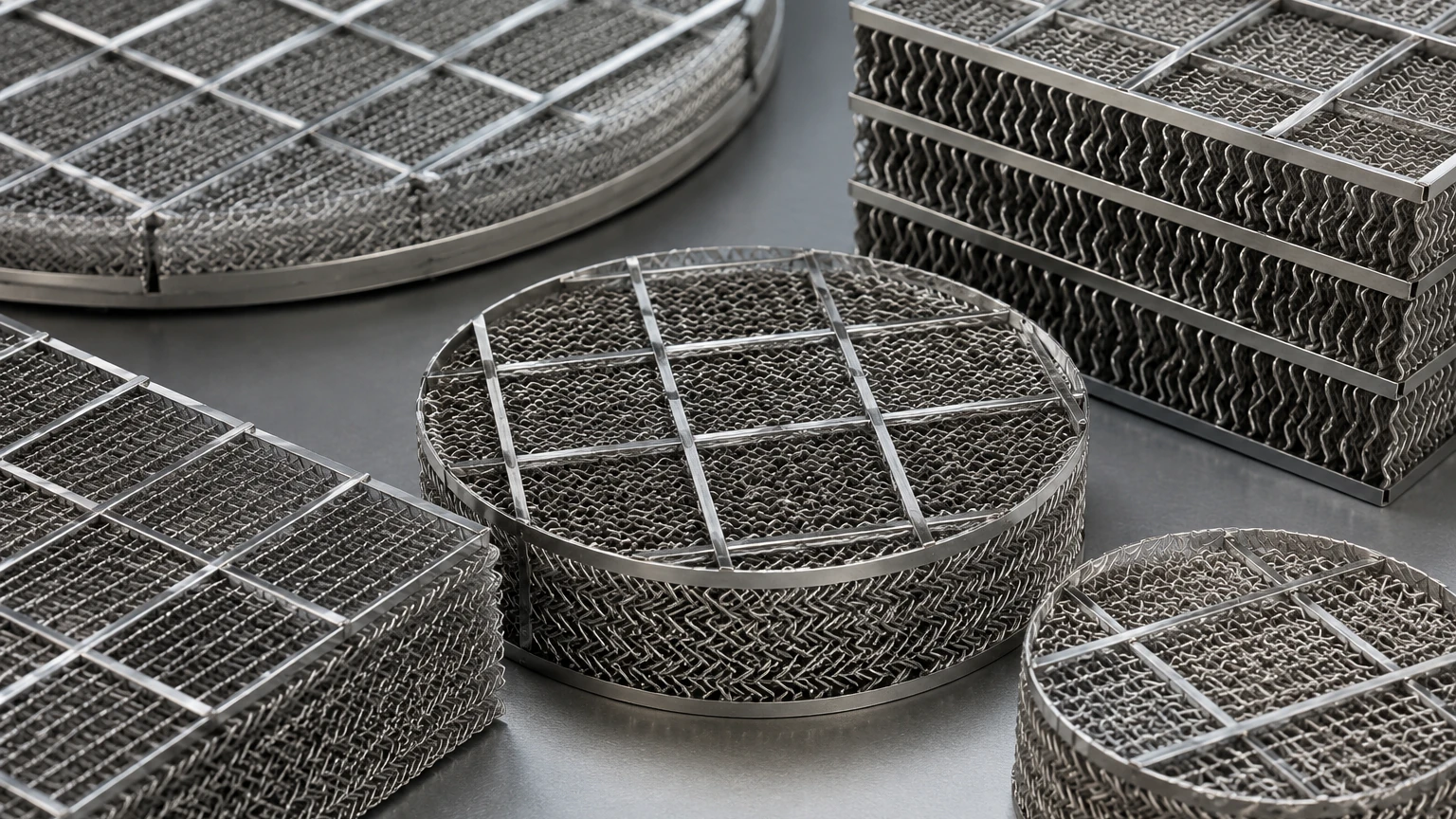
Standard industrial demister pads are typically 100mm to 150mm thick. In applications with extremely high liquid loading or where ultra-high purity is required, multiple stages or thicker pads may be employed. The pads are often manufactured in sections (manway sized) to allow for easy installation through vessel manholes. These sections are supported by grids, which must be robust enough to withstand the weight of the mesh when fully saturated with liquid.
Maintenance and Troubleshooting in Demanding Environments
While demister pads are relatively low-maintenance components, they are not "fit and forget" solutions. In sectors like chemical processing or water treatment, several factors can compromise performance:
1. Fouling and Plugging: Solids entrained in the gas stream or precipitates from the liquid can clog the mesh voids. This leads to a rapid increase in pressure drop and a decrease in separation efficiency. In such cases, integrated spray nozzles may be installed to periodically wash the mesh.
2. Corrosion: Even stainless steel can succumb to localized pitting or stress corrosion cracking if the process chemistry changes. Regular inspection of the wire integrity is vital to prevent mesh fragments from traveling downstream and damaging turbines or valves.
3. Vibration and Mechanical Wear: High-velocity gas streams can cause the knitted mesh to vibrate against the support grids, leading to mechanical thinning of the wire. Ensuring a snug fit within the vessel and using properly engineered support structures can mitigate this risk.
Engineers should establish a baseline pressure drop during commissioning and monitor it as part of a predictive maintenance program. If the pressure drop exceeds 2-3 times the initial value, a cleaning cycle or replacement is usually warranted.
Customization and OEM Solutions from Kaifil
Every industrial application presents a unique set of challenges, from restricted vessel geometry to aggressive chemical compositions. Off-the-shelf solutions rarely provide the optimal balance of efficiency and longevity required for high-stakes industrial environments.
As a manufacturer specializing in custom stainless steel filtration, Kaifil works closely with engineering teams to develop bespoke demister pad solutions. Our expertise in wire mesh knitting and metal fabrication allows us to customize wire diameters, mesh densities, and pad shapes to fit any vessel configuration. Whether you are designing a new evaporator or retrofitting a distillation column, our technical team provides the engineering support necessary to ensure the filtration component matches your specific process parameters.
To explore our full range of stainless steel filtration products and technical capabilities, visit our Main Page.
Conclusion
The demister pad is a deceptively simple component that plays a vital role in the efficiency of modern industrial processes. By understanding the physics of inertial impaction, the importance of material science, and the critical nature of the Souders-Brown velocity limits, technical professionals can ensure their systems operate at peak performance. Selecting a partner like Kaifil ensures that your filtration components are manufactured to the highest standards of precision and durability, providing reliable separation and protecting your capital equipment for years to come.
