


Disc Filtration
In the landscape of industrial separation technology, disc filtration represents a versatile and robust method for removing suspended solids from fluid streams. Unlike standard surface filtration, which relies on a single layer of media, disc filtration often utilizes a stacked configuration or specialized sintered structures to achieve precise micron ratings and high dirt-holding capacities. For engineers and procurement specialists in sectors such as chemical processing, pharmaceuticals, and hydraulic systems, understanding the technical nuances of disc filtration is essential for optimizing process efficiency and ensuring equipment longevity.
Industrial disc filtration typically involves the use of stainless steel or specialized alloy discs. These components are engineered to withstand extreme temperatures, high differential pressures, and corrosive environments that would degrade polymer-based alternatives. By leveraging the mechanical properties of metal, these systems provide a reliable barrier against contaminants while maintaining structural integrity over long operational cycles.
Engineering Principles of Disc Filtration
The fundamental mechanism of disc filtration varies depending on the specific design of the disc. In many industrial applications, particularly those involving stainless steel, the "disc" refers to a circular filter element composed of multiple layers of wire mesh, sintered metal fibers, or etched plates. These discs are often stacked together on a central perforated core to create a high-surface-area filter assembly.
When fluid enters the filter housing, it is forced through the gaps or pores within the disc stack. Contaminants are trapped either on the surface of the discs or within the depth created by the layered media. The geometric precision of these discs allows for a highly controlled "cut point," ensuring that particles above a specific micron size are consistently retained. Because the discs can be compressed or sintered together, they offer a rigid filtration path that does not bypass or channel under fluctuating pressure—a common failure mode in less robust filter types.
Material Selection and Technical Durability
Material science is at the core of effective disc filtration. While plastic discs are common in low-pressure irrigation or basic water treatment, industrial-grade filtration demands the use of high-performance metals. Stainless steel, specifically grades 304 and 316L, is the industry standard due to its excellent corrosion resistance and thermal stability.
1. 316L Stainless Steel: This is the preferred material for applications involving salt water, acids, or pharmaceutical grade fluids. The low carbon content and the addition of molybdenum enhance resistance to pitting and crevice corrosion.
2. Thermal Resistance: Metal disc filters can operate in environments exceeding 400°C (750°F), making them indispensable for steam filtration, hot gas processing, and high-temperature polymer melt filtration.
3. Mechanical Strength: In hydraulic systems where pressure spikes are frequent, the rigidity of a metal disc prevents deformation. This ensures that the filtration gap remains constant, preserving the integrity of the downstream components such as valves and pumps.
By selecting the appropriate alloy, engineers can match the filter’s chemical compatibility with the process fluid, thereby reducing the risk of material leaching or premature filter failure.
Key Performance Indicators for Industrial Discs
When evaluating disc filtration solutions, technical professionals must look beyond simple micron ratings. Several key performance indicators (KPIs) determine the suitability of a disc for a specific application:
Filtration Accuracy (Micron Rating)
Disc filters can be manufactured with ratings ranging from 1 micron to several hundred microns. It is critical to distinguish between nominal and absolute ratings. An absolute-rated disc ensures that 99.9% of particles at the specified size are captured, which is vital for protecting sensitive downstream equipment.
Effective Filtration Area (EFA)
The EFA is the total surface area available for the fluid to pass through. In disc filtration, stacking multiple discs allows for a significant increase in EFA within a compact footprint. A higher EFA leads to lower flux rates (flow per unit area), which generally improves filtration efficiency and extends the time between cleaning cycles.
Differential Pressure ($ΔP$)
The clean pressure drop across the disc stack is a measure of the system's energy efficiency. As the discs accumulate debris, the $ΔP$ increases. Engineering a system with an optimized initial $ΔP$ ensures that the process remains within the pump's operational curve for a longer duration.
Customization and OEM Integration
One of the primary advantages of metal disc filtration is the ability to customize the geometry and media composition to meet specific OEM requirements. Standard off-the-shelf filters often fail to meet the spatial constraints or the unique flow dynamics of specialized industrial machinery.
Customization options typically include:
* Layer Configuration: Combining different mesh counts (e.g., a fine filtration layer protected by coarser drainage and support layers) to optimize both flow and strength.
* Edge Treatment: Discs can be provided with welded, bound, or open edges depending on how they will be seated within the housing.
* Center Hole Dimensions: Precision machining ensures that the discs fit perfectly onto the center support tube, preventing bypass leakage.
For organizations seeking tailored solutions, visiting the Main Page of a specialized manufacturer like Kaifil provides insight into the range of customization possibilities, from material selection to proprietary sintering techniques that enhance the structural bond of the filter media.
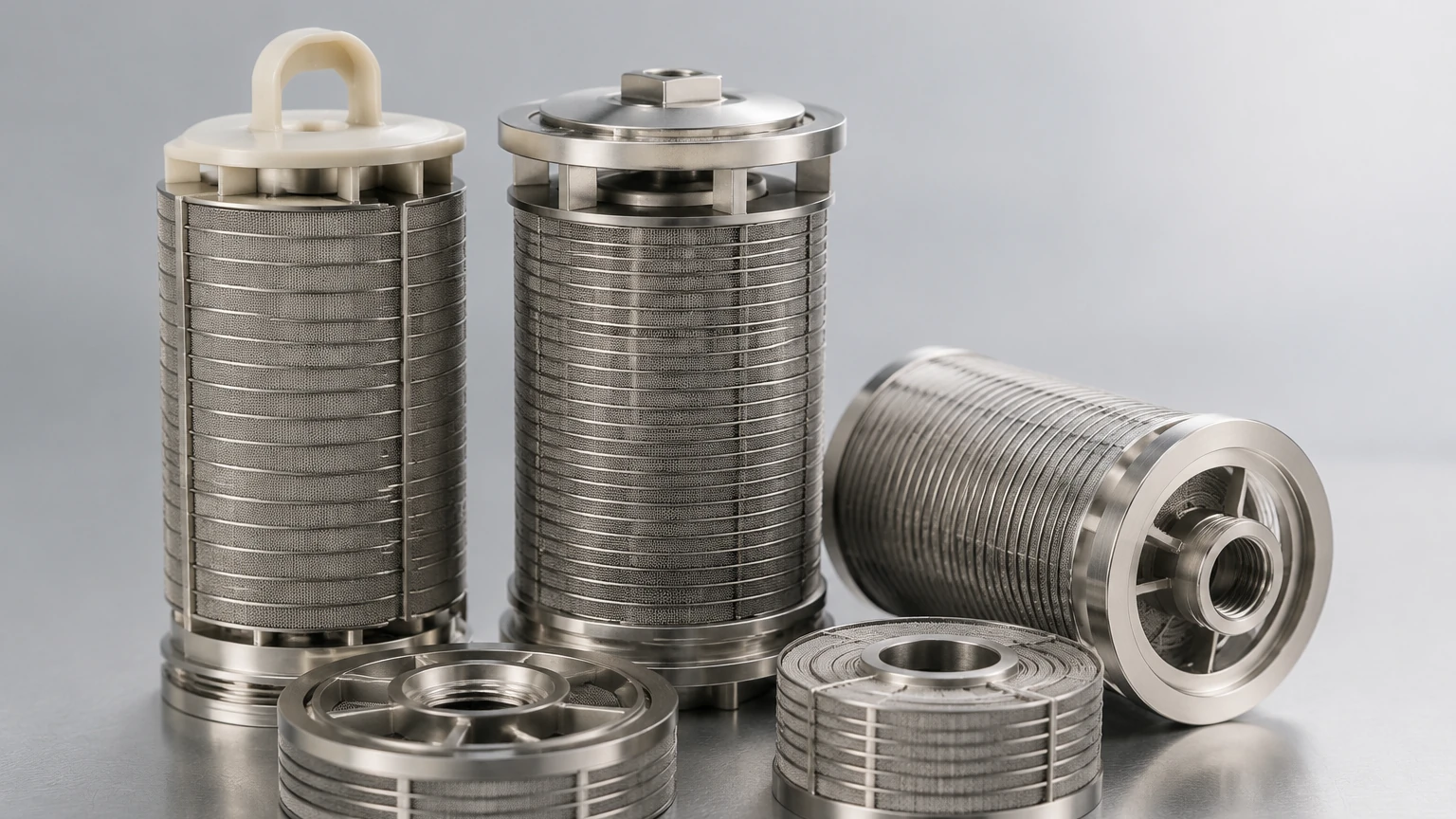
Comparative Analysis: Disc vs. Alternative Technologies
Engineers often must choose between disc filtration, pleated cartridges, and simple bag filters. Each has a specific role in industrial fluid management.
* Disc vs. Pleated Cartridges: While pleated cartridges offer very high surface area, they are often disposable. Metal disc filters, conversely, are typically cleanable and reusable. In high-temperature or highly aggressive chemical environments, the adhesives and gaskets used in pleated cartridges may fail, whereas all-welded metal discs remain functional.
* Disc vs. Bag Filters: Bag filters are excellent for high-solids loading and coarse filtration but lack the precision and pressure resistance of discs. Disc filtration is the superior choice when sub-20 micron accuracy is required in a pressurized system.
* Disc vs. Screen Filters: Standard screens are purely surface-based. Disc stacks can provide a degree of depth filtration, which is more effective at capturing deformable particles or "gel-like" contaminants that might otherwise extrude through a simple screen.
Operational Considerations: Cleaning and Maintenance
The total cost of ownership (TCO) for disc filtration is heavily influenced by the ease of maintenance. Unlike polymer filters that are discarded after a single use, stainless steel discs are designed for multiple cleaning cycles. This not only reduces the environmental impact but also lowers long-term procurement costs.
Cleaning Methods
1. Backwashing: Many disc filtration systems are designed for automated backwashing. By reversing the flow, the accumulated cake is dislodged from the surface of the discs.
2. Ultrasonic Cleaning: For fine-micron discs where particles may be deeply embedded in the mesh, ultrasonic baths use high-frequency sound waves to create cavitation bubbles that strip away contaminants without damaging the metal structure.
3. Chemical Cleaning: Discs used in the food and beverage or pharmaceutical industries can be subjected to Clean-in-Place (CIP) cycles using caustic or acidic solutions to remove organic fouling.
Replacement Cycles
While metal discs are durable, they are not infinite. Engineers should monitor the "recovered" pressure drop after cleaning. If the pressure drop does not return to near-baseline levels, it indicates permanent fouling or media compaction, signaling that the discs have reached the end of their service life.
Selection Guide for Technical Purchasing
Before finalizing a specification for disc filtration, purchasing teams and engineers should confirm several critical data points with their supplier:
* Fluid Characteristics: Viscosity, density, and chemical composition. High-viscosity fluids require larger pore sizes or increased surface area to maintain flow.
* Contaminant Profile: Is the debris hard (sand, metal chips) or soft (algae, biological matter)? This determines if a surface-heavy or depth-heavy disc structure is needed.
* Flow Rate Requirements: Maximum and average flow rates (GPM or m³/h) to ensure the housing and disc stack are sized correctly to avoid excessive velocity.
* Regulatory Compliance: For food or medical applications, ensure the materials are FDA-compliant or meet specific industry standards for purity and traceability.
The Role of Disc Filtration in Modern Industry
As industrial processes become more automated and sensitive to contamination, the demand for high-precision disc filtration continues to grow. In the semiconductor industry, for example, even microscopic particles can ruin a production batch. In the oil and gas sector, protecting expensive injection pumps from sand and scale is a multi-million dollar concern.
Disc filtration provides a scalable, high-strength solution to these challenges. By moving away from disposable media and toward engineered metal components, facilities can achieve more predictable filtration outcomes and better control over their operational budgets. The ability to clean and reuse these components aligns with modern sustainability goals while maintaining the rigorous standards required for high-stakes industrial manufacturing.
In conclusion, disc filtration is more than just a mechanical barrier; it is a precision-engineered component that must be matched to the specific demands of the application. By focusing on material integrity, EFA optimization, and long-term cleanability, engineers can implement filtration systems that provide consistent performance in the most demanding environments.
