


Disk Filter
In industrial filtration, the disk filter serves as a critical component for precision separation in liquid and gas streams. Unlike standard pleated cartridges, disk filters offer a compact, low-profile geometry that is ideal for high-pressure environments, space-constrained housings, and applications requiring frequent cleaning or replacement. For engineering and procurement teams, selecting the appropriate disk filter involves a detailed evaluation of material properties, mesh structures, and mechanical tolerances to ensure long-term operational efficiency.
As a specialized manufacturer, Kaifil provides stainless steel filtration solutions designed to meet the rigorous demands of chemical processing, hydraulic systems, and pharmaceutical manufacturing. Understanding the technical nuances of these components is essential for optimizing filtration performance and reducing the total cost of ownership.
Technical Construction of Metal Disk Filters
The performance of a disk filter is primarily determined by its internal structure and the method of assembly. In industrial settings, these filters are typically constructed from woven wire mesh or sintered metal fibers.
Single-Layer vs. Multi-Layer Designs
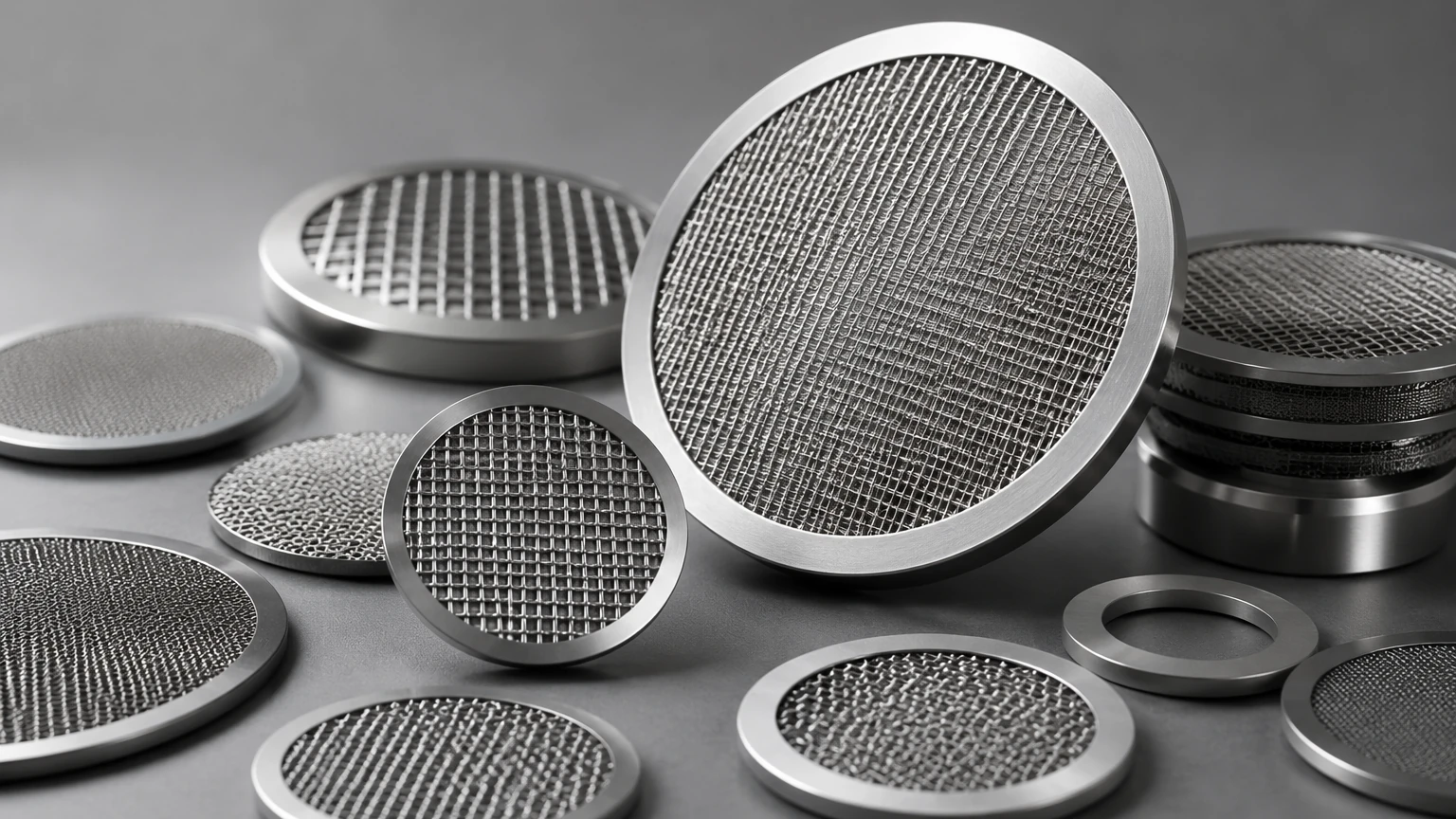
Single-layer disk filters consist of a single sheet of wire mesh, often used for coarse filtration or as a primary screen where high flow rates are prioritized over high dirt-holding capacity. However, for finer filtration requirements, multi-layer designs are standard. These involve stacking multiple layers of mesh—ranging from a fine filtration layer to coarser support layers.
Multi-layer disks are often sintered, a process where the layers are bonded together under high temperature and pressure without the use of adhesives. This creates a robust, integrated structure that prevents the migration of individual wires and maintains pore stability even under significant differential pressure. Sintered disks are preferred in pharmaceutical and food processing because they eliminate the risk of media migration and chemical leaching.
Edge Processing and Sealing
One of the most critical engineering aspects of a disk filter is the edge treatment. Without proper edging, the perimeter of the mesh can fray, leading to bypass or system contamination. Common edging methods include:
* Spot Welding: Used for simpler multi-layer stacks to maintain alignment.
* Aluminum or Stainless Steel Rimming: The mesh is encased in a metal U-section rim, which provides structural rigidity and a reliable sealing surface for the filter housing.
* Rubber or Synthetic Gaskets: In some low-temperature applications, edges are encapsulated in elastomers to provide a leak-proof seal.
Material Selection and Chemical Compatibility
Material choice is the foundation of filter durability. In industrial filtration, stainless steel is the industry standard due to its mechanical strength and resistance to thermal degradation.
Stainless Steel 304 and 316L
* Type 304: Suitable for general industrial use, providing good corrosion resistance against water and mild chemicals. It is a cost-effective choice for non-corrosive environments.
* Type 316L: The "L" denotes low carbon content, which is essential for components that undergo welding or sintering. 316L offers superior resistance to pitting and crevice corrosion, particularly in chloride-rich environments or acidic chemical processing. This material is standard for medical, pharmaceutical, and marine applications.
Specialized Alloys
For extreme environments where standard stainless steel fails, disk filters can be manufactured from high-performance alloys:
* Hastelloy: Used in highly aggressive chemical environments involving strong acids or high-temperature oxidation.
* Inconel: Ideal for high-heat applications, such as hot gas filtration, where the material must maintain structural integrity at temperatures exceeding 600°C.
* Monel: Frequently used in hydrofluoric acid alkylation and marine engineering due to its resistance to seawater and alkaline solutions.
Evaluating Filtration Performance Metrics
Engineers must look beyond the physical dimensions of a disk filter and focus on the fluid dynamics and particle retention capabilities.
Micron Rating: Absolute vs. Nominal
When specifying a disk filter, the distinction between absolute and nominal ratings is vital. A nominal rating refers to the ability of the filter to retain a certain percentage (usually 60% to 90%) of particles of a specific size. In contrast, an absolute rating indicates that 99.9% or more of particles above that size will be captured. For critical applications like hydraulic valve protection or catalyst recovery, absolute-rated sintered mesh disks are necessary to prevent downstream damage.
Pressure Drop and Flow Rate
The pressure drop ($ΔP$) across a disk filter is influenced by the pore size, the open area of the mesh, and the viscosity of the fluid. A common engineering challenge is balancing filtration fineness with flow capacity. A finer mesh increases the resistance to flow, leading to a higher initial pressure drop. To mitigate this, engineers often specify multi-layer sintered disks that utilize a high-porosity filtration layer supported by coarse mesh, allowing for high dirt-holding capacity without sacrificing flow efficiency.
Customization for OEM and Industrial Integration
Industrial filtration systems rarely use off-the-shelf components. Most disk filter applications require customization to fit specific housing geometries or performance envelopes.
Dimensional Tolerances
Precision is paramount when disk filters are used in high-pressure hydraulic manifolds or fuel injection systems. Manufacturers like Kaifil utilize advanced cutting technologies, such as laser cutting or precision stamping, to ensure that disk diameters and thicknesses meet strict tolerances. Even a deviation of a few microns can result in a bypass, rendering the filtration system ineffective.
Layer Configuration
Customization also extends to the layering strategy. For instance, a disk filter used in a polymer melt application might require a five-layer sintered structure: a fine filtration layer protected by two buffer layers and two outer support layers. This configuration prevents the fine mesh from deforming under the high viscosity and pressure of molten plastic.
Industrial Applications and Sector-Specific Requirements
The versatility of the metal disk filter makes it a staple across diverse industries. Each sector brings unique challenges that dictate the filter's design.
Chemical and Petrochemical Processing
In these environments, disk filters are used for catalyst recovery, solvent purification, and gas-liquid separation. The primary concern is chemical compatibility. Filters must withstand continuous exposure to corrosive agents while maintaining their pore structure. Sintered wire mesh disks are often preferred here because of their cleanability and resistance to high-pressure backwashing.
Food and Beverage Industry
Food-grade filtration requires materials that are non-toxic and easy to sterilize. Stainless steel 316L disk filters are commonly used in the production of edible oils, beverages, and dairy products. They must comply with FDA and international food safety standards, ensuring that no metal fragments or contaminants enter the product stream. The smooth surface of sintered mesh facilitates effective Clean-in-Place (CIP) procedures.
Hydraulic and Aerospace Systems
Hydraulic systems rely on disk filters to protect sensitive valves and actuators from particulate contamination. These filters are often integrated directly into the fluid path. Because these systems operate under high pressure and frequent vibration, the disk filter must have high fatigue resistance. Sintered metal fiber disks are particularly effective in these roles as they provide a high surface area in a very small footprint.
Maintenance, Cleaning, and Lifecycle Management
One of the primary advantages of stainless steel disk filters over disposable media is their reusability. However, realizing the full lifecycle value requires a structured maintenance approach.
Cleaning Methodologies
Depending on the contaminant, several cleaning methods can be employed:
* Ultrasonic Cleaning: High-frequency sound waves create cavitation bubbles that dislodge particles from deep within the mesh pores. This is the most effective method for sintered multi-layer disks.
* Backwashing: Reversing the flow of the fluid can remove surface-level cake. This is often automated in continuous process systems.
* Chemical Cleaning: Using specialized solvents or acids to dissolve organic or inorganic deposits. This requires careful verification that the cleaning agent is compatible with the filter material (e.g., ensuring the chemical does not cause stress-corrosion cracking in 304 stainless steel).
Determining Replacement Cycles
While metal filters are durable, they are not infinite. Over time, repeated cleaning and high-pressure cycles can lead to work hardening or permanent pore blockage (blinding). Engineers should monitor the "clean pressure drop" after each maintenance cycle. If the initial pressure drop after cleaning consistently exceeds 20-30% of the original specification, it indicates that the media is reaching the end of its functional life and should be replaced to avoid excessive energy consumption and potential media failure.
Procurement Checklist for Engineering Teams
Before finalizing a purchase order for disk filters, technical professionals should confirm the following parameters with their manufacturer:
1. Media Type: Is woven wire mesh, sintered mesh, or sintered fiber felt more appropriate for the specific particle morphology?
2. Micron Rating Type: Is the requirement for absolute or nominal filtration?
3. Operating Environment: What are the maximum operating temperatures and the full chemical composition of the fluid?
4. Mechanical Load: What is the maximum allowable differential pressure before the disk deforms?
5. Sealing Interface: How will the disk be seated in the housing to prevent bypass?
For technical teams seeking reliable manufacturing partners, reviewing the capabilities and material options available is a necessary step. To explore specific product configurations and engineering support for custom filtration projects, professionals can visit the Main Page of the Kaifil website.
Conclusion
The industrial disk filter is a high-precision tool that demands careful engineering and material selection. By understanding the differences between single-layer and sintered multi-layer designs, and by selecting materials like 316L for their specific chemical resistance, organizations can ensure the reliability of their filtration processes. Whether used in a hydraulic system or a chemical reactor, a well-specified disk filter provides the necessary balance of filtration accuracy, durability, and cost-effectiveness. Working closely with a manufacturer like Kaifil ensures that these components are tailored to the exact needs of the application, providing long-term value in demanding industrial environments.
