


Duplex Basket Filter
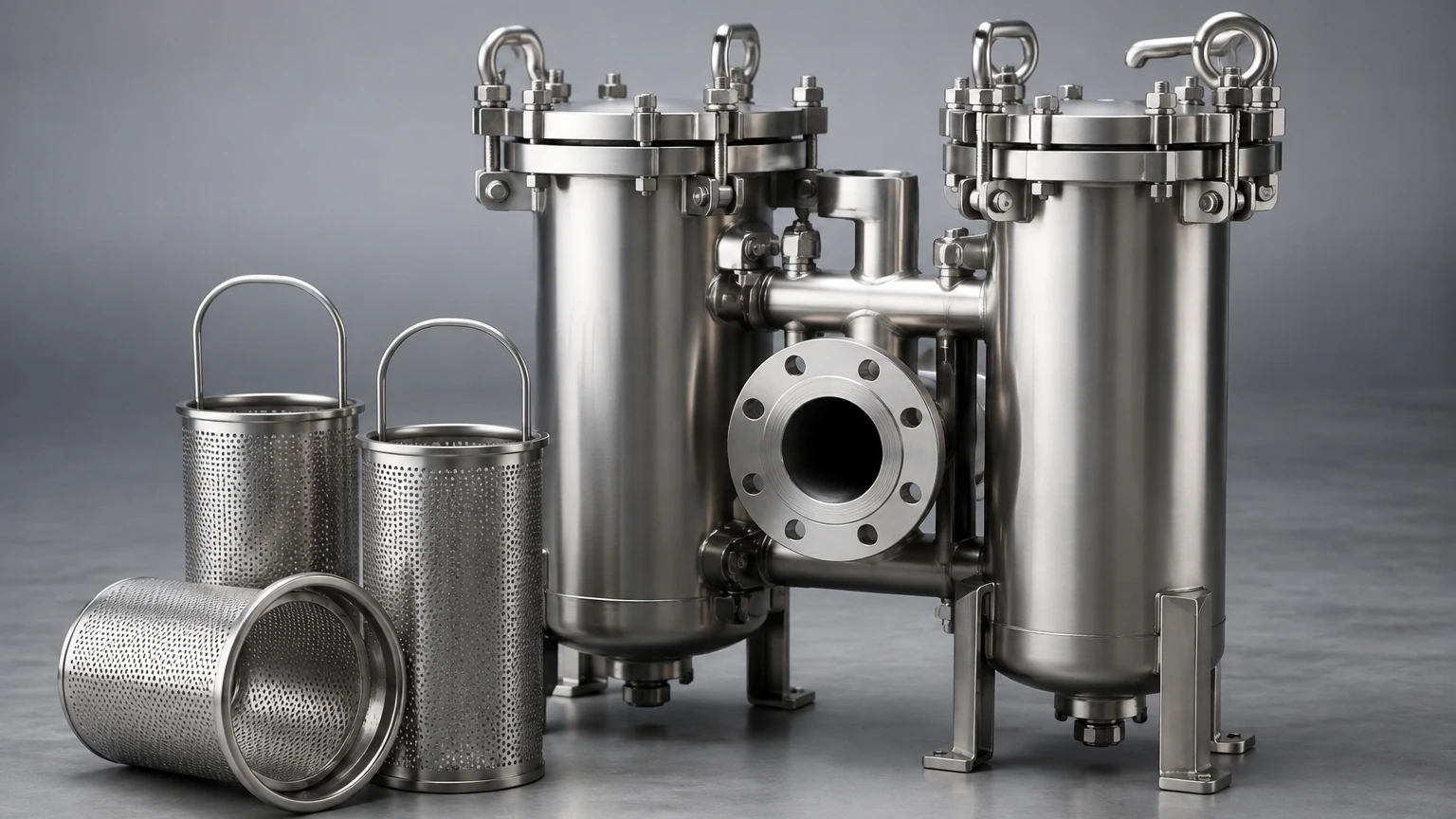
In industrial fluid processing, maintaining continuous flow is often a critical requirement for operational efficiency and equipment protection. A duplex basket filter, also known as a twin basket strainer, is an essential component designed to remove solid contaminants from liquids without interrupting the process flow. Unlike simplex strainers, which require a system shutdown for basket cleaning, the duplex configuration utilizes two separate filter chambers connected by a diversion valve. This allows one chamber to remain in operation while the other is isolated for maintenance, cleaning, or basket replacement.
For engineers and procurement teams, selecting the right duplex basket filter involves a deep understanding of fluid dynamics, material compatibility, and the specific mechanical requirements of the application. As a specialized manufacturer of stainless steel filtration solutions, Kaifil provides high-performance components that meet these rigorous industrial standards. Detailed technical specifications and customization options for these systems can be explored on our Main Page.
Engineering Principles of Duplex Filtration
The primary advantage of a duplex basket filter is its ability to provide 24/7 filtration. The system's architecture consists of two identical housings, an inlet and outlet manifold, and a changeover valve assembly.
The Changeover Mechanism
The heart of the duplex system is the diversion valve. Depending on the flow rate and pressure requirements, several valve types are commonly utilized:
1. Plug Valves: These are often used in smaller or medium-sized duplex filters. A single lever rotates a tapered or cylindrical plug to redirect flow between chambers. They offer a simple, robust design but may require higher torque at elevated pressures.
2. Ball Valves: Utilizing a multi-port ball design, these valves provide excellent sealing and ease of operation. They are frequently used in high-pressure hydraulic and chemical applications.
3. Butterfly Valves: In large-diameter piping systems, four butterfly valves (two per chamber) are often linked by a common actuator or linkage. This setup is efficient for high-volume flow but requires precise synchronization to prevent pressure spikes during transition.
Flow Continuity and Pressure Equalization
During the switchover process, it is vital to avoid "water hammer" or sudden pressure drops. High-quality duplex basket filters often include a pressure equalization line. This small bypass line allows the idle, clean chamber to be filled and pressurized before it is brought online, ensuring a seamless transition and protecting downstream sensitive equipment like pumps and flow meters.
Material Selection and Construction Standards
In industrial environments, the durability of a filter housing and its internal elements is dictated by the chemical properties of the fluid and the external operating conditions.
Housing Materials
Stainless steel is the industry standard for duplex basket filters due to its superior corrosion resistance and structural integrity.
* SS304: Suitable for water treatment, food and beverage, and general industrial applications where moderate corrosion resistance is required.
* SS316L: The preferred choice for chemical processing, pharmaceutical production, and marine environments. The addition of molybdenum provides enhanced resistance to chlorides and acidic solutions.
Filter Element Construction
The internal basket is the most critical component for filtration accuracy. It typically consists of a perforated metal support cage lined with a precision wire mesh.
* Perforated Plate: Provides the structural strength to withstand high differential pressures. Hole sizes usually range from 1/32" to 1/4".
* Wire Mesh Liners: For finer filtration, stainless steel wire mesh is sintered or welded to the support basket. This allows for filtration ratings from 5 microns up to 2000 microns.
* Magnetic Inserts: In hydraulic and machining applications, magnetic rods can be placed inside the basket to capture fine ferrous particles that might otherwise pass through the mesh.
Performance Metrics: Pressure Drop and Micron Ratings
When specifying a duplex basket filter, engineers must balance filtration efficiency with the system's energy consumption. The two primary metrics are the micron rating and the differential pressure ($ΔP$).
Understanding Micron Ratings
The micron rating defines the size of particles the filter can trap. It is important to distinguish between "nominal" and "absolute" ratings. A nominal rating indicates the filter's ability to trap a major percentage of particles of a given size, while an absolute rating (often achieved through high-precision wire mesh) implies that 99.9% of particles above that size will be retained. For critical applications like nozzle protection or fuel filtration, absolute ratings are generally required.
Calculating Differential Pressure
Every filter introduces a restriction to the flow, resulting in a pressure drop. The total pressure drop is the sum of the drop across the housing and the drop across the clean filter basket.
Factors affecting $ΔP$ include:
* Fluid Viscosity: Higher viscosity fluids (like heavy oils) result in a higher pressure drop.
* Flow Velocity: Pressure drop increases with the square of the flow velocity.
* Contaminant Loading: As the basket collects debris, the effective open area decreases, causing $ΔP$ to rise.
Industrial standards typically recommend cleaning or switching the basket when the differential pressure reaches 10-15 psi (0.7-1.0 bar). Operating beyond this "terminal pressure drop" risks basket collapse or bypassing of the seal.
Maintenance Protocols and Operational Safety
The ability to maintain a duplex basket filter while the system is live is its greatest asset, but it requires strict adherence to safety protocols to prevent accidents, especially when dealing with high-temperature or hazardous fluids.
The Cleaning Cycle
1. Detection: Differential pressure gauges or transmitters signal when the active chamber is clogged.
2. Switchover: The operator moves the valve handle to redirect flow to the clean, standby chamber.
3. Venting and Draining: Before opening the isolated chamber, it must be depressurized. The vent valve on the top of the cover is opened first, followed by the drain valve at the bottom to remove the fluid.
4. Basket Removal: The cover (often a quick-opening swing bolt or bolted flange) is removed, and the dirty basket is lifted out.
5. Inspection: The basket should be inspected for signs of damage, such as torn mesh or distorted frames. The seals (O-rings or gaskets) should also be checked for wear.
Sealing and Gasket Considerations
To prevent external leakage and internal bypassing, the choice of sealing material is paramount. Common options include Nitrile (Buna-N) for general oil and water service, EPDM for steam and polar solvents, and Viton (FKM) for high-temperature and aggressive chemical applications.
Industrial Applications and Selection Guidelines
Duplex basket filters are utilized across a broad spectrum of industries where downtime is not an option.
* Chemical Processing: Protecting heat exchangers and reactors from scale and particulate matter in corrosive chemical loops.
* Power Generation: Filtering cooling water for turbines and lubricating oils for large rotating machinery.
* Food and Beverage: Removing pulp, skins, or foreign objects from liquid products while maintaining hygienic standards.
* Marine and Offshore: Essential for fuel oil, lube oil, and seawater cooling systems on ships where engine failure due to contamination can be catastrophic.
* Pulp and Paper: Filtering process water and coatings to prevent nozzle clogging in paper machines.
Selection Checklist for Engineers
Before purchasing a duplex basket filter, technical teams should confirm the following parameters:
* Design Pressure and Temperature: Must exceed the maximum possible system spikes.
* Connection Type: Flanged (ANSI, DIN, JIS) or threaded (NPT, BSP).
* Flow Rate (GPM or m³/h): Ensure the housing size is sufficient to keep initial pressure drop low.
* Fluid Properties: Specific gravity, viscosity, and chemical compatibility with SS304/316L.
* Space Constraints: Duplex filters have a larger footprint than simplex units; ensure adequate clearance for basket removal.
Customization and Engineering Support
Standard off-the-shelf filters may not always meet the unique demands of specialized industrial processes. Customization is often required for non-standard pipe sizes, specific micron ratings, or unique housing geometries.
Kaifil specializes in engineering custom stainless steel filtration components that integrate seamlessly into complex systems. Whether the requirement is for a specific mesh weave, reinforced basket structures for high-pressure differentials, or specialized surface finishes for pharmaceutical applications, our manufacturing capabilities ensure high-performance results. By focusing on precision metal filter components, we help engineers optimize their filtration efficiency and reduce the total cost of ownership through durable, cleanable, and reusable filter elements.
For more information on our full range of industrial filtration solutions and to discuss your specific project requirements with our engineering team, please visit our Main Page.
