


Duplex Basket Strainers
In industrial fluid handling, the requirement for continuous operation is often a non-negotiable parameter. Whether in chemical processing, power generation, or large-scale water treatment, system downtime for routine maintenance can lead to significant production losses and operational inefficiencies. Duplex basket strainers are engineered specifically to address this challenge. By utilizing a dual-chamber design, these filtration units allow for the cleaning or replacement of filter elements without interrupting the flow of the process fluid.
As a specialized manufacturer of stainless steel filtration solutions, Kaifil provides precision-engineered components that form the core of high-performance duplex systems. Understanding the technical nuances of these strainers—from valve mechanisms to material compatibility—is essential for engineers and procurement teams tasked with maintaining system integrity and optimizing total cost of ownership.
The Engineering Logic of Duplex Filtration
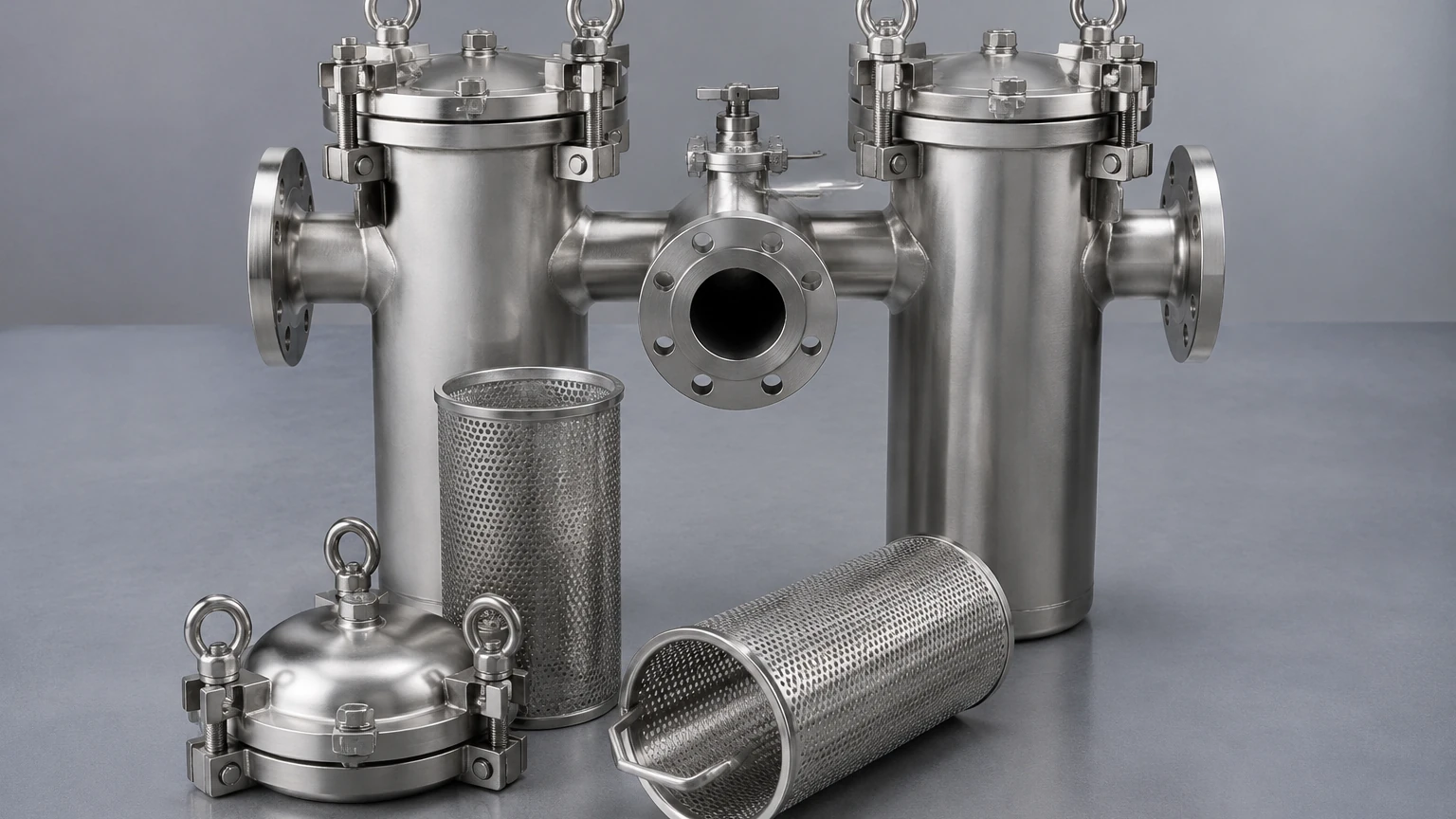
The fundamental advantage of duplex basket strainers lies in their redundancy. Unlike simplex strainers, which require a system shutdown or a bypass line to service the filter basket, a duplex system incorporates two separate strainer chambers connected by a common manifold. A diverter valve assembly directs the fluid flow into one chamber while the other remains isolated and depressurized.
Diverter Valve Mechanisms
The efficiency of a duplex strainer is largely determined by the type of diverter valve used to switch flow between chambers. There are three primary configurations used in industrial applications:
1. Plug Valves: These are common in many standard duplex designs. A tapered or cylindrical plug rotates within the housing to block one port while opening the other. They are valued for their simplicity and robustness in high-pressure environments.
2. Ball Valves: Often used in smaller or high-precision systems, ball valves provide a tight seal and quick operation. They are particularly effective when handling fluids that require a high degree of shut-off integrity to prevent cross-contamination between the active and idle chambers.
3. Sliding Gate or Butterfly Valves: In very large diameter piping systems, sliding gates or butterfly valves may be employed to manage flow diversion. These are typically chosen when space constraints or specific flow coefficients (Cv) are the primary engineering concerns.
For technical professionals, the selection of the valve mechanism must account for the viscosity of the fluid and the required speed of the changeover. A well-designed valve ensures a "no-leak" transition, preventing pressure spikes or flow cavitation during the switch.
Critical Components: The Stainless Steel Filter Basket
While the housing and valves provide the structural framework, the actual filtration occurs within the basket. The performance of duplex basket strainers is directly tied to the quality and configuration of these internal elements. Kaifil specializes in manufacturing these critical components, focusing on durability and filtration accuracy.
Material Selection
Stainless steel is the industry standard for duplex strainer baskets due to its mechanical strength and resistance to corrosion. Common grades include:
* 304 Stainless Steel: Suitable for general industrial applications, including water treatment and non-corrosive chemical handling.
* 316/316L Stainless Steel: The preferred choice for pharmaceutical, food and beverage, and marine environments. The addition of molybdenum provides enhanced resistance to pitting and crevice corrosion in chloride-rich environments.
* Specialty Alloys: For highly aggressive chemical processes, baskets may be fabricated from Hastelloy or Monel, though stainless steel remains the most versatile and cost-effective solution for the majority of B2B applications.
Basket Construction and Micron Ratings
Baskets are typically constructed using a combination of perforated metal for structural support and a fine wire mesh lining for precision filtration. The "open area ratio" is a critical metric here; it represents the ratio of the total area of the holes in the basket to the cross-sectional area of the inlet pipe. A higher ratio—typically 6:1 or greater—results in lower pressure drops and longer intervals between cleanings.
Engineers must specify the required micron rating based on the smallest particle size that needs to be removed to protect downstream equipment like pumps, nozzles, and heat exchangers. You can Review product options and application support on the Kaifil Main Page to determine the appropriate mesh density and structural reinforcement for your specific flow requirements.
Performance Evaluation: Flow Rate and Pressure Drop
One of the most common errors in specifying duplex basket strainers is improper sizing based solely on pipe diameter. Correct sizing must be based on the flow rate, fluid viscosity, and the maximum allowable pressure drop (ΔP).
Calculating Differential Pressure
As debris accumulates in the active basket, the differential pressure across the strainer increases. Most industrial duplex systems are equipped with a differential pressure gauge or switch. A typical rule of thumb is to size the strainer so that the initial "clean" pressure drop does not exceed 2 psi (0.14 bar). The basket should be cleaned or the flow diverted when the ΔP reaches approximately 10-15 psi, depending on the structural limits of the basket and the requirements of the downstream process.
The Impact of Viscosity
Fluid viscosity has a significant impact on pressure drop. High-viscosity fluids, such as heavy oils or resins, move more slowly through the filter media and create higher resistance. In these cases, larger housings or coarser mesh may be required to maintain the desired flow rate without exceeding pressure limits. Engineering teams should always provide the fluid's centipoise (cP) or Saybolt Universal Seconds (SUS) values during the procurement phase to ensure the duplex system is sized correctly.
Operational Safety and Maintenance Protocols
The primary benefit of duplex basket strainers is the ability to perform maintenance safely while the system is online. However, this requires strict adherence to operational protocols to prevent accidents and equipment damage.
The Changeover Process
When the differential pressure indicates that the active basket is full, the operator follows these general steps:
1. Equalize Pressure: Many duplex strainers feature an equalization line. Opening this valve allows fluid to fill the idle chamber gradually, preventing a sudden pressure drop or water hammer when the main diverter valve is turned.
2. Divert Flow: The main handle or actuator is moved to shift the flow to the clean chamber. Modern designs often include an arrow or indicator to show which chamber is currently in service.
3. Vent and Drain: Before opening the idle chamber, it must be vented to atmosphere and drained of fluid. This is a critical safety step, especially when handling hazardous chemicals or high-temperature fluids.
4. Basket Cleaning: The cover is removed (often via quick-opening swing bolts), and the basket is lifted out. It is cleaned using a pressure washer, ultrasonic bath, or chemical solvent, depending on the nature of the contaminants.
Seal Integrity
The seals and O-rings in the chamber covers and valve assembly are wear items. Common materials include Buna-N, EPDM, Viton, and PTFE. Selecting the right seal material is essential for preventing external leaks and internal bypass. During every basket cleaning, seals should be inspected for signs of compression set, swelling, or cracking.
Industry Applications for Duplex Systems
Duplex basket strainers are utilized across a broad spectrum of industries where process continuity is vital:
* Chemical Processing: Protecting expensive reactors and catalysts from particulate contamination. Stainless steel construction ensures compatibility with a wide range of reagents.
* Power Generation: Filtering cooling water from rivers or lakes to protect condenser tubes and heat exchangers from debris like sand, silt, and biological matter.
* Marine Engineering: Used in fuel oil and lube oil systems on ships, where a clogged filter could lead to engine failure in open water.
* Pulp and Paper: Managing white water and coating fluids where high solids loading requires frequent cleaning cycles.
* Water Treatment: Serving as pre-filtration for membrane systems (RO/UF) to extend the life of delicate filter media.
Customization and OEM Solutions
Standard off-the-shelf duplex strainers may not always meet the specific spatial or performance constraints of a complex industrial installation. This is where custom manufacturing becomes a strategic advantage. As an experienced provider of filtration components, Kaifil works with engineers to develop tailored solutions that might include:
* Custom Flange Configurations: Matching existing piping layouts to minimize installation costs.
* Reinforced Baskets: Designing internal elements to withstand high differential pressures without collapsing.
* Specialized Coatings: Applying internal linings for extreme chemical resistance.
* Automated Changeover: Integrating electric or pneumatic actuators with the facility’s control system (PLC) for remote operation based on differential pressure triggers.
When evaluating a supplier for duplex basket strainers, it is important to confirm their capability to handle both the structural housing requirements and the precision manufacturing of the internal mesh elements. A manufacturer that understands the interplay between the two can provide a more reliable and efficient filtration solution.
Conclusion: Selecting the Right Partner
Investing in duplex basket strainers is a decision that impacts the long-term reliability of an industrial facility. By allowing for continuous flow and providing a robust barrier against particulate contamination, these units protect downstream assets and reduce the total cost of maintenance.
Successful implementation requires a deep understanding of fluid dynamics, material science, and mechanical engineering. Engineers should prioritize suppliers who offer technical transparency, detailed performance data, and the ability to customize components to meet unique application challenges. For more information on high-performance stainless steel filtration components and customized industrial solutions, visit the Kaifil Main Page to explore our technical capabilities and product range. Ensuring that your duplex system is equipped with precision-engineered baskets and reliable valve mechanisms is the first step toward achieving optimized filtration performance and operational peace of mind.
