


Duplex Water Strainer
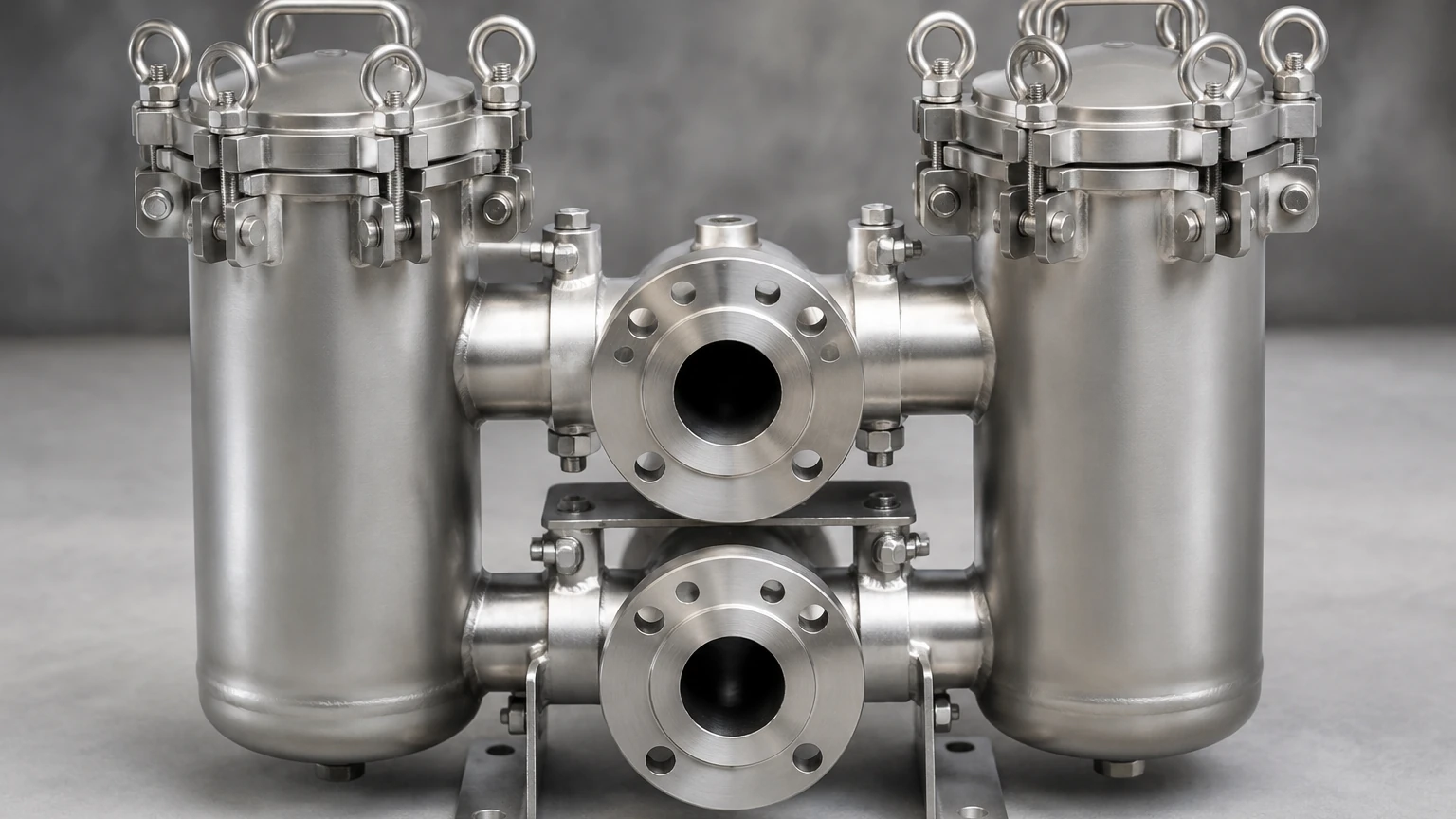
In industrial fluid handling, the ability to maintain continuous operation while protecting downstream equipment from particulate contamination is a critical engineering requirement. The duplex water strainer serves as a primary solution for systems where flow cannot be interrupted for maintenance. Unlike simplex strainers, which require a system shutdown to clean or replace the filter element, a duplex configuration utilizes two separate chambers connected by a common valve assembly. This design allows one chamber to remain in operation while the other is isolated for cleaning, ensuring 24/7 uptime for critical infrastructure.
For engineers and procurement teams, selecting the correct duplex water strainer involves more than simply matching pipe sizes. It requires a deep understanding of fluid dynamics, material compatibility, and the specific filtration demands of the application. As a professional manufacturer of custom stainless steel filtration solutions, Kaifil provides the technical expertise necessary to integrate these components into complex industrial environments.
Engineering and Design: The Dual-Chamber Advantage
The fundamental architecture of a duplex water strainer consists of two filter housings, an inlet and outlet manifold, and a change-over valve mechanism. The valve is the heart of the system, responsible for diverting the flow between the two housings. Depending on the application requirements, these valves may be manual or automated.
The Change-Over Mechanism
In most industrial duplex strainers, a plug valve or a sliding gate valve is used to manage the transition. The engineering goal is to ensure a "no-leak" seal on the isolated side while maintaining a constant flow path on the active side. High-quality duplex systems are designed with a "synchronized" valve movement, which prevents flow restriction during the switch-over process. This is particularly important in hydraulic systems and cooling loops where a sudden drop in pressure could trigger safety alarms or equipment failure.
Basket Design and Flow Path
Inside each chamber is a strainer basket, typically constructed from perforated metal or stainless steel wire mesh. The fluid enters the basket from the top or side, passes through the mesh, and exits through the outlet. The debris is trapped inside the basket, making it easy to remove and clean once the chamber is isolated. Engineers must evaluate the "open area ratio"—the ratio of the total area of the holes in the basket to the cross-sectional area of the inlet pipe. A higher ratio generally leads to a lower initial pressure drop and longer intervals between cleanings.
Material Selection and Chemical Compatibility
Material integrity is paramount when dealing with industrial water systems, which may contain corrosive chemicals, high-temperature fluids, or abrasive solids. Stainless steel is the industry standard for high-performance duplex water strainers due to its superior mechanical properties and resistance to oxidation.
Stainless Steel Grades
* 304 Stainless Steel: Suitable for general-purpose water filtration, food and beverage applications, and non-corrosive industrial fluids. It provides excellent durability and is cost-effective for standard environments.
* 316/316L Stainless Steel: Contains molybdenum, which enhances resistance to chloride-induced pitting and crevice corrosion. This is the preferred material for pharmaceutical processing, chemical plants, and applications involving brackish water or marine environments.
* Specialty Alloys: For highly aggressive chemical processing, manufacturers may utilize Duplex stainless steels or high-nickel alloys to ensure the longevity of the strainer body and internal components.
Sealing and Gaskets
The choice of sealing material is equally critical. O-rings and gaskets must be compatible with the fluid's chemical composition and temperature. Common materials include EPDM for general water service, Viton (FKM) for high-temperature and chemical resistance, and PTFE for extreme chemical inertness. Failure to select the correct seal can lead to bypass leakage, which compromises the entire filtration process.
Technical Specifications: Micron Ratings and Pressure Drop Management
Defining the performance of a duplex water strainer requires a precise look at filtration accuracy and hydraulic efficiency. The main objective is to remove particles of a specific size without creating an excessive barrier to flow.
Understanding Micron Ratings
Filtration accuracy is measured in microns (μm). A duplex water strainer can be fitted with various mesh linings to achieve the desired level of clarity.
* Coarse Filtration (500μm – 5mm): Used for protecting pumps and heat exchangers from large debris like stones, scale, and wood chips.
* Fine Filtration (25μm – 500μm): Used in process water loops, nozzle protection, and pre-filtration for more sensitive membrane systems.
Engineers must balance the desire for fine filtration with the reality of pressure drop. The finer the mesh, the faster the basket will clog, leading to more frequent change-overs.
Calculating Pressure Drop (ΔP)
Pressure drop is the difference in pressure between the inlet and outlet of the strainer. It is influenced by fluid velocity, viscosity, and the percentage of the basket that is clogged. Most systems are designed with an initial "clean" pressure drop of less than 2-3 psi. Once the pressure drop reaches a predetermined limit (often 10-15 psi), the operator or an automated sensor triggers the switch to the standby chamber. Monitoring ΔP is the most effective way to ensure the duplex water strainer is operating within its design parameters.
Application-Specific Considerations in Industrial Sectors
Different industries impose unique demands on filtration hardware. A duplex water strainer must be tailored to the specific regulatory and operational needs of the sector it serves.
Food and Beverage Industry
In food and beverage production, hygiene is the top priority. Strainers must be designed with smooth internal surfaces to prevent bacterial growth and must be capable of withstanding Clean-in-Place (CIP) procedures. Stainless steel components with sanitary finishes and specialized connections (such as Tri-Clamp) are standard in these applications.
Chemical and Pharmaceutical Processing
These sectors often deal with hazardous or high-purity fluids. The duplex water strainer must provide absolute containment and reliable isolation. In pharmaceutical settings, material traceability (MTRs) and compliance with standards like USP Class VI for seals are often required. The ability to customize the internal filter cartridges allows for precise control over product purity.
Hydraulic and Cooling Systems
In heavy machinery and power generation, duplex strainers protect sensitive hydraulic valves and heat exchanger tubes. These systems often operate at high pressures, requiring robust housing designs and reinforced strainer baskets that can withstand high differential pressures without collapsing.
Maintenance Protocols and Operational Safety
The primary advantage of a duplex water strainer is the ability to perform maintenance without stopping the process. However, this requires strict adherence to safety protocols to prevent accidental exposure to pressurized fluids.
The Change-Over Process
1. Equalize Pressure: Before switching, a small bypass valve is often used to fill the standby chamber with fluid and equalize the pressure. This prevents a sudden pressure surge (water hammer) when the main valve is turned.
2. Divert Flow: The handle or actuator is moved to the standby chamber.
3. Vent and Drain: The isolated chamber is vented to atmospheric pressure and drained of fluid.
4. Clean the Basket: The cover is removed, and the basket is cleaned or replaced.
Replacement Cycles
While stainless steel baskets are durable, they are not permanent. Over time, repeated cleaning and exposure to high-velocity particles can cause wire fatigue or mesh blinding. Facilities should maintain a stock of replacement baskets to ensure that a clean element is always ready for the next cycle. Regular inspection of the valve seats and seals is also necessary to prevent internal bypassing between the two chambers.
Customization and OEM Solutions for Specialized Filtration
Standard off-the-shelf strainers may not meet the requirements of every industrial application. Customization is often necessary to accommodate specific space constraints, unusual flow rates, or unique fluid properties. As a specialized manufacturer, Kaifil works closely with engineering teams to develop bespoke filtration components.
Tailored Engineering
Customization options include specialized inlet/outlet orientations, the addition of differential pressure sensors, and the integration of automated backwash systems. For OEM applications, the strainer can be designed to fit within a specific machine footprint, utilizing custom mounting brackets and connection types. By focusing on precision metal filter components and wire mesh filters, manufacturers can provide a level of filtration accuracy that standard cast-body strainers cannot achieve.
Total Cost of Ownership (TCO)
When evaluating a duplex water strainer, it is important to look beyond the initial purchase price. The TCO includes the cost of replacement parts, the labor required for maintenance, and the potential cost of downtime if the strainer fails. Investing in a high-quality stainless steel duplex system from a reliable manufacturer ensures long-term reliability and reduces the frequency of component replacement.
For engineers and purchasing professionals seeking reliable, high-performance filtration hardware, understanding these technical nuances is the first step toward optimizing system performance. To review product options and application support, or to discuss specific customization requirements for your project, visit the Main Page.
Conclusion
The duplex water strainer is an indispensable component in modern industrial fluid management. By providing a redundant filtration path, it eliminates the need for costly system shutdowns and protects expensive downstream equipment from damage. Whether used in chemical processing, water treatment, or food production, the success of a duplex strainer depends on proper material selection, accurate micron sizing, and a robust mechanical design. Working with an experienced manufacturer like Kaifil allows industrial operators to secure filtration solutions that are precisely engineered for their most demanding applications.
