


Flue Gas Filter
In industrial combustion and chemical processing, managing exhaust streams is a critical requirement for both environmental compliance and equipment protection. A flue gas filter serves as the primary barrier against particulate matter, heavy metals, and corrosive aerosols that are generated during high-temperature operations. Unlike standard air filtration, flue gas treatment involves navigating extreme thermal conditions, fluctuating pressure differentials, and chemically aggressive environments. For engineers and procurement teams, selecting the appropriate filtration media is not merely a matter of efficiency ratings; it is a complex balancing act between material science, mechanical design, and long-term operational costs.
Industrial facilities, ranging from waste-to-energy plants to chemical refineries, rely on robust filtration systems to ensure that emissions meet stringent regulatory standards while protecting downstream components like heat exchangers and turbines. As a manufacturer specializing in stainless steel filtration, Kaifil provides the technical expertise and precision components necessary to address these demanding applications. To explore the full range of industrial filtration capabilities, engineers can visit the Main Page for detailed product specifications and application support.
The Role of Flue Gas Filters in Industrial Emission Control
The primary function of a flue gas filter is the removal of fly ash and other solid particulates from combustion gases before they are released into the atmosphere or moved to secondary treatment stages. In many B2B industrial contexts, the "flue gas" is not just smoke; it is a complex mixture of nitrogen, carbon dioxide, water vapor, and oxygen, often laced with pollutants such as sulfur oxides (SOx), nitrogen oxides (NOx), and particulate matter (PM).
Effective filtration at this stage is vital for several reasons. First, it prevents the accumulation of abrasive particles in ductwork and fans, which can lead to mechanical wear and premature failure. Second, it facilitates the recovery of valuable catalysts or products in chemical processing environments. Finally, it ensures that the facility adheres to environmental mandates regarding opacity and particulate concentration. Because flue gases often exit combustion chambers at temperatures exceeding 250°C (482°F), traditional polymer-based filter bags often reach their thermal limits, making stainless steel and metal mesh filters the preferred choice for high-durability applications.
Material Selection for High-Temperature Flue Gas Environments
When specifying a flue gas filter, the choice of material is perhaps the most critical engineering decision. The filter must maintain its structural integrity and filtration accuracy while exposed to continuous thermal cycling and potentially corrosive gasses. Stainless steel remains the industry standard due to its excellent mechanical properties and resistance to oxidation.
Grade 304 and 316L Stainless Steel
For most standard industrial flue gas applications, Grade 304 stainless steel offers a cost-effective solution with adequate heat resistance. However, in environments where the gas stream contains higher concentrations of chlorides or sulfur compounds, Grade 316L is preferred. The addition of molybdenum in 316L provides superior resistance to pitting and crevice corrosion, which is particularly important if the gas temperature drops near the dew point, causing acidic vapors to condense on the filter surface.
High-Nickel Alloys and Inconel
In extreme cases, such as specialized chemical incineration or high-temperature metal smelting, standard stainless steels may undergo rapid oxidation or scaling. In these scenarios, engineers may specify high-nickel alloys or Inconel. These materials maintain their tensile strength at much higher temperatures and offer exceptional resistance to carburization and nitriding, ensuring the filter does not become brittle over time.
Technical Specifications and Engineering Parameters
To ensure a flue gas filter performs as expected, several technical parameters must be defined during the design phase. These factors influence the physical footprint of the filtration system, the energy required to move gas through the media, and the frequency of maintenance cycles.
1. Micron Rating and Filtration Efficiency: This defines the size of the smallest particle the filter is designed to capture. For flue gas, sub-micron particles are often the target, requiring precision-woven wire mesh or sintered metal fiber media. Engineers must determine if the application requires absolute filtration or nominal filtration based on the downstream sensitivity.
2. Permeability and Pressure Drop (ΔP): A filter with low permeability will cause a high pressure drop, forcing the system’s induction fans to work harder and consume more energy. The goal is to maximize the surface area—often through pleating or multi-layer mesh designs—to maintain high flow rates while keeping the ΔP within acceptable limits.
3. Face Velocity: This is the speed at which the gas approaches the filter surface. If the velocity is too high, particles may be forced through the media (breakthrough) or become deeply embedded, making the filter difficult to clean. Proper sizing of the filter housing is essential to maintain an optimal face velocity.
4. Structural Rigidity: Flue gas streams can be turbulent. The filter elements must be designed with internal supports or outer cages to prevent collapsing or deforming under high differential pressure or mechanical vibration.
Comparing Metal Mesh Filters with Traditional Fabric Media
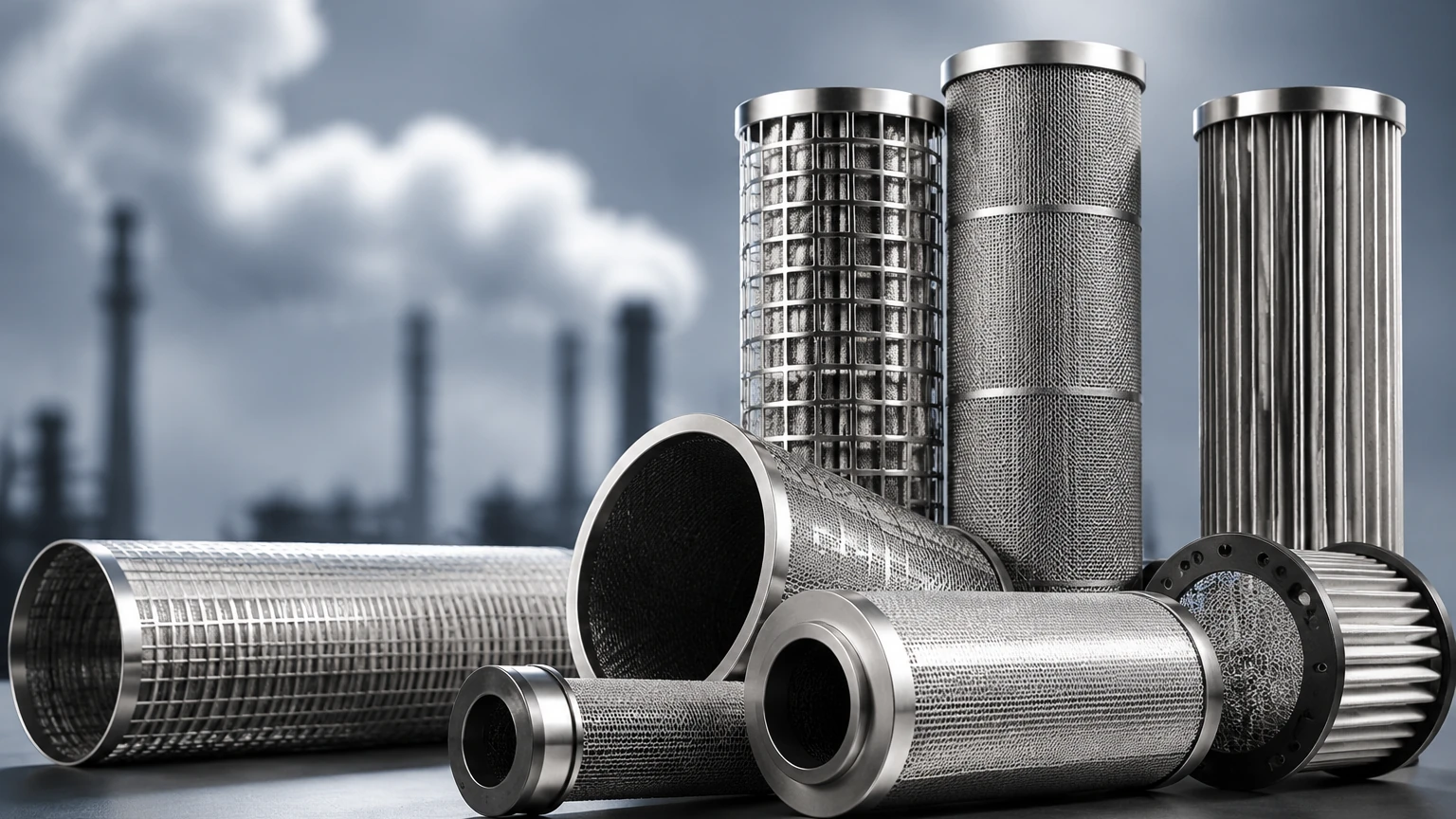
In the B2B filtration market, engineers often choose between fabric "baghouse" filters and rigid metal filters. While fabric filters are common in low-temperature, non-corrosive applications, metal flue gas filters offer distinct advantages in demanding industrial settings.
* Thermal Stability: Fabric filters (made of polyester, aramid, or PTFE) have strict temperature ceilings. Exceeding these limits can cause the bags to melt or catch fire. Metal filters can operate at significantly higher temperatures, often eliminating the need for expensive gas-cooling equipment upstream of the filter.
* Chemical Resilience: Many flue gas streams are chemically active. While PTFE coatings can protect fabric bags, they are prone to mechanical damage. Stainless steel filters provide inherent chemical resistance throughout the entire thickness of the media.
* Cleaning and Regeneration: Metal filters are highly compatible with pulse-jet cleaning systems. The rigidity of the metal allows for high-pressure back-pulsing to dislodge the filter cake effectively without the risk of tearing the media. This leads to a longer service life and more consistent pressure drop profiles over time.
Operational Challenges: Managing Pressure Drop and Clogging
The most common operational issue with any flue gas filter is "blinding" or clogging. This occurs when particulates become trapped within the pores of the filter media rather than forming a porous cake on the surface. In flue gas applications, this is often exacerbated by moisture. If the gas temperature falls below the acid dew point, liquid droplets can mix with the fly ash to form a sticky, cement-like substance that is nearly impossible to remove via standard cleaning methods.
To mitigate these risks, systems are often designed with heat-tracing or insulation to keep the gas stream well above the dew point. Additionally, the selection of the filter's surface finish can play a role. A smoother, electro-polished stainless steel mesh can facilitate better cake release compared to a rougher surface. Engineers must also consider the "dust loading" of the gas—the concentration of solids per cubic meter—to determine the appropriate cleaning frequency and the total filter area required to prevent rapid clogging.
Customization and OEM Solutions for Specialized Applications
Every industrial facility has a unique flue gas profile, which means off-the-shelf filtration solutions are rarely optimal. Customization is a core component of effective flue gas management. As a manufacturer, Kaifil works with engineering teams to develop bespoke filter elements that fit existing housings or meet specific spatial constraints.
Customization options include:
* Layered Mesh Configurations: Combining different mesh counts to create a gradient density filter, which improves dirt-holding capacity and extends the time between cleaning cycles.
* Pleated Designs: For applications with high flow rates but limited space, pleating the stainless steel mesh can increase the effective filtration area by several hundred percent without increasing the outer dimensions of the cartridge.
* End-Cap and Fitting Integration: Custom flanges, threaded connections, or bayonet-style fittings can be engineered to ensure a leak-proof seal within the filter housing, preventing "bypass" where unfiltered gas escapes around the edges of the filter.
By focusing on these precision engineering details, OEM manufacturers ensure that the filtration component is a seamless part of the larger emission control strategy. For more information on custom manufacturing capabilities, interested parties should refer to the Main Page.
Total Cost of Ownership and Long-Term Maintenance
While the initial capital expenditure for a stainless steel flue gas filter is typically higher than that of fabric or disposable alternatives, the Total Cost of Ownership (TCO) is often significantly lower. This is due to several factors related to durability and maintenance.
First, the lifespan of a high-quality metal filter can be measured in years, whereas fabric bags may need replacement every few months in harsh environments. The costs associated with downtime, labor for replacement, and the disposal of contaminated filter bags add up quickly. Second, the ability to clean and reuse stainless steel filters reduces waste and procurement overhead. In many cases, metal filters can be removed and ultrasonically cleaned or chemically washed to restore them to near-original performance levels.
Furthermore, the energy savings associated with a well-designed, low-pressure-drop metal filter can be substantial. By maintaining a consistent and predictable ΔP, the facility can optimize its fan speeds and reduce electricity consumption. When evaluating a flue gas filter, procurement teams should look beyond the purchase price and consider the long-term impact on operational efficiency and maintenance budgets.
Conclusion
Selecting a flue gas filter is a technical undertaking that requires a deep understanding of the specific process conditions, from temperature peaks to chemical concentrations. Stainless steel filtration solutions provide the necessary resilience and precision to handle the rigors of industrial emission control, offering a durable alternative to traditional media. By focusing on material integrity, structural design, and ease of regeneration, engineers can implement filtration systems that not only comply with environmental regulations but also enhance the overall reliability of the industrial process. For those seeking specialized guidance and high-performance filtration components, the Main Page serves as a comprehensive resource for industrial filtration solutions.
