


Element Filter
In industrial filtration systems, the performance of the entire process often hinges on the integrity and design of the internal component: the filter element. Whether used in hydraulic systems, chemical processing, or food and beverage production, an element filter serves as the primary barrier against contaminants. Selecting the correct element requires a deep understanding of fluid dynamics, material science, and the specific mechanical stresses of the application environment.
As a specialized manufacturer, Kaifil provides high-performance stainless steel filtration solutions designed to meet rigorous industrial standards. Understanding the technical nuances of these components is essential for engineers and procurement teams who must balance filtration efficiency with operational longevity and cost-effectiveness.
Engineering Fundamentals of Industrial Filter Elements
The primary function of an element filter is to remove particulate matter from a liquid or gaseous stream while maintaining a manageable pressure drop. From an engineering perspective, several variables dictate the success of the filtration process:
Filtration Mechanisms
Industrial filter elements typically operate through surface filtration or depth filtration. Surface filters, such as those made from single-layer wire mesh, capture particles on the upstream side of the media. These are often preferred for applications where the particles are of a uniform size or where the filter must be cleaned and reused. Depth filters, conversely, utilize a thicker medium to trap particles throughout the tortuous path of the material, offering higher dirt-holding capacity for varying particle sizes.
Differential Pressure (ΔP)
Differential pressure is the difference between the pressure upstream and downstream of the filter element. As the element filter captures contaminants, the pores become restricted, causing the ΔP to increase. Engineers must select elements with sufficient structural strength to withstand the maximum expected differential pressure without collapsing or bypassing. Monitoring ΔP is the standard method for determining when an element requires cleaning or replacement.
Flow Rate and Viscosity
The flow rate of the medium directly impacts the velocity at which fluid passes through the filter media. Higher velocities can lead to higher pressure drops and may force deformable particles through the mesh. Additionally, the viscosity of the fluid must be considered; high-viscosity fluids (such as heavy oils or syrups) require larger surface areas or coarser media to maintain efficient flow without excessive energy consumption.
Material Selection for Demanding Environments
The choice of material is perhaps the most critical factor in ensuring the durability of an element filter. In industrial settings, stainless steel is the gold standard due to its mechanical strength and resistance to various forms of degradation.
304 vs. 316L Stainless Steel
Most industrial filter elements are constructed from 304 or 316L stainless steel. While 304 provides excellent strength and basic corrosion resistance, 316L contains molybdenum, which significantly enhances its resistance to pitting and crevice corrosion in chloride-rich environments. For pharmaceutical and food-grade applications, 316L is often mandatory to ensure the highest levels of hygiene and chemical stability.
Temperature and Chemical Compatibility
Unlike polymer-based filters, stainless steel elements can operate at extreme temperatures, often exceeding 500°F (260°C), depending on the seals and structural adhesives used. Furthermore, they are compatible with a wide range of aggressive solvents, acids, and bases. When selecting an element filter, it is vital to confirm that the material of the filter media, the end caps, and any gaskets or O-rings are compatible with the process fluid to prevent premature failure or batch contamination.
Structural Variations in Element Filter Design
To meet diverse industrial needs, filter elements are manufactured in several configurations, each offering distinct advantages in terms of strength and filtration accuracy.
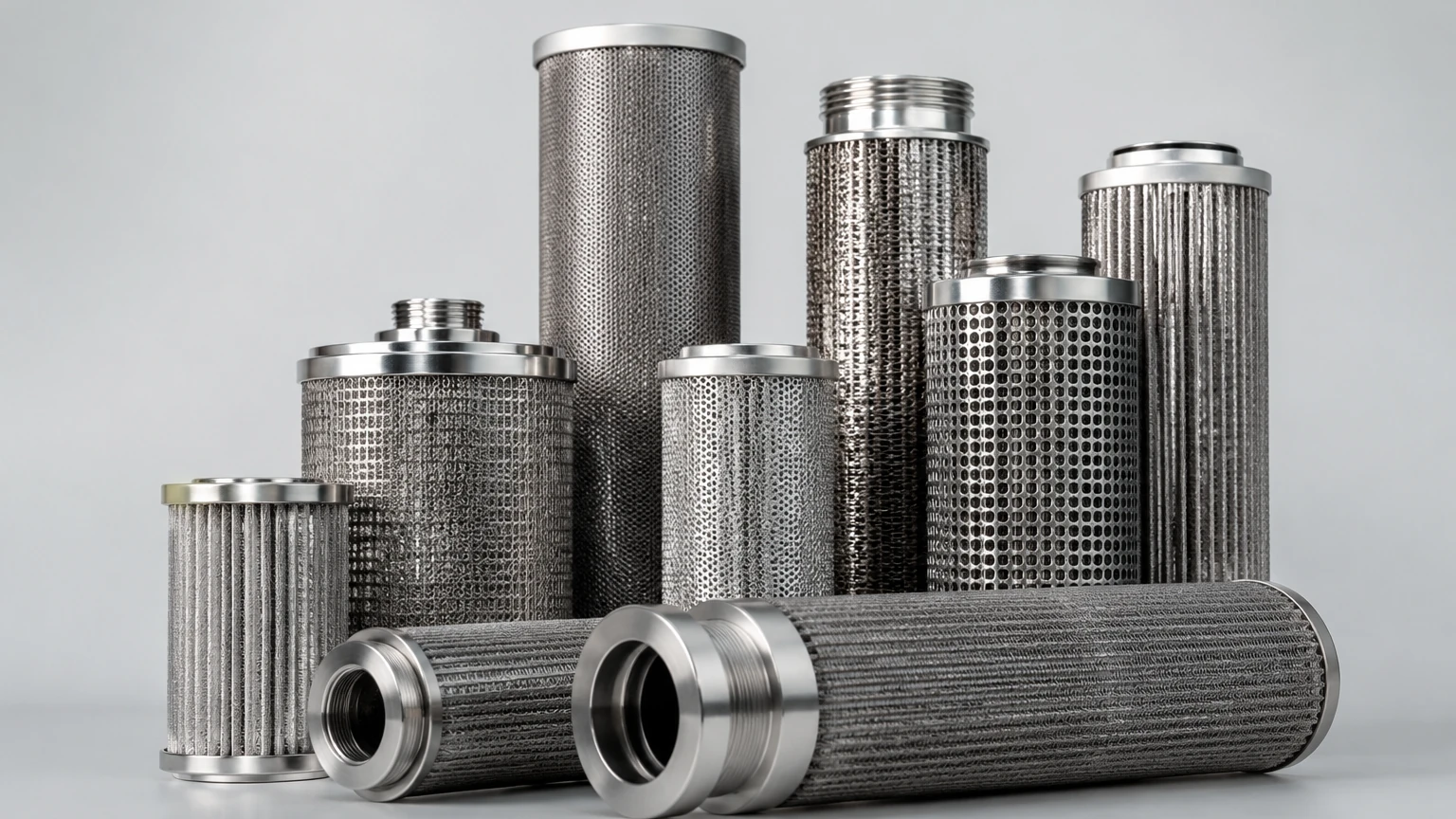
Wire Mesh Filters
Stainless steel wire mesh is a versatile medium that can be woven into various patterns, including plain, twill, and dutch weaves. Dutch weave patterns, in particular, provide a dense, strong mesh capable of fine filtration while maintaining high mechanical integrity. These elements are highly valued for their cleanability and precise pore size distribution.
Sintered Metal Elements
Sintering involves bonding layers of wire mesh or metal powders through heat and pressure without melting the base material. Sintered element filters are exceptionally robust, offering high resistance to pressure surges and backwashing. They are often used in high-pressure hydraulic systems and gas filtration where structural stability is paramount.
Pleated Filter Cartridges
Pleating the filter media significantly increases the effective surface area within the same footprint. This design allows for higher flow rates and longer service intervals because the increased surface area reduces the face velocity of the fluid and increases the total dirt-holding capacity. Pleated stainless steel elements are an excellent choice for applications requiring high-efficiency filtration in a compact space.
Evaluating Filtration Efficiency and Micron Ratings
Understanding how a filter's performance is measured is essential for selecting the right component for a specific process. The two most common ways to describe filtration fineness are nominal and absolute micron ratings.
1. Nominal Rating: This is an indicative value, often representing the ability of the filter to retain a certain percentage (e.g., 60% to 90%) of particles of a specific size. It is less precise and is generally used for pre-filtration stages.
2. Absolute Rating: This refers to the diameter of the largest hard spherical particle that will pass through the filter under specified test conditions. For critical processes in the chemical or pharmaceutical industries, an absolute rating is necessary to guarantee the removal of specific contaminants.
Engineers should also look for the Beta Ratio (β), which is a more comprehensive measure of filtration efficiency. The Beta Ratio compares the number of particles of a given size upstream of the filter to the number of particles downstream. A higher Beta Ratio indicates a more efficient filter element.
Operational Longevity and Maintenance Strategies
The total cost of ownership (TCO) for an element filter is not just the initial purchase price, but the cumulative costs of maintenance, downtime, and replacement.
Cleaning and Regeneration
One of the primary advantages of stainless steel element filters is their ability to be cleaned and reused. Depending on the contaminant, cleaning methods may include:
* Backwashing: Reversing the flow of fluid to flush particles from the surface.
* Ultrasonic Cleaning: Using high-frequency sound waves in a cleaning solution to dislodge fine particles trapped deep within the mesh.
* Chemical Cleaning: Using specific solvents to dissolve accumulated resins or organic matter.
Replacement Cycles
While reusable, every element filter has a finite lifespan. Repeated cleaning cycles can eventually lead to work hardening of the metal or gradual erosion of the mesh. It is important to establish a replacement schedule based on the number of cleaning cycles or evidence of structural fatigue. For mission-critical applications, keeping a detailed log of ΔP trends can help predict failure before it occurs.
Customization for Specific Industrial Applications
Standard off-the-shelf filters often fall short in specialized industrial environments. Customization allows engineers to tailor the element filter to the exact requirements of the housing and the process. Kaifil specializes in providing these tailored solutions, ensuring that every component integrates seamlessly into existing infrastructure.
OEM and Custom Configurations
Customization options typically include:
* Dimensions: Adjusting length, outer diameter, and inner diameter to fit proprietary housings.
* End-Cap Styles: Options such as DOE (Double Open End), SOE (Single Open End) with various O-ring configurations (e.g., 222, 226), or threaded connections.
* Reinforcement: Adding internal cores or external cages to provide additional support for high-pressure or high-viscosity applications.
By collaborating with a manufacturer that understands these technical requirements, purchasing teams can ensure they receive a product that meets both performance and regulatory standards. For more detailed information on available configurations and technical support, you can visit the Main Page to review product options and application support.
Conclusion: Making an Informed Selection
Selecting the right element filter is a technical decision that impacts the efficiency, safety, and profitability of industrial operations. By focusing on material compatibility, structural design, and precise filtration ratings, engineers can optimize their processes and reduce long-term costs. Whether the goal is to protect sensitive downstream equipment or to ensure the purity of a final product, the filter element remains the most vital link in the filtration chain. Partnering with a manufacturer like Kaifil ensures access to the engineering expertise and high-quality manufacturing necessary to solve even the most challenging filtration problems.
