


F7 Filter
In the landscape of industrial air and gas filtration, the F7 filter represents a critical threshold between general-purpose ventilation and high-precision environmental control. Classified under the EN 779:2012 standard, the F7 grade is designated as a "fine filter," capable of capturing a significant percentage of sub-micron particles. For engineers and facility managers in sectors such as pharmaceutical manufacturing, food processing, and chemical refining, understanding the performance parameters, material science, and operational economics of F7-rated media is essential for maintaining system integrity and protecting downstream equipment.
As industrial processes become more sensitive to particulate contamination, the demand for reliable fine filtration has increased. While the F7 classification originated in the HVAC industry, its principles and performance metrics are frequently applied to specialized industrial filtration systems, including those utilizing custom stainless steel components to ensure durability in demanding environments. This guide examines the technical specifications of the F7 filter, its transition to modern standards, and the engineering considerations necessary for its successful implementation.
Technical Specifications and Efficiency Benchmarks
The F7 filter is defined by its ability to capture fine atmospheric dust and particles. Under the EN 779 standard, which was the primary benchmark for many years, an F7 filter must demonstrate an average efficiency (Em) of 80% to 90% for 0.4 µm particles. This level of efficiency is a significant step up from M5 or M6 medium-grade filters, which typically range from 40% to 60% efficiency for the same particle size.
The Transition to ISO 16890
It is important for procurement teams to recognize that the EN 779 standard has been largely superseded by ISO 16890. While the industry still frequently uses the term "F7 filter," the ISO 16890 standard provides a more nuanced view of performance based on particle size fractions: PM1, PM2.5, and PM10.
An F7 filter typically aligns with the ePM1 50% to 65% or ePM2.5 65% to 95% categories under the new standard. This means the filter is capable of capturing at least 50% of particles smaller than 1 micron (PM1). For industrial applications where fine combustion particles, bacteria, or oil mists are a concern, the PM1 rating is the most relevant metric for evaluating a filter's protective capabilities.
Pressure Drop and Airflow Dynamics
From an engineering perspective, the efficiency of an F7 filter must be balanced against its resistance to airflow, known as pressure drop (measured in Pascals or inches of water gauge).
1. Initial Pressure Drop: The resistance of a clean filter at its rated airflow. For F7 filters, this typically ranges between 80 Pa and 120 Pa, depending on the media density and pleat geometry.
2. Final Pressure Drop: The maximum allowable resistance before the filter must be replaced to prevent system strain or bypass. For F7-grade media, the recommended final pressure drop is often set at 250 Pa to 450 Pa.
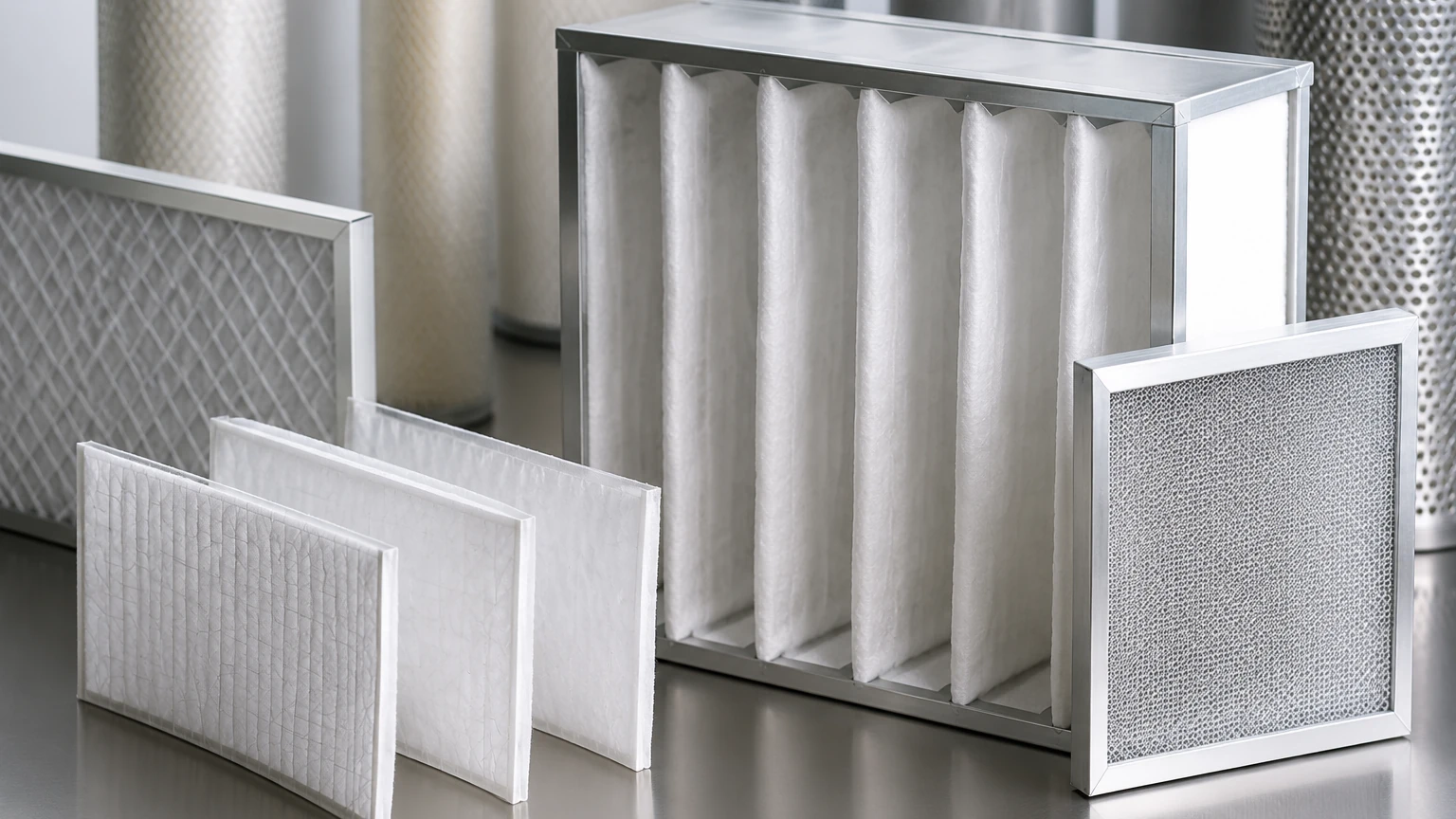
High-quality F7 filters are designed with an optimized surface area—often through deep pleating or pocket configurations—to minimize the initial pressure drop and maximize the dust-holding capacity (DHC). This ensures a longer service life and lower energy consumption for the fan systems driving the air through the filtration bank.
Material Science in Fine Filtration
The performance of an F7 filter is fundamentally tied to the media used in its construction. In industrial settings, the choice of material is dictated not only by filtration efficiency but also by the chemical and thermal conditions of the process.
Synthetic and Glass Fiber Media
Traditionally, F7 filters utilize glass fiber paper or synthetic melt-blown non-woven fabrics. Glass fiber media offers excellent efficiency and thermal stability but can be fragile. Synthetic media is more robust and resistant to moisture, making it suitable for environments with high humidity or where mechanical vibration might cause fiber shedding in lower-quality glass media.
The Role of Stainless Steel and Metal Mesh
In specialized industrial applications, such as those served by Main Page, standard synthetic F7 filters may be insufficient due to extreme temperatures, high pressures, or corrosive chemical exposure. In these instances, custom-engineered stainless steel wire mesh or sintered metal fiber media can be designed to achieve fine filtration performance comparable to F7 standards.
Stainless steel filtration components offer several advantages in heavy-duty industrial contexts:
* Thermal Resistance: Capable of operating at temperatures exceeding 300°C, where synthetic F7 media would melt or degrade.
* Chemical Compatibility: Highly resistant to solvents, acids, and alkaline cleaning agents used in CIP (Clean-in-Place) systems.
* Mechanical Strength: Able to withstand high differential pressures without the risk of media collapse or blow-through.
* Cleanability: Unlike disposable synthetic filters, metal mesh components can often be cleaned and reused, providing a lower total cost of ownership in specific high-value processes.
Critical Applications for F7 Filtration
The F7 filter serves as a versatile workhorse across multiple industries. Its primary role is often to act as a secondary filter, protecting more sensitive components or ensuring the final air quality meets regulatory standards.
Pre-filtration for HEPA Systems
In cleanroom environments (ISO Class 7 and 8), F7 filters are almost universally used as pre-filters for HEPA (H13/H14) filters. HEPA filters are expensive and have a high resistance to airflow; by capturing 80-90% of the 0.4 µm particulate load, the F7 filter significantly extends the life of the HEPA stage, ensuring the facility remains within its operational budget.
Food and Beverage Processing
In food production, airborne contaminants can lead to spoilage or product recalls. F7 filters are used in make-up air units for packaging halls and fermentation rooms to remove mold spores, pollen, and fine dust. When used in conjunction with stainless steel housings, these systems provide a hygienic barrier that is easy to sanitize.
Pharmaceutical and Laboratory Use
Laboratories and pharmaceutical secondary manufacturing (tableting, packaging) require controlled environments to prevent cross-contamination. F7 filters provide the necessary level of cleanliness for non-sterile zones and serve as the final filtration stage for many general laboratory ventilation systems.
Gas Turbine and Compressor Protection
High-speed rotating machinery is extremely sensitive to erosion and fouling caused by fine particulates. F7-rated intake filters protect turbine blades and compressor stages from the buildup of fine atmospheric dust, which can otherwise lead to reduced efficiency and increased maintenance costs.
Selection Criteria: Choosing the Right F7 Filter
When selecting an F7 filter for an industrial application, engineers must look beyond the basic efficiency rating. Several factors influence the long-term performance and reliability of the filtration system.
1. Environmental Conditions
Is the filter exposed to high humidity or oil mists? In such cases, a hydrophobic or oleophobic coating may be required to prevent the media from "blinding" (clogging prematurely due to moisture). If the process involves corrosive gases, the frame and support grid must be made of corrosion-resistant materials, such as 304 or 316L stainless steel.
2. Face Velocity and Airflow Volume
Filters are rated for specific airflow volumes (expressed in m³/h or CFM). Exceeding the rated face velocity of an F7 filter will not only increase the pressure drop but may also decrease the filtration efficiency, as particles are forced through the media at speeds that overcome the mechanisms of diffusion and interception.
3. Dust Holding Capacity (DHC)
A filter with a lower initial cost but a low DHC will require more frequent replacements, leading to higher labor costs and more frequent system downtime. Engineers should evaluate the "Total Cost of Ownership," which includes the purchase price, energy costs associated with pressure drop, and the cost of disposal and replacement.
4. Structural Integrity
In industrial HVAC systems, filters are often subject to turbulent airflow. An F7 filter must have a rigid frame and secure bonding between the media and the frame to prevent air bypass. For high-pressure applications, pleated media should be supported by a metal wire mesh to maintain its shape and prevent pleat deformation.
Maintenance and Monitoring Protocols
The effectiveness of an F7 filter is only as good as the maintenance program supporting it. Failure to monitor filter performance can lead to increased energy consumption or, in the worst case, a breach in the filtration barrier.
Differential Pressure Monitoring
Every F7 filter bank should be equipped with a differential pressure gauge (e.g., a Magnehelic gauge or a digital pressure transducer). This allows operators to track the loading of the filter in real-time. A sudden drop in pressure may indicate a ruptured filter or a bypass, while a rapid increase suggests an unusual spike in environmental dust or moisture.
Replacement Cycles
While pressure drop is the primary indicator for replacement, some industries mandate time-based replacement cycles to prevent microbial growth on the filter media, especially in humid environments. In food and pharmaceutical applications, F7 filters may be replaced every 6 to 12 months regardless of the pressure drop reading to ensure hygiene standards are maintained.
Gasket and Seal Inspection
A common point of failure in fine filtration is the seal between the filter and the holding frame. Even a small gap can allow a significant amount of unfiltered air to bypass the F7 media. During every filter change, gaskets should be inspected for compression set or degradation, and the clamping mechanism should be checked for proper tension.
Custom Filtration Solutions
While standard-sized F7 filters meet the needs of many general ventilation systems, unique industrial processes often require customized solutions. This is particularly true in the chemical processing and hydraulic industries, where standard synthetic filters cannot survive the operational environment.
Customized stainless steel filtration components can be engineered to meet specific micron ratings while providing the structural strength required for high-pressure liquid or gas streams. By collaborating with a specialist manufacturer, engineers can develop filtration systems that integrate F7-level efficiency into a durable, reusable metal format. For more information on customized industrial filtration options, technical professionals can Review product options and application support to find solutions tailored to their specific mechanical and chemical requirements.
Conclusion
The F7 filter is a vital component in the hierarchy of industrial filtration, providing a high level of protection against sub-micron particles. Whether used as a standalone final filter or as a pre-filter for HEPA systems, its performance is defined by a delicate balance of efficiency, pressure drop, and material durability. By understanding the technical nuances of the F7 classification and the transition to the ISO 16890 standard, procurement and engineering teams can make informed decisions that optimize both air quality and operational efficiency. In demanding environments, the shift toward high-performance materials like stainless steel ensures that even the most rigorous filtration requirements are met with reliability and longevity.
