


Fabricated Strainer for Pipeline
In industrial fluid handling, the integrity of downstream equipment—such as pumps, flow meters, heat exchangers, and control valves—is paramount to operational efficiency and safety. A fabricated strainer for pipeline systems serves as the primary line of defense against mechanical damage caused by scale, weld slag, sediment, and other foreign particulates. Unlike standard cast strainers, fabricated units offer a level of design flexibility and material specificity that is essential for demanding industrial environments, including chemical processing, water treatment, and oil and gas applications.
Selecting the correct fabricated strainer requires a deep understanding of fluid dynamics, material compatibility, and the specific mechanical constraints of the piping system. This guide examines the engineering considerations, design variations, and selection criteria necessary for technical professionals to optimize pipeline protection.
The Distinction Between Fabricated and Cast Strainers
When specifying a strainer, engineers must first decide between a cast and a fabricated construction. Cast strainers are produced by pouring molten metal into a mold, resulting in a fixed geometry and limited material options (typically carbon steel, iron, or bronze). While cost-effective for standard sizes and pressures, they lack the versatility required for specialized applications.
A fabricated strainer for pipeline use is constructed by welding together various components, including pipe sections, flanges, and plate steel. This manufacturing method offers several distinct advantages:
1. Material Versatility: Fabricated units can be constructed from a wide range of alloys, including SS304, SS316L, Duplex stainless steel, and Monel, which are often unavailable or prohibitively expensive in cast forms.
2. Dimensional Customization: Engineers can specify custom face-to-face dimensions, nozzle orientations, and offset configurations to fit existing piping layouts without the need for expensive modifications.
3. Pressure Ratings: Fabricated strainers can be designed to meet specific ASME B31.3 or Section VIII pressure vessel codes, accommodating high-pressure requirements that exceed the limits of standard cast classes.
4. Capacity and Size: For large-diameter pipelines (typically above 12 inches), fabricated strainers are often the only viable solution, as the weight and complexity of casting such large bodies become impractical.
Core Engineering Specifications and Materials
Material selection is the most critical factor in ensuring the longevity of a fabricated strainer for pipeline service. The choice is dictated by the chemical composition of the fluid, the operating temperature, and the external environment.
Stainless Steel Grades
Stainless steel is the industry standard for fabricated strainers due to its corrosion resistance and structural integrity.
* SS304/304L: Suitable for general-purpose applications, water treatment, and food processing where moderate corrosion resistance is required.
* SS316/316L: The preferred choice for chemical processing and marine environments. The addition of molybdenum provides superior resistance to chlorides and pitting.
* High-Alloy Steels: In highly aggressive environments, such as those involving concentrated acids or high-temperature steam, specialized alloys like Hastelloy or Duplex stainless steel are utilized to prevent premature failure.
Design Standards
Fabricated strainers are typically designed and manufactured according to international standards to ensure safety and reliability. These include:
* ASME B16.5: For pipe flanges and flanged fittings.
* ASME B31.3: Process Piping code.
* Pressure Equipment Directive (PED): Required for equipment operating in the European Economic Area.
* NACE MR0175: For materials used in H2S-containing environments in oil and gas production.
Common Configurations: T-Type, Y-Type, and Basket Strainers
The geometry of a fabricated strainer for pipeline systems significantly impacts its performance, maintenance requirements, and pressure drop characteristics. There are three primary configurations used in industrial settings.
1. Fabricated Y-Strainers
Y-strainers are characterized by their compact, cylindrical shape with a side leg that houses the filter element. They are most effective in high-pressure steam or gas lines where the amount of debris is relatively low. Because the debris is collected in the "leg," they can be installed either horizontally or vertically (downward flow). However, their dirt-holding capacity is limited compared to other designs.
2. Fabricated Basket (Simplex) Strainers
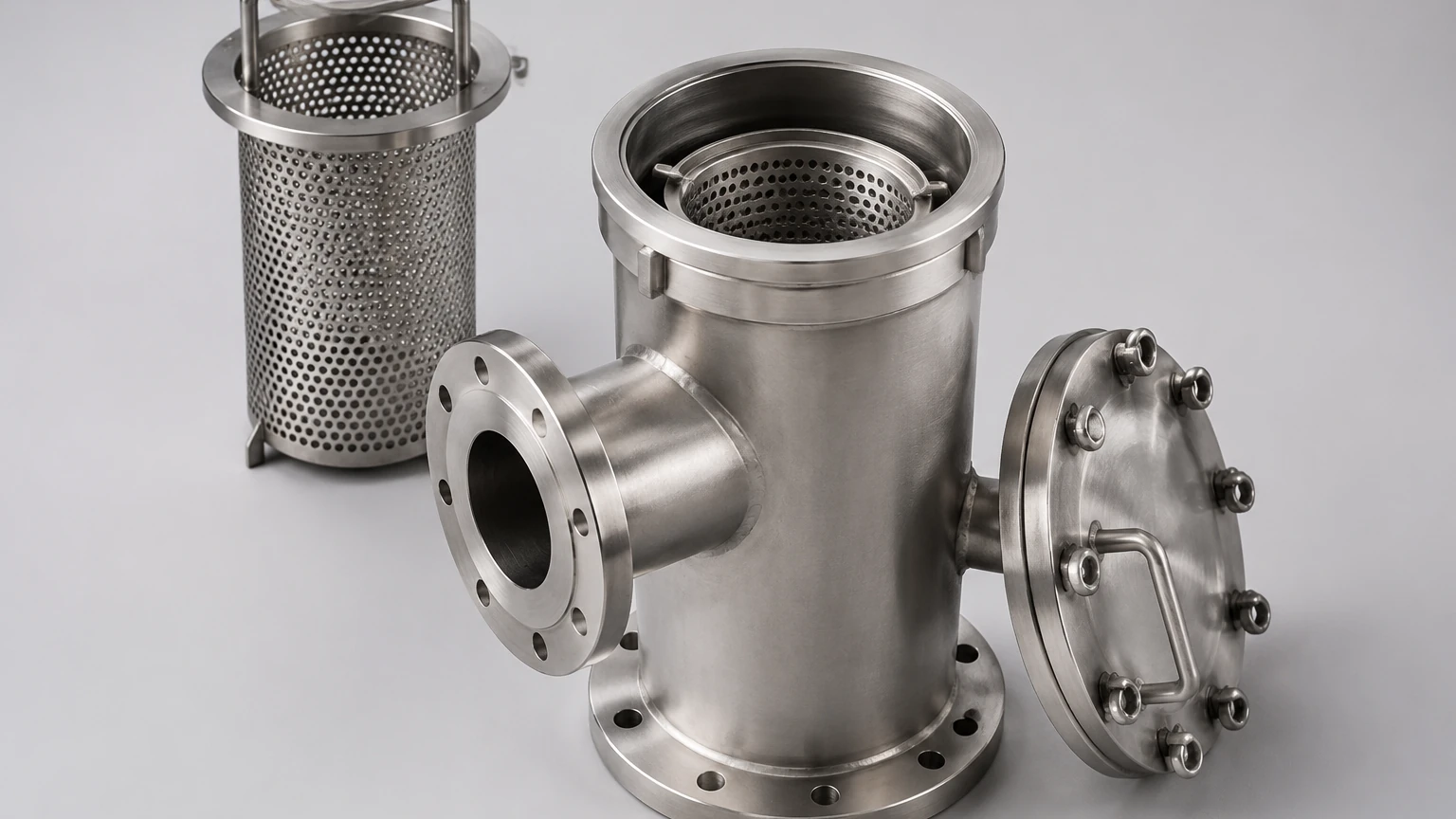
Basket strainers are designed for liquid applications where a higher dirt-holding capacity is required. The vertical orientation of the basket allows for the collection of a significant volume of solids before cleaning is necessary. Fabricated basket strainers are often used in suction lines for pumps. They feature a top-entry cover that can be bolted or equipped with a quick-opening mechanism for rapid maintenance.
3. Fabricated T-Type Strainers
T-type strainers provide a compact, inline solution with a branch connection that allows for easy access to the filter element. They are particularly useful in large-diameter pipelines where space is constrained. T-type strainers offer a lower pressure drop than Y-strainers and can be configured for straight-through or right-angle flow. They are frequently used in the protection of meters and pumps in the oil and gas industry.
Filtration Media and Precision Components
The internal element is the functional heart of the fabricated strainer. At Kaifil, we specialize in manufacturing high-precision stainless steel filtration components that ensure the efficiency of these systems. The choice of media depends on the required filtration accuracy, which is usually measured in microns or mesh size.
* Perforated Plate: This is the structural foundation of most strainer baskets. Perforation sizes typically range from 1/32" to 1/2". It is used for coarse filtration or as a support for finer mesh.
* Wire Mesh Filters: For finer filtration requirements, a stainless steel wire mesh is lined inside or outside the perforated basket. This allows for the removal of particles as small as 5 microns. The weave type (plain, twilled, or dutch) is selected based on the required strength and flow rate.
* Wedge Wire: For heavy-duty applications, wedge wire elements provide superior mechanical strength and resistance to clogging. The V-shaped profile of the wire ensures that only two-point contact is made with particles, facilitating easier cleaning during backwashing.
When evaluating the internal element, engineers must consider the Open Area Ratio (OAR). The OAR is the ratio of the total open area of the strainer element to the internal cross-sectional area of the inlet pipe. A standard OAR of 4:1 or 6:1 is often specified to ensure that the strainer does not become a bottleneck in the system, even as it begins to load with debris.
Critical Selection Criteria for Industrial Applications
Specifying a fabricated strainer for pipeline systems involves more than just matching the pipe size. Engineers must evaluate several operational parameters to ensure the unit performs reliably over its service life.
Flow Rate and Pressure Drop
The pressure drop (ΔP) across a clean strainer is a function of the fluid velocity, viscosity, and the open area of the filter element. An excessive pressure drop can lead to cavitation in pumps or insufficient flow to downstream processes. It is standard practice to size a strainer so that the initial clean pressure drop does not exceed 2 PSI (0.14 bar).
Viscosity Considerations
High-viscosity fluids, such as heavy oils or resins, require larger strainer bodies and coarser mesh to maintain acceptable flow rates. As viscosity increases, the pressure drop rises exponentially. In these cases, a fabricated basket strainer with an oversized body is often necessary to provide sufficient surface area.
Debris Loading and Cleaning Cycles
If the process fluid contains a high concentration of solids, a simplex strainer may require frequent shutdowns for cleaning. In such scenarios, a duplex strainer (two simplex units connected by a diverter valve) or an automated self-cleaning strainer should be considered. For standard fabricated units, installing differential pressure gauges is essential to monitor the loading of the basket and signal when maintenance is required.
Installation and Maintenance Best Practices
To maximize the performance of a fabricated strainer for pipeline protection, proper installation and maintenance protocols must be followed.
1. Orientation: Ensure the strainer is installed in the correct orientation relative to flow. For Y-strainers in liquid service, the leg must point downward to trap debris. For basket strainers, the unit must be level to ensure the basket seats correctly.
2. Venting and Draining: Fabricated strainers should be equipped with vent valves on the cover to release trapped air and drain valves on the bottom to facilitate safe fluid removal before opening the unit for cleaning.
3. Gasket Integrity: During maintenance, gaskets should be inspected for wear or chemical degradation. Using high-quality spiral wound or PTFE gaskets ensures a leak-proof seal, especially in high-pressure applications.
4. Spare Parts: Maintaining a stock of replacement baskets and seals is critical to minimizing downtime. Because fabricated strainers are often custom-built, sourcing replacement internals from the original manufacturer ensures a precise fit.
Achieving Optimized Filtration Performance
For engineers and purchasing teams, the goal is to balance initial capital expenditure with long-term operational reliability. A fabricated strainer for pipeline systems is an investment in the protection of much more expensive assets. By focusing on material quality, precise engineering of the internal mesh, and adherence to pressure vessel standards, facilities can significantly reduce the risk of unplanned outages.
Kaifil provides the technical expertise and manufacturing capability to develop customized stainless steel filtration solutions tailored to specific industrial requirements. From material selection to the final welding of the vessel, our focus remains on durability and precise performance. To explore our full range of precision metal filter components and custom filtration designs, please visit our Main Page.
Before finalizing a purchase, technical professionals should confirm the following data points with their supplier:
* Maximum operating pressure and temperature.
* Required micron rating and allowable pressure drop.
* Fluid compatibility with housing and seal materials.
* Specific dimensional constraints for the installation site.
* Compliance requirements for industry-specific certifications (e.g., FDA for food, ASME for pressure safety).
By addressing these factors during the design phase, you ensure that the fabricated strainer for pipeline service provides robust, maintenance-friendly protection for your critical infrastructure.
