


Materials Selection for Chemical Storage Tanks
In industrial chemical processing, the integrity of storage systems is a foundational requirement for safety, environmental compliance, and process efficiency. Selecting the appropriate materials for chemical storage tanks is a complex engineering task that requires a deep understanding of fluid dynamics, metallurgy, and chemical compatibility. A failure in this selection process does not merely result in a leaking tank; it can lead to catastrophic structural failure, contamination of the entire production line, and significant downstream damage to precision equipment, including high-performance filtration systems.
For engineers and procurement professionals, the process of materials selection for chemical storage tanks must be approached with a lifecycle perspective. This involves evaluating how the material interacts with the stored medium over time, the potential for particulate generation, and the compatibility of the tank material with the necessary filtration components used to maintain fluid purity.
Fundamental Criteria for Chemical Compatibility
The primary driver in materials selection for chemical storage tanks is the chemical nature of the substance being stored. This is not a binary decision of "compatible" or "incompatible," but rather a gradient of resistance that changes based on several variables.
Concentration and pH Levels
The concentration of a chemical can radically alter its corrosivity. For instance, sulfuric acid at low concentrations is highly corrosive to many metals due to its high ionization, whereas highly concentrated sulfuric acid (98%) can often be stored in carbon steel because it forms a protective ferrous sulfate layer. However, if that concentration fluctuates or absorbs moisture from the air, the protective layer can fail. Engineers must determine the maximum and minimum possible concentrations during the entire storage cycle.
Temperature Fluctuations
Chemical reactivity generally increases with temperature. A material that is stable at 25°C may undergo rapid stress corrosion cracking or accelerated uniform corrosion at 60°C. Furthermore, thermal expansion coefficients must be considered, especially in composite or lined tanks where mismatched expansion rates can lead to delamination or cracking of the protective interior barrier.
Trace Impurities
Often, it is not the primary chemical that causes material failure but the trace impurities or additives. For example, the presence of chlorides in an otherwise benign solution can cause pitting in 304-grade stainless steel. In these scenarios, upgrading to 316L or a duplex stainless steel becomes a technical necessity to ensure the longevity of the vessel and the purity of the stored medium.
Metallic Materials: The Role of Stainless Steel
Metallic alloys remain the standard for high-pressure, high-temperature, and high-volume chemical storage. Among these, stainless steel is the most versatile due to its inherent corrosion resistance and structural strength.
Austenitic Stainless Steels (304 and 316L)
Grade 304 stainless steel is widely used for mild chemicals, alcohols, and food-grade applications. However, for more aggressive chemical environments, Grade 316L is the industry benchmark. The addition of molybdenum in 316L provides significantly better resistance to pitting and crevice corrosion in chloride-rich environments. The "L" designation signifies low carbon content, which is critical for welding; it prevents carbide precipitation during the welding process, thereby maintaining the corrosion resistance of the heat-affected zones.
High-Nickel Alloys and Duplex Steels
When standard austenitic steels are insufficient, engineers turn to duplex stainless steels (such as 2205). These materials offer a combination of austenitic and ferritic structures, providing higher strength and superior resistance to stress corrosion cracking. For extreme environments involving highly oxidizing acids or hot brine, high-nickel alloys like Hastelloy or Inconel may be required, although their cost often limits their use to critical components or internal linings.
Non-Metallic Materials and Composite Solutions
For many low-pressure applications, non-metallic materials offer an excellent balance of chemical resistance and cost-effectiveness. These materials do not corrode in the traditional sense but are subject to degradation through permeation, swelling, or chemical attack on the polymer chains.
Thermoplastics (HDPE and XLPE)
High-Density Polyethylene (HDPE) and Cross-linked Polyethylene (XLPE) are common for storing inorganic acids and bases. XLPE, in particular, offers enhanced structural integrity and impact resistance due to its molecular cross-linking. However, these materials have lower temperature limits than metals and are susceptible to UV degradation if not properly stabilized for outdoor use.
Fiberglass Reinforced Plastic (FRP)
FRP tanks are engineered composites consisting of a resin matrix and glass fiber reinforcement. The chemical resistance is provided by the resin (such as vinyl ester or epoxy), while the glass fibers provide structural strength. FRP is highly customizable, allowing engineers to specify different resin types for the inner "chemical barrier" and the outer structural layers. This makes FRP a preferred choice for large-diameter tanks storing corrosive liquids like sodium hypochlorite or hydrochloric acid.
Corrosion Mechanisms and Risk Mitigation
Understanding how materials fail is as important as understanding why they succeed. In the context of materials selection for chemical storage tanks, several specific corrosion mechanisms must be monitored:
1. Uniform Corrosion: The even loss of metal across the surface. This is the most predictable form and is usually managed by including a "corrosion allowance" in the tank wall thickness.
2. Pitting Corrosion: Localized, deep holes that can penetrate a tank wall quickly despite the rest of the surface appearing healthy. This is common in stainless steels exposed to halides.
3. Stress Corrosion Cracking (SCC): The growth of crack formations in a corrosive environment under tensile stress. This is particularly dangerous because it can lead to sudden, catastrophic failure.
4. Galvanic Corrosion: Occurs when two dissimilar metals are in electrical contact within an electrolyte. This is a common risk at tank nozzles, valves, and internal filtration supports.
To mitigate these risks, engineers often specify passivation treatments for stainless steel surfaces. Passivation involves treating the metal with a mild oxidant (like nitric acid) to remove free iron from the surface and enhance the protective chromium oxide layer.
The Impact of Material Selection on Industrial Filtration
The choice of tank material has a direct and profound impact on the downstream filtration requirements. A storage tank is not a static environment; it is a source of potential contamination. For instance, if a carbon steel tank is used for a slightly corrosive fluid, the resulting iron oxide (rust) particulates will quickly blind downstream filters.
In high-purity industries such as pharmaceuticals or specialty chemicals, the tank material must not shed any particulates or leach ions into the fluid. This is where the synergy between the storage vessel and the filtration system becomes critical. Even when the correct materials selection for chemical storage tanks is made, fine particulates can still enter the system during loading or through atmospheric vents.
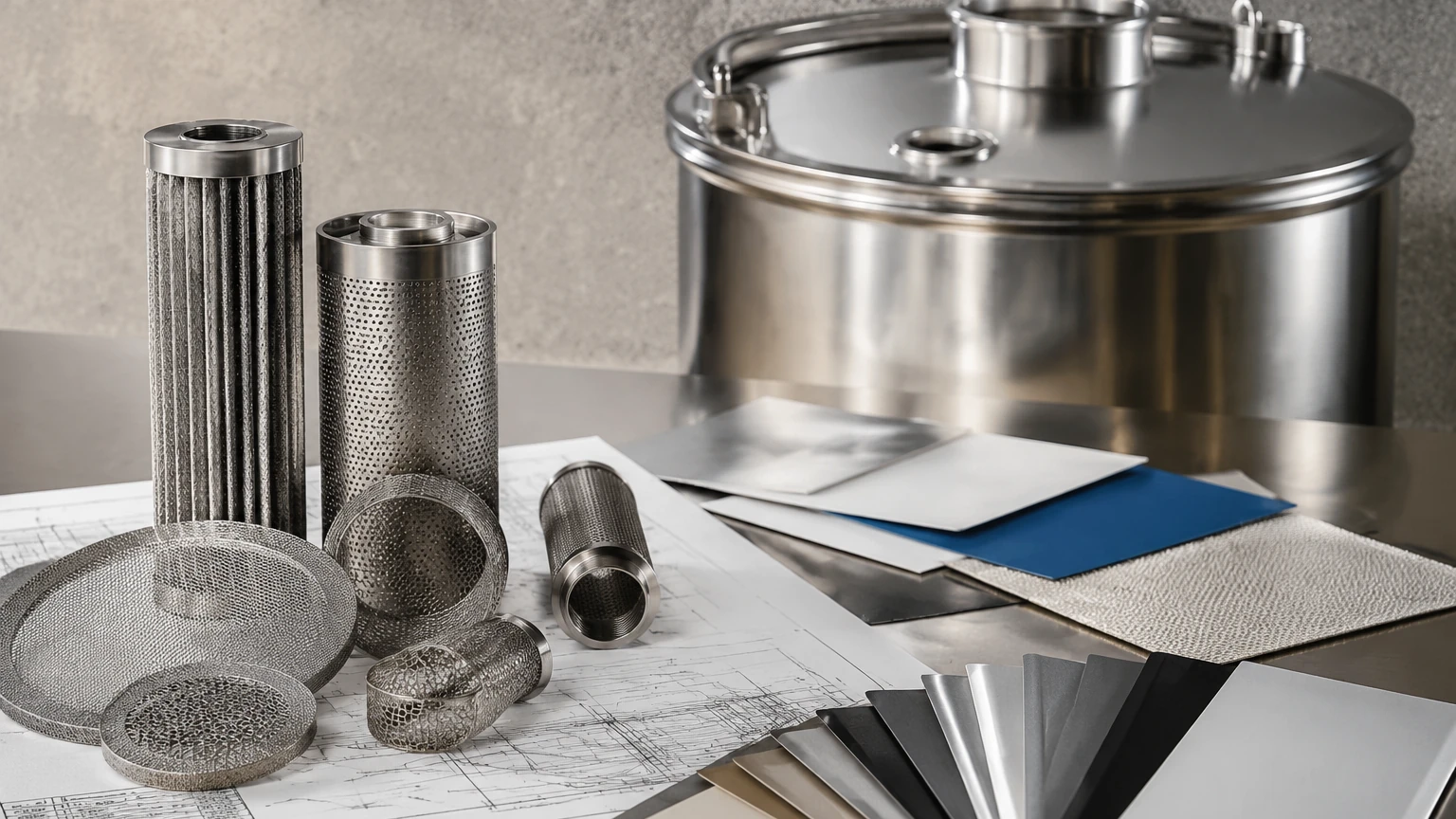
To maintain the required purity levels, engineers rely on precision filtration components. For example, if a tank is constructed from 316L stainless steel to ensure durability, the internal filtration elements—such as wire mesh strainers or sintered metal cartridges—should ideally match or exceed that material specification to prevent galvanic corrosion and ensure consistent performance.
Professional manufacturers like Kaifil specialize in these types of custom solutions. On the Main Page, technical teams can find information regarding custom-engineered stainless steel filter cartridges and wire mesh components designed to withstand the same rigorous chemical environments as the storage tanks themselves. Integrating high-quality filtration at the tank outlet or within the recirculation loop is the only way to guarantee that the materials selection for the tank translates into a high-quality end product.
Engineering Checklist for Material Specification
Before finalizing the materials selection for chemical storage tanks, the following technical data points must be confirmed by the engineering and purchasing teams:
* Full Chemical Profile: Include all trace elements, catalysts, and cleaning agents used in the tank.
* Operating Temperature Range: Define the normal operating temperature, as well as the maximum possible temperature during a process upset or steam cleaning.
* Pressure Requirements: Determine if the tank will operate under atmospheric pressure, vacuum, or positive pressure (ASME Section VIII compliance).
* Cleaning Protocols: Will the tank be subjected to Clean-in-Place (CIP) cycles with caustic or acidic solutions? The material must withstand both the stored product and the cleaning agents.
* Filtration Compatibility: Identify the micron rating required for downstream processes and ensure the tank material does not produce debris that exceeds the capacity of the Main Page filtration solutions installed in the line.
* Regulatory Compliance: Ensure the material meets industry-specific standards such as FDA for food/beverage, USP Class VI for pharmaceuticals, or API 650 for petroleum and chemical storage.
Total Cost of Ownership (TCO) Considerations
In B2B procurement, the initial capital expenditure (CAPEX) of a storage tank is often a secondary concern compared to the Total Cost of Ownership (TCO). A lower-cost material that requires frequent inspection, interior relining, or results in high filtration replacement costs is ultimately more expensive than a premium material like 316L stainless steel or high-grade FRP.
Maintenance cycles are also a critical factor. Metallic tanks allow for non-destructive testing (NDT) methods like ultrasonic thickness testing, which can provide highly accurate data on the remaining service life. In contrast, some composite materials may require more invasive inspection techniques. By selecting a material that minimizes particulate generation and corrosion, facilities can extend the life of their filtration media, reduce downtime for filter changes, and ensure a more stable production environment.
Conclusion
Materials selection for chemical storage tanks is a high-stakes engineering decision that dictates the safety and efficiency of an entire industrial facility. By carefully weighing chemical compatibility, thermal constraints, and the potential for contamination, engineers can specify storage solutions that protect both the environment and the process.
When these tanks are paired with compatible, high-performance filtration components—such as the custom stainless steel solutions provided by Kaifil—the result is a robust system capable of maintaining the highest standards of fluid purity. For those seeking to optimize their filtration performance in conjunction with their chemical storage strategy, reviewing the technical capabilities on the Main Page of a specialist manufacturer is the recommended next step in the engineering process.
Download Materials Selection for Chemical Storage Tanks as a PDF
