


Filter Bags for Water
In industrial water treatment and liquid processing, the selection of filtration media is a critical decision that impacts operational efficiency, product purity, and long-term maintenance costs. Filter bags for water represent one of the most versatile and cost-effective methods for removing suspended solids from liquid streams. Unlike complex automated systems, bag filtration offers a straightforward mechanical solution for high-flow applications, provided the engineering parameters are correctly defined.
For engineers and procurement professionals, understanding the technical nuances of bag filtration—ranging from material compatibility to micron efficiency—is essential for optimizing system performance. As a specialist in precision metal filtration, Kaifil provides the technical expertise required to navigate these choices, ensuring that filtration components meet the rigorous demands of industrial environments.
The Role of Filter Bags in Industrial Water Treatment
Filter bags for water are primarily utilized as pressure filtration components. The process involves a liquid stream being pumped into a filter housing, passing through the bag media from the inside out, and exiting through the housing outlet. Contaminants are trapped within the bag, which can then be cleaned or replaced depending on the media type.
This method is favored in sectors such as chemical processing, food and beverage, and cooling water systems due to its high dirt-holding capacity and relatively low initial capital expenditure. However, the performance of these bags is not universal; it is highly dependent on the physical and chemical characteristics of the water being treated and the specific requirements of the downstream equipment.
Material Selection and Media Types
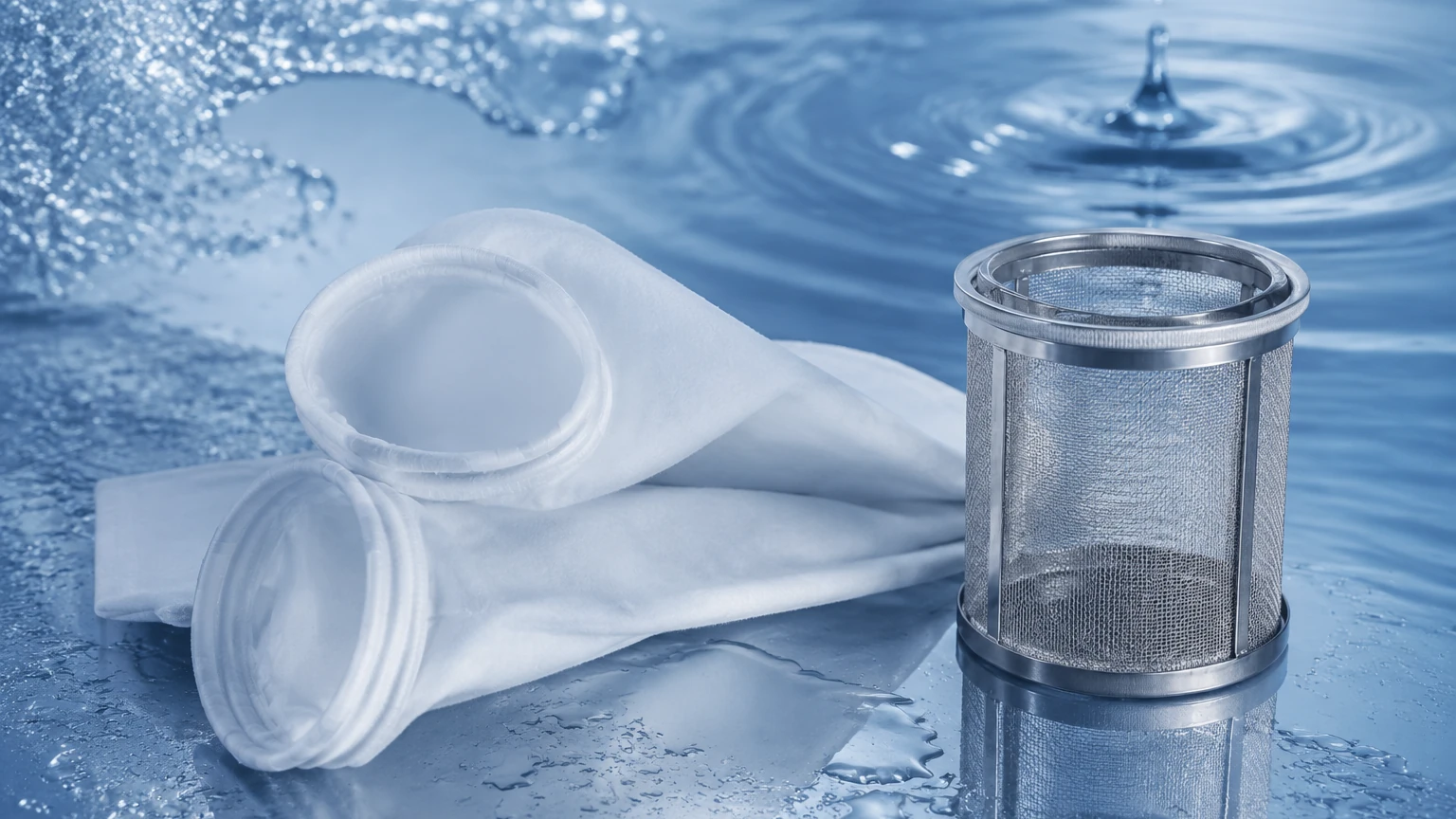
When specifying filter bags for water, the choice of media is the first technical hurdle. Industrial filter bags are generally categorized into two types: disposable synthetic fibers and reusable metal mesh.
Synthetic Felt and Monofilament
1. Polypropylene (PP): Widely used for its broad chemical resistance and affordability. It is suitable for most water-based applications where temperatures do not exceed 90°C.
2. Polyester (PE): Offers higher temperature resistance than polypropylene (up to 150°C) and excellent tensile strength, making it ideal for hot water circuits and steam condensate recovery.
3. Nylon Monofilament: A woven media that provides precise pore sizes. It is often used for surface filtration where consistent particle size exclusion is more important than total dirt-holding capacity.
Stainless Steel Mesh
For demanding industrial applications, stainless steel wire mesh bags—often manufactured by specialists like Kaifil—offer significant advantages. These bags are constructed from 304 or 316L stainless steel and provide high mechanical strength, resistance to extreme temperatures, and the ability to be cleaned and reused. In high-pressure systems or applications involving aggressive chemicals, stainless steel mesh is often the only viable solution to prevent media migration or structural collapse.
Critical Engineering Parameters for Filter Bags for Water
To ensure the longevity of the filtration system, engineers must evaluate several key performance indicators before finalizing a specification.
Micron Rating: Nominal vs. Absolute
One of the most common points of confusion in water filtration is the micron rating. A nominal rating indicates the filter's ability to retain a majority of particles (typically 60% to 80%) of a specific size. An absolute rating implies a 99.9% efficiency at that size. For general water pre-filtration, a nominal bag is often sufficient and more economical. However, if the water is feeding a sensitive reverse osmosis (RO) membrane or a high-pressure nozzle, an absolute-rated bag or a high-efficiency pleated cartridge may be required.
Flow Rate and Differential Pressure
The flow rate (measured in GPM or m³/h) determines the size and number of bags required. A common engineering mistake is sizing the system for the maximum flow rate without considering the "clean pressure drop." As the bag collects solids, the differential pressure (ΔP) increases. If the initial ΔP is too high, the service life of the bag will be significantly shortened. Ideally, a clean filter bag should operate with a pressure drop of less than 2 PSI (0.14 bar).
Viscosity and Particle Loading
While water has a low viscosity (1 cps), the presence of oils, polymers, or high concentrations of silt can change the filtration dynamics. High particle loading requires larger surface areas to prevent premature "blinding" of the media. In such cases, multi-bag housings or staged filtration (coarse to fine) are recommended to maintain continuous operation.
Stainless Steel Mesh vs. Synthetic Media
While synthetic bags are common, the total cost of ownership (TCO) often favors stainless steel components in specific industrial contexts. Engineers should consider the following comparison when evaluating filter bags for water:
* Durability: Synthetic bags are prone to tearing under high differential pressure or water hammer effects. Stainless steel mesh maintains structural integrity under fluctuating pressures.
* Environmental Impact: Disposable bags contribute to industrial waste streams. Reusable metal filters support sustainability goals by reducing the frequency of media disposal.
* Chemical Compatibility: While polypropylene is resistant to many acids, it can degrade in the presence of certain oxidizing agents or solvents. Stainless steel 316L provides superior resistance to a wider spectrum of industrial chemicals.
* Temperature Limits: Synthetic bags have a hard ceiling for temperature. Metal mesh can operate in cryogenic or high-heat environments without losing its filtration precision.
By visiting the Main Page of a professional manufacturer, engineers can review technical specifications for custom metal filter components that bridge the gap between standard bag performance and high-end industrial requirements.
Operational Challenges and Maintenance Strategies
Even the best-specified filter bag will fail if maintenance protocols are ignored. There are three primary risks associated with industrial water bag filtration:
1. Bypass: If the bag is not seated correctly in the housing or if the seal (typically a plastic flange or steel ring) is damaged, unfiltered water will bypass the media. This can lead to catastrophic failure of downstream components.
2. Media Migration: In low-quality synthetic bags, fibers can break loose and enter the effluent stream. This is particularly problematic in the pharmaceutical and food industries. Using high-quality welded seams or stainless steel mesh eliminates this risk.
3. Blinding: This occurs when the surface of the bag is coated with a thin layer of fine solids or biological growth, causing a rapid spike in pressure. Regular monitoring of differential pressure gauges is the only reliable way to prevent housing rupture or pump cavitation.
Replacement Cycles
Standard practice dictates that filter bags for water should be replaced when the differential pressure reaches 15–20 PSI (1.0–1.4 bar). Operating beyond this point risks forcing contaminants through the media (particle unloading) or bursting the bag.
Technical Checklist for Procurement and Customization
Before contacting a manufacturer for custom filtration solutions, technical teams should confirm the following data points to ensure the product is fit for purpose:
* Fluid Characteristics: Temperature, pH level, and chemical composition.
* Contaminant Profile: Are the solids hard, gelatinous, or fibrous? What is the expected particle size distribution?
* Operating Conditions: Maximum operating pressure, required flow rate, and frequency of system start/stop cycles.
* Housing Compatibility: Confirm the bag size (e.g., Size #1, #2, #3, or #4) and the type of top ring (Snap-band, Plastic Flange, or Zinc-coated Steel).
* Compliance Requirements: Does the media need to meet FDA, EC, or specific industrial standards for food or pharmaceutical contact?
Conclusion
Filter bags for water are a foundational component of industrial fluid management. While they appear simple, their successful implementation requires a deep understanding of material science and fluid dynamics. By moving beyond generic solutions and considering high-performance materials like stainless steel mesh, facilities can achieve higher filtration accuracy and improved durability.
For organizations seeking to optimize their filtration processes, partnering with a manufacturer that understands the complexities of custom metal components is essential. To explore technical specifications and engineering support for your next project, you may review product options and application support on the Kaifil Main Page.
