


Filter Foam for Aquarium
In the realm of aquatic life support systems, filtration is the primary determinant of environmental stability. For engineers and procurement specialists managing large-scale aquatic systems, public aquaria, or recirculating aquaculture systems (RAS), selecting the appropriate filter foam for aquarium applications is a decision rooted in fluid dynamics, material science, and microbiology. While often perceived as a simple sponge, industrial-grade filter foam is a precision-engineered component designed to balance mechanical straining with biological surface area.
As a specialist in custom stainless steel filtration solutions, Kaifil understands that high-performance filtration often requires a multi-stage approach. Whether you are designing a high-volume life support system (LSS) or sourcing components for industrial-scale aquatic tanks, understanding the technical specifications of foam media is essential for optimizing system longevity and water quality. For more information on advanced filtration components, visit our Main Page.
The Engineering of Open-Cell Reticulated Foam
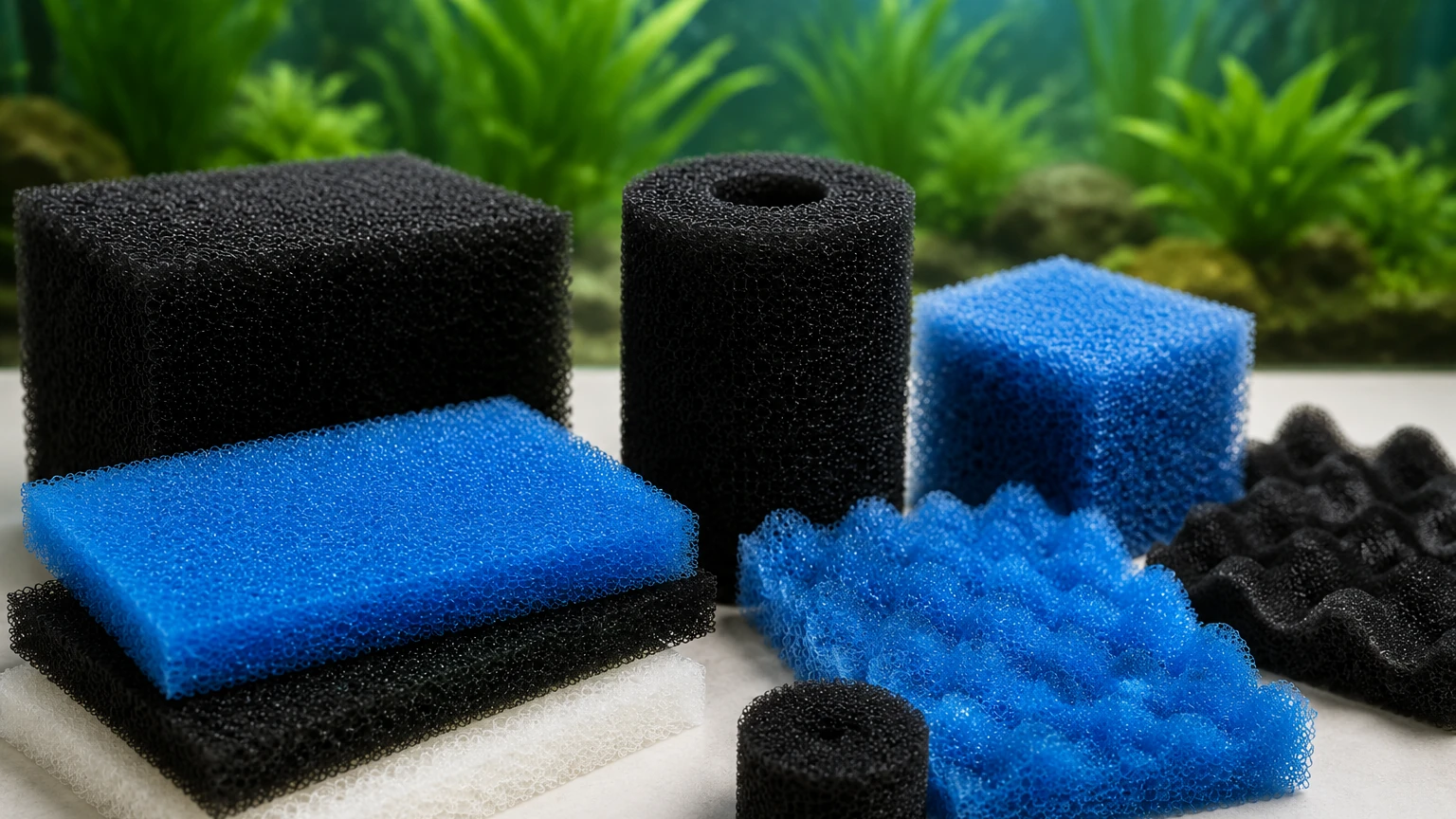
The effectiveness of filter foam for aquarium use is defined by its cellular structure. Unlike standard upholstery foam, which has closed cells that trap air and prevent water flow, aquarium filter foam must be "reticulated." Reticulation is a manufacturing process—often involving a thermal or chemical treatment—that strips away the thin cell membranes (the "windows"), leaving only the skeletal strands (the "struts").
This process creates a three-dimensional, open-cell matrix that allows water to pass through with minimal resistance while maximizing the internal surface area. From a B2B procurement perspective, the key metric for this structure is PPI (Pores Per Inch).
Understanding PPI Ratings
* 10 to 20 PPI (Coarse): These foams feature large pores and are primarily used for mechanical pre-filtration. They are designed to capture large debris, such as uneaten food or plant matter, without clogging quickly. In industrial setups, coarse foam acts as the first line of defense, protecting finer media and pump impellers from physical damage.
* 30 to 45 PPI (Medium): This is the most versatile grade, offering a balance between mechanical straining and biological colonization. The pore size is small enough to capture finer particulates while providing a significant increase in surface area for nitrifying bacteria.
* 50 to 100 PPI (Fine/Polishing): Fine foams are used for water polishing. They capture microscopic particles, resulting in high clarity. However, they possess a much higher flow resistance and are prone to rapid clogging, requiring frequent maintenance or replacement.
Material Science: Polyurethane vs. Polyether
When sourcing filter foam for aquarium systems at an industrial scale, the chemical composition of the polymer is a critical factor in determining the total cost of ownership (TCO) and system safety. Most aquarium foams are made from polyurethane, but they are categorized into two distinct types: polyester and polyether.
Polyether-Based Foam
Polyether foams are the industry standard for aquatic environments. They exhibit superior resistance to hydrolysis (breakdown when exposed to water) and are generally more stable in both freshwater and saltwater applications. Polyether foam does not degrade as quickly as polyester when submerged, ensuring that the structural integrity of the filter remains intact over years of operation.
Polyester-Based Foam
While polyester foams can be manufactured with very precise pore sizes, they are susceptible to hydrolytic degradation. Over time, the struts of the foam can become brittle and crumble, potentially releasing microplastics into the water column. For long-term industrial or commercial applications, polyether is almost always the preferred specification.
The Dual Role: Mechanical and Biological Filtration
Filter foam for aquarium use is unique because it serves two distinct filtration phases simultaneously. Understanding this duality is essential for engineers designing filtration sequences.
Mechanical Straining and Tortuosity
Mechanical filtration in foam is achieved through a principle known as tortuosity. As water flows through the complex, winding paths of the reticulated matrix, suspended solids are forced to change direction. Heavier particles cannot navigate these turns as easily as the water and become trapped against the struts. The depth of the foam block is as important as the PPI; a thicker block provides a longer path, increasing the probability of particle capture.
Biological Surface Area (BSA)
The internal struts of the foam provide a massive surface area for the colonization of aerobic nitrifying bacteria (*Nitrosomonas* and *Nitrobacter*). These bacteria are responsible for the nitrogen cycle, converting toxic ammonia into nitrite and then into relatively harmless nitrate. For large-scale systems, the "Effective Surface Area" is a vital calculation. While a 50 PPI foam has more surface area than a 20 PPI foam, the higher risk of clogging in fine foam can lead to anaerobic zones where beneficial bacteria die off due to lack of oxygen. Therefore, a tiered approach—using coarse foam followed by medium foam—is often the most stable engineering solution.
Fluid Dynamics and Pressure Drop
In B2B applications, such as public aquarium LSS or industrial aquaculture, pump efficiency is a major operational cost. The choice of filter foam directly impacts the "head loss" or pressure drop across the filtration unit.
1. Initial Pressure Drop: Clean, high-PPI foam creates a higher initial resistance to flow than coarse foam. Engineers must size pumps to handle the flow requirements at the end of the filter's service cycle, not just at the beginning.
2. Clogging Kinetics: As the foam captures debris, the effective pore size decreases, and the pressure drop increases exponentially. If the foam is too fine for the bioload of the system, the pump may experience cavitation, or the water may find a path of least resistance, leading to "channeling."
3. Channeling: This occurs when water bypasses the bulk of the filter media by flowing through gaps between the foam and the filter housing. Precision-cut foam that fits the housing with a slight compression (typically 5-10%) is necessary to ensure all water is forced through the media.
Comparison: Foam vs. Stainless Steel Filtration
While filter foam for aquarium use is excellent for biological and general mechanical filtration, there are scenarios where industrial metal filters, such as those produced by Kaifil, are superior. Understanding when to use which media is key to professional system design.
* Durability: Foam eventually degrades and requires replacement. Stainless steel wire mesh filters are permanent components that can be cleaned and reused indefinitely, making them more cost-effective for high-pressure industrial pre-filtration.
* Precision: Metal filters offer absolute micron ratings. While foam PPI is a nominal rating (approximate), stainless steel mesh provides a guaranteed filtration threshold, which is critical in pharmaceutical-grade aquatic research or sensitive chemical processing.
* Heat and Chemical Resistance: In applications involving high temperatures or aggressive cleaning chemicals, foam may melt or dissolve. Stainless steel 316L remains inert and structurally sound.
For systems requiring the highest level of durability and precision, integrating stainless steel components alongside traditional foam media often yields the best results. Explore our customized metal filtration solutions on our Main Page.
Maintenance Protocols and Replacement Cycles
For a B2B operation, maintenance must be scheduled and predictable. The lifespan of filter foam for aquarium applications depends on the bioload and the PPI rating.
* Cleaning via Mechanical Agitation: Foam should be cleaned by squeezing it in a container of system water (to preserve the bacterial colony). If the foam does not "spring back" to its original shape after being squeezed, the polymer has lost its elasticity and the foam must be replaced.
* Bio-Fouling: Over time, a biofilm called "periphyton" can become so thick that it restricts flow even after cleaning. In commercial settings, a rotating replacement schedule is often used—replacing 25-50% of the foam media at a time to ensure the biological filter remains stable while restoring flow rates.
* Monitoring: Installing pressure gauges before and after the filter allows maintenance teams to identify exactly when the foam has reached its loading capacity, moving from reactive to proactive maintenance.
Customization and OEM Procurement
For manufacturers of aquarium equipment or designers of large-scale aquatic facilities, off-the-shelf foam sizes are rarely sufficient. Custom-cut filter foam allows for optimized filter housing designs that maximize flow and minimize bypass.
When sourcing foam, procurement teams should confirm:
* Material Certification: Ensure the foam is "aquarium safe" and free from fire retardants or anti-fungal agents often found in industrial foams, which can be toxic to aquatic life.
* Dimensional Accuracy: Precision cutting (often via CNC or waterjet) ensures the 5-10% compression fit required to prevent channeling.
* PPI Consistency: Batch-to-batch consistency in pore density is vital for maintaining predictable flow rates across multiple installations.
Conclusion
Selecting the right filter foam for aquarium systems requires a deep understanding of the intersection between mechanical performance and biological requirements. By evaluating PPI, material base (polyether vs. polyester), and the specific fluid dynamics of the system, engineers can design filtration arrays that are both efficient and easy to maintain.
While foam remains a staple for biological filtration and light mechanical straining, demanding industrial applications often benefit from the precision and permanence of stainless steel filtration components. Whether you are looking for standard media or custom-engineered metal filter cartridges, Kaifil provides the technical expertise to support your project. To review our full range of industrial filtration capabilities, please visit our Main Page.
