


What Is Backwashing a Filter
In industrial filtration, maintaining the continuity of a process while ensuring the purity of the fluid stream is a primary engineering challenge. Among the various methods used to extend the service life of filter media and maintain system efficiency, backwashing stands out as a critical technique. For engineers and facility managers, understanding what is backwashing a filter involves more than just knowing it as a cleaning cycle; it requires a deep dive into fluid dynamics, pressure differentials, and material durability.
Backwashing is the process of reversing the flow of a fluid through a filter medium to dislodge and remove accumulated contaminants. Unlike disposable filtration systems that require frequent cartridge replacement, backwashable systems—particularly those utilizing stainless steel wire mesh or sintered metal components—are designed for longevity and repeated cleaning. This article examines the technical nuances of backwashing, its application in demanding industrial environments, and the engineering criteria necessary for optimizing these systems.
Understanding the Fundamental Principles of Backwashing
To answer the question of what is backwashing a filter from an engineering perspective, one must look at the interaction between the filter media and the particulate matter. During the normal filtration cycle (forward flow), fluid passes through the filter, and solids are trapped either on the surface of the media (surface filtration) or within the structure of the media (depth filtration). Over time, these solids form a "filter cake" or plug the pores of the mesh.
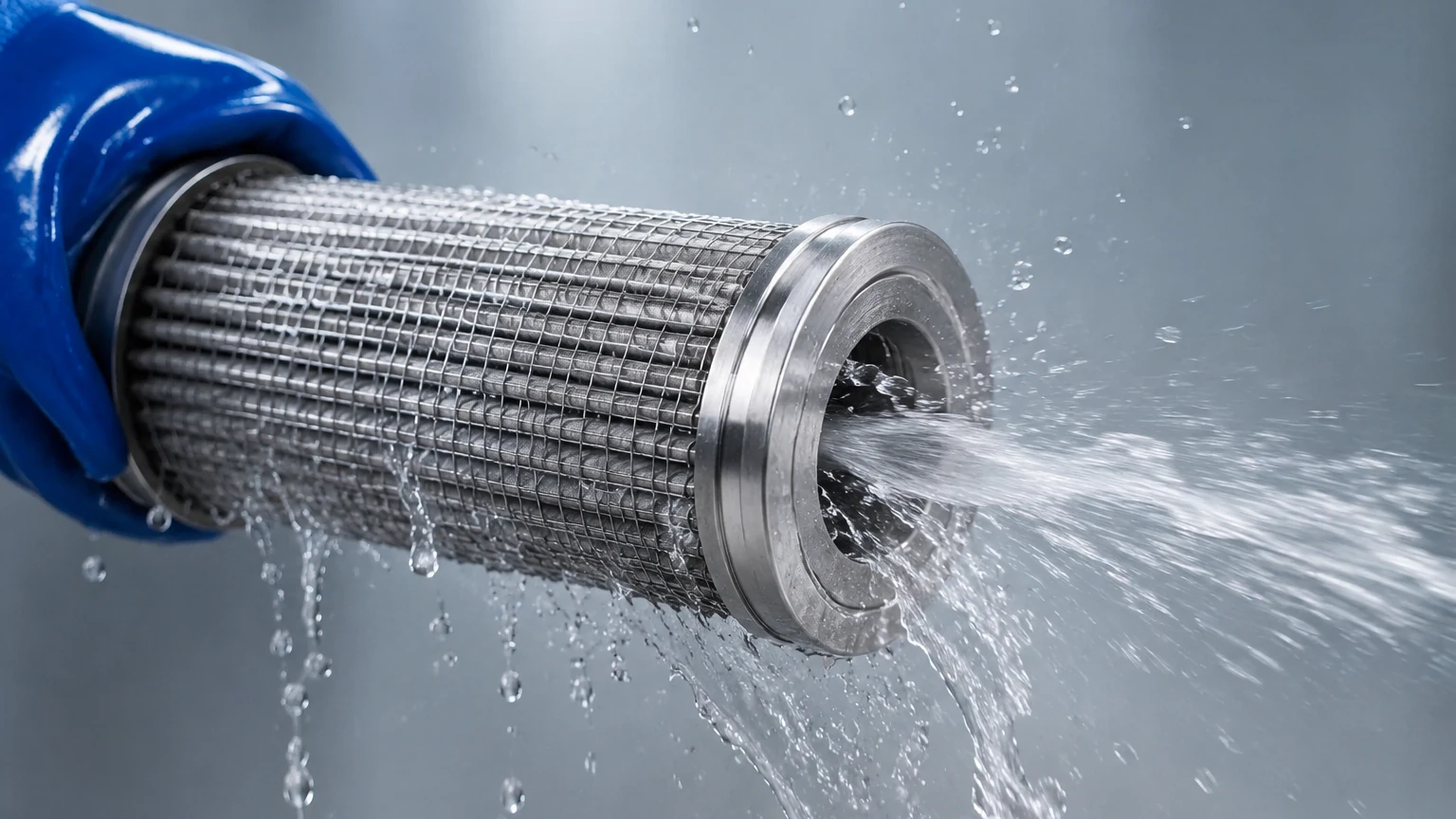
Backwashing initiates a reverse flow—typically at a higher velocity or pressure than the forward flow—which creates a hydrodynamic force sufficient to lift the particles away from the media. In a well-designed system, this reverse flow fluidizes the trapped particles and carries them out through a dedicated waste or drain port.
For industrial applications, especially those involving stainless steel filter cartridges, the structural integrity of the media is paramount. The filter must be able to withstand the reverse pressure without deforming or experiencing "media migration," where parts of the filter itself break off into the clean stream. This is why precision-engineered metal filters are often preferred over polymer alternatives in systems where backwashing is a standard operational requirement.
The Role of Differential Pressure in Backwash Cycles
The primary indicator used to determine when a backwash cycle is necessary is differential pressure (ΔP). Differential pressure is the difference in pressure between the inlet (upstream) and the outlet (downstream) of the filter housing. As contaminants accumulate on the filter surface, the effective open area decreases, forcing the fluid to move through smaller openings at higher resistance, which increases the ΔP.
In automated industrial systems, sensors monitor this pressure drop. When the ΔP reaches a predetermined set point—often referred to as the "terminal pressure drop"—the system triggers a backwash cycle. For engineers, setting this threshold is a balancing act. If the backwash is triggered too early, the system wastes energy and backwash fluid. If it is triggered too late, the high pressure can compress the filter cake so tightly that it becomes nearly impossible to remove, or it may even damage the filter elements.
Effective backwashing typically requires a reverse flow rate that is 1.5 to 2 times the forward flow rate. This ensures that the shear forces are strong enough to overcome the adhesion between the particles and the stainless steel mesh. For more information on high-performance filter designs that support these rigorous cycles, technical teams often refer to the Main Page for detailed specifications on mesh geometry and structural reinforcements.
Material Selection: Why Stainless Steel Filters Excel in Backwash Applications
When discussing what is backwashing a filter, the material of the filter element is a decisive factor in the system's success. Industrial processes involving high temperatures, corrosive chemicals, or high-viscosity fluids cannot rely on standard fabric or paper filters for backwashing.
Stainless steel (typically 304 or 316L) and other specialty alloys are the gold standard for backwashable filter elements for several reasons:
1. Mechanical Strength: Stainless steel wire mesh can withstand significant pressure reversals without collapsing. This allows for "pulse cleaning," where a high-pressure burst of air or fluid is used to shock the contaminants off the surface.
2. Corrosion Resistance: In chemical processing or water treatment, the backwash fluid itself may be aggressive. Stainless steel ensures the filter does not degrade during the cleaning process.
3. Thermal Stability: Many industrial backwash cycles use steam or hot water to help break down organic or oily contaminants. Metal filters maintain their pore size and structural integrity at temperatures that would melt or warp synthetic media.
4. Uniform Pore Structure: Precision-woven wire mesh provides a consistent pore size, which ensures that the backwash flow is distributed evenly across the entire surface of the filter, preventing "dead zones" where contaminants might remain.
Operational Benefits: Sustainability and Cost-Effectiveness
Implementing a backwashable filtration system offers significant long-term advantages over disposable systems. While the initial capital expenditure for stainless steel filter cartridges and the associated valving for backwashing is higher, the total cost of ownership (TCO) is generally much lower in high-volume industrial applications.
Reduced Consumable Costs
In a disposable system, every time a filter clogs, it must be removed, disposed of, and replaced. This creates a recurring cost for the filters themselves, as well as the labor required for the change-out. A backwashable stainless steel filter can be cleaned thousands of times, often lasting several years before requiring replacement.
Minimized Downtime
Manual filter changes require the process to be halted, the housing to be opened, and the system to be bled and restarted. Backwashing, especially when automated, can occur in seconds or minutes. Many systems utilize a "duplex" configuration or a multi-element design where one part of the filter is backwashed while the rest remains online, allowing for continuous operation.
Environmental Impact
Backwashing is a more sustainable choice for modern industrial facilities. By eliminating the constant stream of used, contaminated filter cartridges destined for landfills, companies can significantly reduce their environmental footprint. Furthermore, in many closed-loop systems, the backwash fluid can be treated and recycled, further reducing resource consumption.
Technical Considerations for Designing Backwashable Systems
Designing a system that effectively utilizes backwashing requires careful consideration of several engineering variables. It is not enough to simply reverse the pump; the entire architecture must support the cleaning mechanism.
* Backwash Fluid Source: Engineers must decide whether to use the filtered process fluid (internal backwash) or an external clean fluid (external backwash) for the cleaning cycle. Internal backwash is simpler but results in a loss of processed product. External backwash prevents product loss but requires a separate fluid supply and potential compatibility checks.
* Valve Configuration: Automated backwashing requires a series of actuated valves (inlet, outlet, backwash inlet, and drain). The timing of these valves is critical to prevent water hammer—a pressure surge that can rupture pipes or damage filter elements.
* Waste Management: The backwash effluent contains a high concentration of solids. The system must be designed to handle this concentrated waste stream, whether it goes to a settling tank, a centrifuge, or a secondary filtration stage.
* Micron Rating and Mesh Type: Not all mesh types are equally easy to backwash. For instance, a plain weave mesh is easier to clean than a complex Dutch weave, though the latter may offer finer filtration. Engineers must select a micron rating that balances the required filtration accuracy with the ability of the backwash cycle to clear the pores.
Common Challenges and Troubleshooting
Even with a well-designed system, backwashing can face challenges. One of the most common issues is "incomplete cleaning," where a portion of the filter remains clogged after the cycle. This often happens if the backwash flow rate is insufficient or if the contaminants are particularly adhesive (such as biological films or certain polymers).
Another challenge is "media blinding," where particles become wedged so deeply within the pores that the reverse flow cannot dislodge them. In these cases, periodic chemical cleaning (CIP – Clean In Place) or ultrasonic cleaning may be required to supplement the standard backwash cycles. Monitoring the "clean ΔP"—the pressure drop immediately after a backwash—is the best way to track the long-term health of the filter element. If the clean ΔP begins to creep upward over several months, it indicates that the backwash cycles are becoming less effective and a more intensive cleaning or replacement is approaching.
Conclusion: Making Informed Decisions for Industrial Filtration
Understanding what is backwashing a filter is essential for any technical professional involved in fluid processing. It is a sophisticated maintenance strategy that, when paired with high-quality stainless steel filter elements, ensures process stability, reduces operational costs, and supports sustainable manufacturing practices.
For engineers looking to implement or optimize a backwashable system, the choice of filter media is the most critical decision. The durability, precision, and chemical compatibility of the filter element determine the success of every backwash cycle. By focusing on robust materials and precise engineering specifications, facilities can achieve a filtration solution that meets the rigorous demands of modern industry. To explore the range of customizable stainless steel filtration components designed for these applications, visit the Main Page for technical guidance and product details.
