


Filter Frit
In the landscape of precision industrial filtration, the filter frit serves as a critical component for fluid management, particulate retention, and media support. Unlike standard woven wire cloth, a filter frit is typically a porous, sintered structure designed to provide high mechanical strength while maintaining specific permeability. For engineers and procurement specialists in sectors such as chemical processing, pharmaceuticals, and high-performance liquid chromatography (HPLC), understanding the technical nuances of frit selection is essential for ensuring system longevity and process purity.
As a specialized manufacturer of stainless steel filtration solutions, Kaifil provides high-performance components tailored to demanding industrial environments. This guide explores the engineering principles, material considerations, and application-specific requirements that define the performance of a filter frit, providing the technical foundation necessary for informed industrial procurement.
Engineering Principles and Manufacturing of Filter Frits
The manufacturing of a filter frit involves advanced powder metallurgy or specialized mesh sintering techniques. The most common method for producing high-precision frits is the sintering of spherical or irregular metallic powders. During this process, the metal powder is placed into a mold and heated in a controlled-atmosphere furnace to a temperature just below its melting point. This facilitates solid-state diffusion, where the particles bond at their contact points (necks), creating a rigid, porous matrix.
The resulting structure is characterized by an interconnected network of pores. Unlike surface filtration media, such as a single layer of wire mesh, a sintered filter frit offers depth filtration characteristics. The tortuous path created by the bonded particles traps contaminants not just on the surface, but within the thickness of the frit itself. This increases the dirt-holding capacity and prevents the immediate blinding of the filter surface.
Engineers must distinguish between powder-sintered frits and mesh-sintered frits. Powder-sintered components offer exceptional uniformity in pore size and are ideal for applications requiring filtration ratings down to 0.5 microns. Mesh-sintered frits, often constructed from multiple layers of stainless steel wire cloth, provide higher permeability and are frequently used as support structures for finer filter media or in high-flow gas applications. Kaifil specializes in both formats, ensuring that the structural integrity of the component matches the mechanical stresses of the intended application.
Material Selection for Demanding Environments
Material compatibility is a primary concern when selecting a filter frit, as these components are often exposed to aggressive solvents, high temperatures, and fluctuating pressure gradients. The most prevalent material used in industrial frits is 316L stainless steel. The "L" denotes low carbon content, which is essential for preventing carbide precipitation during the sintering process, thereby maintaining the alloy's corrosion resistance.
316L stainless steel provides excellent resistance to a wide range of organic solvents and many mild acids. However, for extreme environments, other alloys may be required:
* Titanium: Preferred for its high strength-to-weight ratio and exceptional resistance to chlorides and seawater, making it a staple in marine and specialized chemical applications.
* Nickel-Based Alloys (e.g., Hastelloy): Used in highly corrosive environments where 316L might suffer from pitting or stress corrosion cracking, such as in the presence of strong mineral acids.
* 304 Stainless Steel: A cost-effective alternative for less demanding applications where high-level corrosion resistance is not the primary driver.
Beyond chemical compatibility, the thermal properties of the material must be evaluated. Sintered metal frits can typically withstand temperatures exceeding 400°C (752°F) in oxidizing environments and even higher in reducing atmospheres. This thermal stability allows for in-situ sterilization (SIP) and high-temperature gas filtration, which would degrade polymer-based filtration components.
Key Performance Metrics: Pore Size and Permeability
When specifying a filter frit, the two most critical metrics are the mean pore size (filtration rating) and the permeability (flow rate vs. pressure drop). These factors are inversely related; as the pore size decreases to capture finer particles, the resistance to flow increases.
Filtration Rating: Absolute vs. Nominal
In the context of a filter frit, an absolute rating refers to the diameter of the largest hard spherical particle that will pass through the filter under specified test conditions. A nominal rating, conversely, represents an efficiency percentage (often 60% to 90%) of particles retained at a certain micron size. For analytical applications like HPLC, absolute ratings are generally required to protect sensitive columns from particulate damage.
Permeability and Pressure Drop
Permeability is a measure of how easily a fluid can pass through the porous structure. This is governed by Darcy’s Law, which relates the flow rate to the fluid viscosity, the thickness of the frit, and the pressure differential ($ΔP$). Engineers must ensure that the selected frit does not introduce an excessive pressure drop that could strain pumps or reduce system efficiency. Factors influencing this include:
1. Porosity: The percentage of void space in the frit. Higher porosity generally leads to better flow but lower mechanical strength.
2. Frit Thickness: Thicker frits provide better depth filtration and mechanical support but increase the flow resistance.
3. Pore Geometry: The shape and distribution of the pores, which are controlled during the sintering process.
Industrial Applications and System Integration
Filter frits are found in a diverse array of industrial and laboratory equipment. Their role varies from simple particulate removal to complex fluid distribution.
Analytical Instrumentation (HPLC/UHPLC)
In chromatography, the filter frit is a critical safeguard. It is placed at the inlet of the column to prevent micro-particulates from the sample or mobile phase from clogging the packed bed. These frits must be precision-engineered to have minimal dead volume, preventing peak broadening and maintaining the integrity of the analytical results.
Chemical and Petrochemical Processing
In large-scale chemical reactors, larger sintered frits act as catalyst recovery filters or gas spargers. As spargers, they introduce fine gas bubbles into a liquid, maximizing the surface area for gas-liquid reactions. The durability of the sintered metal ensures that the sparger can withstand the turbulent environment inside a reactor vessel.
Pharmaceutical and Biotech Manufacturing
Due to their ability to be cleaned and sterilized, stainless steel frits are ideal for pharmaceutical processes. They are used in the filtration of active pharmaceutical ingredients (APIs) and as vents for sterile tanks, where they allow for pressure equalization while maintaining a microbial barrier.
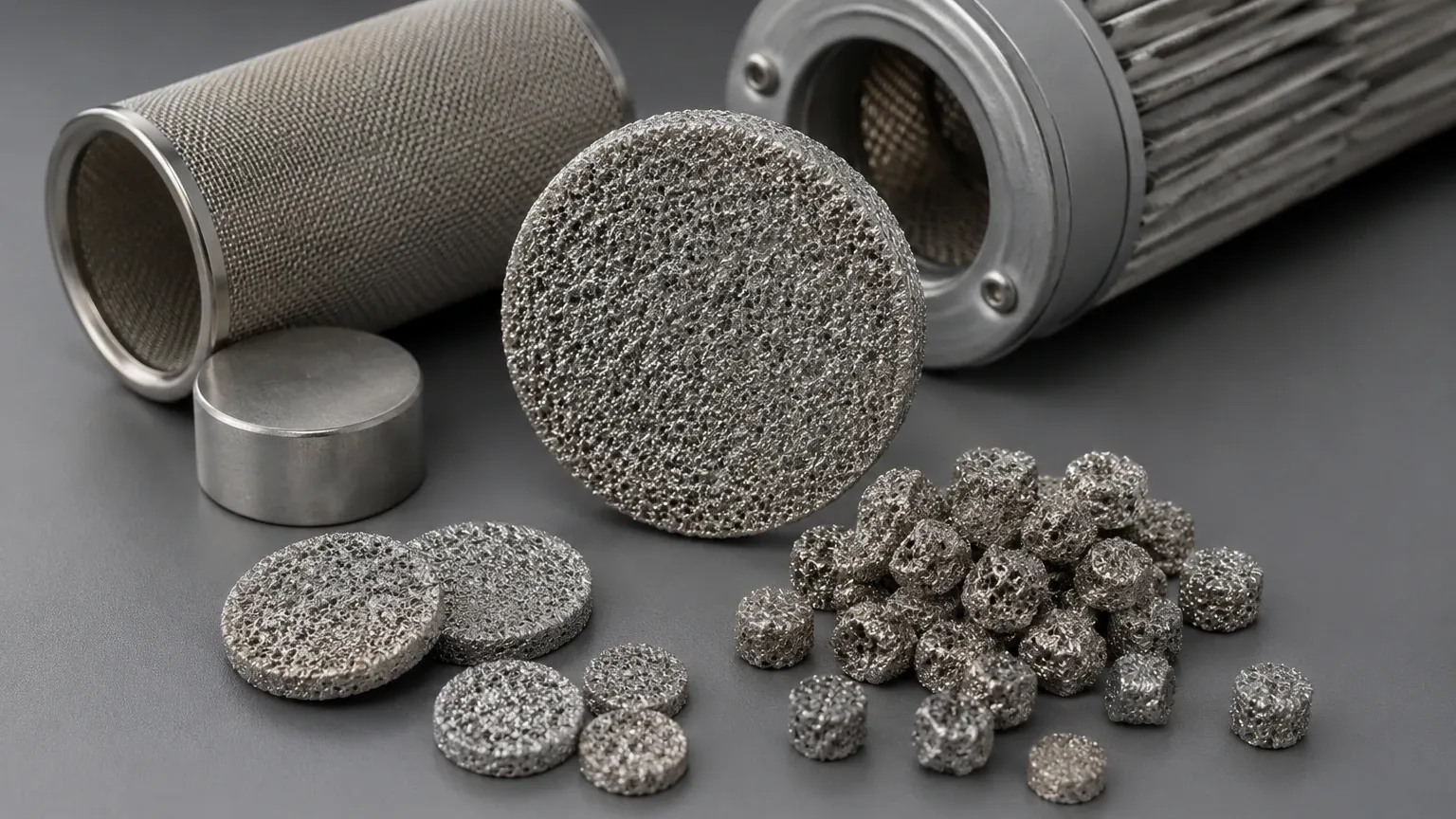
For organizations looking to integrate these components into their broader systems, reviewing the comprehensive product range on the Main Page can provide insights into how different filtration geometries—from flat discs to cylindrical cartridges—can be adapted to specific housing requirements.
Customization and OEM Requirements
In many B2B scenarios, off-the-shelf filter frits do not meet the exacting tolerances or unique geometries required by specialized equipment. Customization is often necessary in several dimensions:
* Dimensional Tolerances: High-precision instruments require frits with diameter tolerances as tight as ±0.05mm to ensure a leak-free press fit into housings.
* Integrated Housings: To simplify assembly for OEM customers, frits can be pre-pressed or welded into stainless steel or PEEK (Polyether ether ketone) rings. This prevents bypass and protects the edges of the porous media.
* Surface Finish: For applications in the food and beverage or pharmaceutical industries, the non-porous sections of the filter assembly may require specific electropolishing to meet sanitary standards.
Kaifil works closely with engineering teams to develop customized filtration components. By controlling the entire manufacturing process—from metal powder selection to final inspection—it is possible to produce frits that meet specific flow-pressure profiles tailored to a particular machine's hydraulic or pneumatic circuit.
Maintenance, Cleaning, and Longevity
One of the primary advantages of a stainless steel filter frit over disposable polymer filters is its cleanability. In many industrial processes, the total cost of ownership (TCO) is significantly reduced by implementing a cleaning regimen rather than frequent replacement.
Cleaning Methods
1. Ultrasonic Cleaning: This is the most effective method for removing fine particulates trapped within the depth of the frit. The high-frequency sound waves create cavitation bubbles that dislodge contaminants.
2. Backflushing: Reversing the flow of clean fluid through the frit can remove surface cakes and loosely lodged particles.
3. Chemical Cleaning: Soaking the frit in compatible solvents or caustic solutions can dissolve organic build-up or mineral scales.
4. Thermal Burn-off: For frits used in high-temperature polymer processing, heating the frit to a temperature that carbonizes organic contaminants can restore permeability.
Replacement Indicators
Despite their durability, frits eventually reach a point of "permanent fouling" where the pressure drop no longer returns to baseline levels after cleaning. Engineers should monitor the $ΔP$ across the filter; a consistent increase in the post-cleaning pressure drop indicates that the internal pore structure is becoming restricted, and a replacement is necessary to prevent system failure or pump damage.
Conclusion: Selecting the Right Filter Frit
Selecting the appropriate filter frit is a balance of material science, fluid dynamics, and mechanical engineering. By focusing on the specific micron rating required for the application, the chemical environment the frit will inhabit, and the necessary flow characteristics, technical teams can ensure optimal performance.
Whether the requirement is for a sub-micron disc for a laboratory instrument or a heavy-duty sintered support for an industrial hydraulic system, the quality of the sintering process remains the determining factor in the component's reliability. For further technical specifications, application support, or to explore custom OEM capabilities, technical professionals are encouraged to consult the resources available on the Kaifil Main Page to find the filtration solution that aligns with their specific operational goals.
