


Filtri Acqua Industriali
In the landscape of modern manufacturing and processing, the quality of process water is a critical variable that directly impacts equipment longevity, product consistency, and operational efficiency. Industrial water filtration, or the implementation of *filtri acqua industriali*, represents a fundamental engineering requirement across sectors ranging from chemical processing and pharmaceuticals to food and beverage production. For engineers and procurement specialists, selecting the correct filtration system requires a deep understanding of fluid dynamics, material science, and the specific contaminants present in the water supply.
Industrial water filters are not generic components; they are precision-engineered tools designed to remove suspended solids, particulates, and biological matter from water streams. Whether the application involves cooling tower water, boiler feed water, or high-purity process water, the choice of filter medium and housing configuration determines the overall reliability of the industrial system. This guide explores the technical parameters, material considerations, and engineering criteria essential for optimizing industrial water filtration.
Understanding Technical Specifications for Filtri Acqua Industriali
When evaluating *filtri acqua industriali*, the first step is defining the performance requirements based on the specific application. Engineers must look beyond simple flow rates to understand how a filter will behave under varying industrial conditions. Key technical specifications include:
Micron Rating and Filtration Efficiency
The micron rating defines the size of particles the filter is capable of capturing. This is further categorized into absolute and nominal ratings. A nominal rating indicates the filter's ability to retain a majority of particles of a specific size, whereas an absolute rating (often achieved through high-precision stainless steel wire mesh) guarantees the retention of nearly all particles above the specified threshold. In critical industrial processes, absolute ratings are preferred to prevent downstream contamination.
Flow Rate and Differential Pressure
Every filter introduces a degree of resistance to the fluid flow, known as pressure drop or differential pressure ($ΔP$). It is vital to select a filter that can handle the required flow rate (measured in $m^3/h$ or GPM) without exceeding the maximum allowable pressure drop. As the filter accumulates debris, the $ΔP$ increases. Engineering teams must calculate the "clean" pressure drop and establish a "terminal" pressure drop at which the filter element must be cleaned or replaced.
Material Compatibility
The chemical composition of the water—including pH levels, chloride content, and the presence of oxidizing agents—dictates the material of construction. While plastic filters may suffice for low-pressure, non-critical applications, industrial environments typically demand the robustness of metals. Stainless steel, particularly grades 304 and 316L, is the standard for *filtri acqua industriali* due to its resistance to corrosion and mechanical stress.
The Advantages of Stainless Steel in Water Filtration
For high-demand industrial applications, stainless steel filtration components offer significant advantages over synthetic alternatives. As a specialist manufacturer, Kaifil emphasizes the use of precision-engineered metal media to ensure long-term performance.
1. Mechanical Strength: Industrial water systems often experience pressure surges and hydraulic shocks. Stainless steel filter cartridges and wire mesh elements possess the structural integrity to withstand these stresses without collapsing or bypassing.
2. Thermal Stability: Many industrial processes involve high-temperature water or steam cleaning (SIP/CIP). Stainless steel maintains its physical properties at temperatures where polymers would soften or degrade.
3. Corrosion Resistance: In applications involving brackish water or chemical additives, 316L stainless steel provides superior resistance to pitting and crevice corrosion, ensuring that the filter itself does not become a source of contamination.
4. Sustainability and Reusability: Unlike disposable plastic cartridges, stainless steel filters are typically cleanable and reusable. This reduces the total cost of ownership and minimizes the environmental impact of industrial waste.
To explore specific material options and technical configurations, engineers can Review product options and application support to align filtration hardware with their system requirements.
Types of Industrial Water Filter Components
The architecture of *filtri acqua industriali* varies based on the nature of the solids being removed and the required level of precision. Common configurations include:
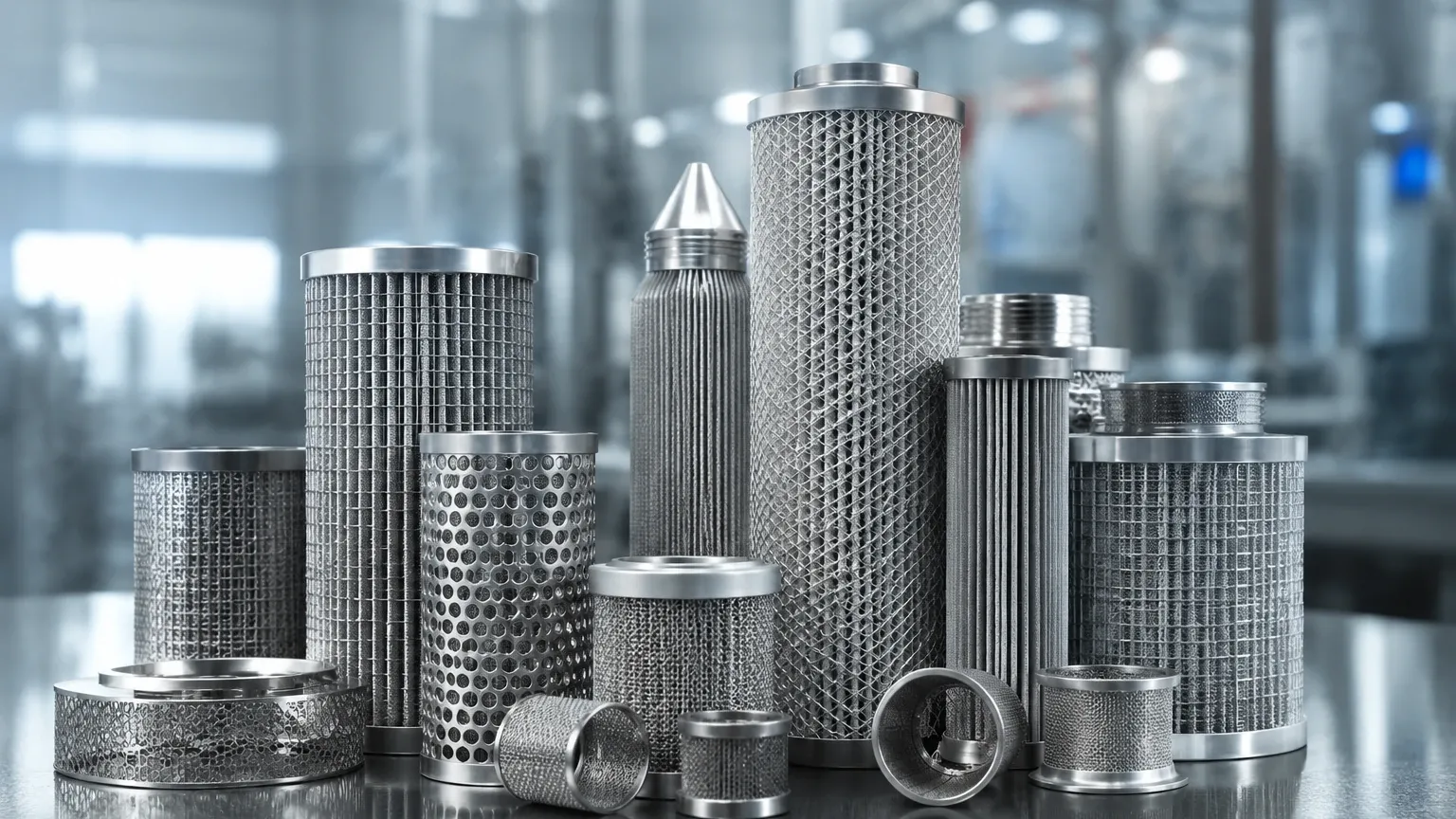
Stainless Steel Wire Mesh Filters
Wire mesh filters are constructed from woven metallic cloth. They are highly versatile and can be manufactured in multiple layers (sintered) to provide depth filtration or single layers for surface filtration. They are ideal for removing sand, scale, and larger particulates from water streams.
Sintered Metal Filter Cartridges
Sintered metal elements are created by fusing metal powders or fibers under high heat and pressure. This creates a porous, rigid structure with a highly controlled pore size. Sintered filters are used when extreme precision is required, such as in the protection of sensitive membranes or high-pressure nozzles.
Wedge Wire Screens
Wedge wire is characterized by its V-shaped profile wires. This design is particularly effective for self-cleaning filters because the outward-widening slots prevent clogging and facilitate easy backwashing. These are frequently used in intake water systems and large-scale industrial water treatment.
Basket Strainers
Used primarily for coarse filtration, basket strainers protect pumps and valves from large debris. They are designed for high-volume flow and are usually the first line of defense in an industrial water circuit.
Engineering Considerations for High-Performance Systems
Integrating *filtri acqua industriali* into an existing process requires more than just matching pipe sizes. Several engineering factors must be addressed to ensure the system operates at peak efficiency.
Sealing Mechanisms
The integrity of the seal between the filter element and the housing is paramount. In industrial water filtration, O-rings or gaskets made from EPDM, Viton, or PTFE are used depending on the chemical and thermal profile of the water. A failure in the seal leads to "bypass," where unfiltered water moves downstream, potentially damaging sensitive equipment.
Surface Area vs. Flux Rate
The flux rate is the volume of water passing through a unit area of the filter medium. By increasing the surface area—often through pleating the stainless steel mesh—engineers can lower the flux rate. A lower flux rate reduces the velocity of particles hitting the mesh, which improves filtration efficiency and extends the time between cleaning cycles.
Structural Support
In high-pressure applications, the filter medium requires internal or external support cores. These perforated tubes or cages prevent the mesh from deforming under the force of the water flow. The design of these supports must be optimized to provide maximum strength while minimizing the restriction of flow.
Customization and OEM Solutions for Specific Applications
Every industrial facility has unique challenges, from space constraints to specific contaminant profiles. Standard off-the-shelf filters often fail to meet the exact needs of specialized sectors like pharmaceutical grade water or high-pressure hydraulic cooling. This is where customized manufacturing becomes essential.
Customized *filtri acqua industriali* allow for:
* Bespoke Dimensions: Fitting high-performance filtration into compact skid designs or existing housing units.
* Tailored Micron Ratings: Developing specific mesh weaves to target unique particle shapes or sizes found in specific industrial byproducts.
* Specialized End Fittings: Ensuring compatibility with proprietary housing designs, including DOE (Double Open End), SOE (Single Open End) with various fin or code configurations.
By working with a manufacturer like Kaifil, companies can develop OEM components that are specifically engineered for their proprietary machinery, ensuring that the filtration stage is a seamless part of the industrial process.
Maintenance and Operational Longevity
The total cost of ownership (TCO) of *filtri acqua industriali* is heavily influenced by maintenance requirements. While the initial investment in stainless steel filtration is higher than in disposable systems, the long-term savings are substantial.
Cleaning Protocols
Stainless steel filters can be cleaned using several methods:
* Backwashing: Reversing the flow of water to dislodge particles trapped on the surface of the mesh.
* Ultrasonic Cleaning: Using high-frequency sound waves in a solvent bath to remove fine particulates from deep within sintered structures.
* Chemical Cleaning: Using acids or alkalis to dissolve organic or mineral scaling, provided the filter material is compatible.
Monitoring Performance
Modern industrial systems should include differential pressure sensors across the filtration stage. By monitoring the $ΔP$ in real-time, maintenance teams can perform cleaning only when necessary, preventing unnecessary downtime while ensuring the system never operates with a clogged filter.
Replacement Cycles
Even with regular cleaning, metal filters eventually reach the end of their service life due to mechanical wear or irreversible fouling. However, a well-maintained stainless steel filter can last for years, whereas polymer filters might require replacement every few weeks. This longevity is a key factor for procurement departments focusing on operational stability.
Selecting the Right Partner for Industrial Filtration
Choosing a provider for *filtri acqua industriali* involves evaluating more than just the product catalog. It requires a partner with the technical expertise to understand the nuances of industrial fluid dynamics. A reliable manufacturer should provide:
* Material Certification: Verification of the stainless steel grade to ensure it meets industrial and regulatory standards.
* Technical Documentation: Detailed drawings, pressure drop curves, and micron retention data.
* Application Engineering: The ability to consult on the best filter type for a specific water chemistry or flow requirement.
In conclusion, *filtri acqua industriali* are vital components that safeguard the integrity of industrial processes. By prioritizing high-quality materials like stainless steel and focusing on precise engineering specifications such as micron ratings and flow dynamics, industrial operators can achieve higher efficiency and lower maintenance costs. For those seeking to optimize their filtration systems with durable, custom-engineered solutions, the Main Page of Kaifil offers a comprehensive overview of the capabilities and products available to meet these demanding requirements.
