


Filter Lube Oil
In industrial machinery, the lubrication system is often compared to the circulatory system of a living organism. Its primary function is to reduce friction, dissipate heat, and transport contaminants away from critical moving parts. However, the effectiveness of a lubricant is entirely dependent on its purity. To filter lube oil correctly requires a deep understanding of fluid dynamics, material science, and the specific mechanical requirements of the equipment in question. For engineers and maintenance professionals, selecting the appropriate filtration solution is not merely a routine procurement task but a critical engineering decision that impacts the total cost of ownership (TCO) and the operational lifespan of high-value assets.
The Engineering Necessity of Lube Oil Filtration
Lubricating oils are subjected to extreme conditions, including high pressures, fluctuating temperatures, and mechanical shear. Over time, these conditions contribute to the degradation of the oil and the accumulation of contaminants. These contaminants generally fall into two categories: primary and secondary. Primary contaminants include environmental dust, moisture, and debris introduced during maintenance. Secondary contaminants are the result of internal processes, such as metal wear particles, soot from combustion, and chemical byproducts like varnish and sludge.
When you filter lube oil, the goal is to remove these particulates before they can cause abrasive wear. Abrasive wear occurs when particles larger than the lubricant film thickness enter the contact zone between moving parts, such as bearings or gears. If these particles are not captured by a high-efficiency filter, they act as grinding agents, leading to surface fatigue, pitting, and eventual component failure. Therefore, the filtration system must be designed to maintain the oil's cleanliness level within the tolerances specified by the equipment manufacturer.
Technical Parameters for Filter Selection
Selecting a filter for lube oil applications involves more than just matching a thread size or a housing diameter. Engineers must evaluate several technical parameters to ensure the filter performs reliably under varying operational loads.
Viscosity and Flow Rate
One of the most significant challenges in lube oil filtration is the variability of oil viscosity. Lubricating oils are highly temperature-sensitive; at cold start-up, the oil is thick and resistant to flow. As the machinery reaches operating temperature, the viscosity drops significantly. A filter must be engineered to handle the maximum flow rate at the highest expected viscosity without triggering the bypass valve. If the pressure drop (ΔP) across the filter media exceeds the bypass setting, unfiltered oil will circulate through the system to prevent oil starvation, leaving the machinery vulnerable to damage.
Micron Rating: Absolute vs. Nominal
When reviewing specifications on a Main Page or technical datasheet, it is vital to distinguish between nominal and absolute micron ratings. A nominal rating is an internal commercial standard representing a percentage efficiency (often 50% or 90%) at a given particle size. In contrast, an absolute rating indicates that the filter will capture 99.9% or more of particles at that size. For critical lube oil systems, such as those in gas turbines or high-speed compressors, absolute-rated filters are generally required to ensure consistent protection.
Beta Ratio (β)
The Beta Ratio is the industry standard for expressing a filter's efficiency. It is calculated by dividing the number of particles of a certain size upstream of the filter by the number of particles of that same size downstream. For example, a β10 = 1000 rating means that for every 1000 particles of 10 microns entering the filter, only one passes through. High-performance stainless steel filters often provide superior Beta stability compared to disposable cellulose media, especially under high-pressure pulses.
The Advantages of Stainless Steel Filtration Media
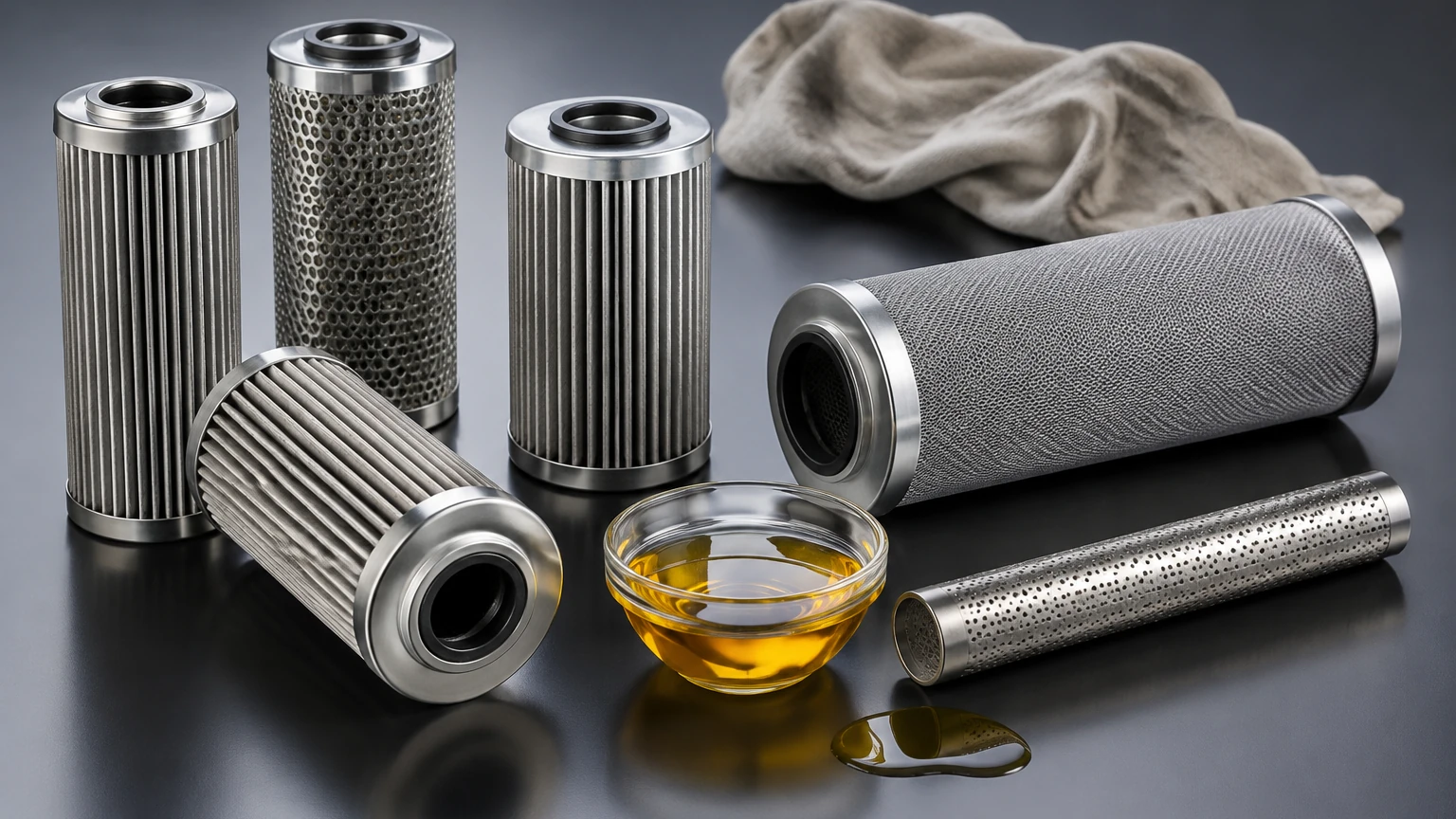
While disposable synthetic or cellulose filters are common, many industrial applications benefit significantly from stainless steel filtration components. Kaifil specializes in the manufacture of these robust solutions, which offer several distinct advantages for lube oil systems.
Thermal and Chemical Stability
Lube oils in heavy industrial gearboxes or hydraulic systems can reach temperatures that degrade standard glue-bonded filters. Stainless steel filters, particularly those that are all-welded or sintered, can withstand extreme temperatures without losing structural integrity. Furthermore, they are immune to the chemical additives found in modern high-performance lubricants, which can sometimes cause swelling or softening in synthetic media.
Structural Integrity and Pressure Resistance
In systems characterized by high-pressure spikes or cyclic flow, the filter media must resist deformation. Stainless steel wire mesh and sintered metal fiber provide high mechanical strength. This prevents "media migration," where fragments of the filter material itself break off and enter the downstream flow—a common failure mode in lower-quality disposable filters.
Cleanability and Reusability
For many B2B operations, the ability to clean and reuse a filter is a major factor in reducing long-term operational costs. Stainless steel filters can be cleaned using ultrasonic baths, back-flushing, or chemical solvents. This not only reduces the waste stream but also ensures that the system always operates with a filter that meets its original design specifications, rather than relying on a revolving door of varying-quality replacements.
Understanding ISO 4406 Cleanliness Codes
To effectively filter lube oil, engineers use the ISO 4406 standard to quantify oil cleanliness. This code uses three numbers to represent the count of particles larger than 4μm, 6μm, and 14μm per milliliter of fluid. For example, a code of 18/16/13 indicates a specific range of particle counts at each level.
When designing a filtration strategy, the target ISO code should be determined by the most sensitive component in the system. High-pressure hydraulic valves might require a 16/14/11 rating, while a large industrial gearbox might operate safely at 19/17/14. The filtration media must be selected specifically to achieve and maintain these targets. If the filter is too coarse, the oil will never reach the required cleanliness; if it is too fine without sufficient surface area, it will clog prematurely, leading to excessive maintenance intervals.
Customization and OEM Integration
Every industrial application has unique constraints, from spatial limitations in a machine's housing to specific flow requirements. Kaifil provides customized filtration solutions that address these engineering challenges. Customization options typically include:
* Pleated Designs: Increasing the surface area of the stainless steel mesh allows for higher flow rates and greater dirt-holding capacity without increasing the overall footprint of the filter.
* Reinforced Cores: For high-differential pressure applications, internal support cores prevent the collapse of the filter element.
* End Cap Configurations: Custom machining of end caps ensures a perfect seal within existing housings, preventing bypass leakage.
By working with a manufacturer that understands the nuances of metal filtration, purchasing teams can secure components that are precisely tuned to their equipment's needs, rather than settling for "off-the-shelf" parts that may offer sub-optimal performance.
Common Risks in Lube Oil Systems
Failure to properly filter lube oil leads to several well-documented risks that can halt production and cause catastrophic mechanical failure.
Varnish Formation
Varnish is a thin, insoluble film that deposits on internal surfaces. It is often caused by the thermal degradation of the oil. While standard mechanical filters are designed to capture hard particles, specialized sub-micron filtration or chemical treatment is often needed to manage varnish. However, maintaining low particulate levels through high-quality stainless steel filtration can help reduce the catalytic effect that metal particles have on oil oxidation, thereby slowing varnish formation.
Water Contamination
Water is a common contaminant in lube oil, leading to rust, reduced lubricity, and the depletion of additives. While primary filtration focuses on particulates, the use of coalescing filters or centrifugal separators is often necessary in conjunction with standard particulate filters. Stainless steel mesh can be treated or configured to assist in the separation of large water droplets in certain system designs.
Aeration and Foaming
If a filter is poorly designed or if the suction line has a leak, air can become entrained in the oil. Aerated oil is compressible, which leads to spongy hydraulic response and cavitation in pumps. Ensuring that the filter housing and the filter element are correctly matched and sealed is essential to preventing air ingress during the filtration process.
Lifecycle Management and Total Cost of Ownership
When evaluating filtration options, the initial purchase price is only one component of the total cost. A comprehensive analysis must include:
1. Replacement Frequency: How long does the filter last before the pressure drop necessitates a change?
2. Labor Costs: The time required for maintenance personnel to change filters and dispose of contaminated media.
3. Oil Life Extension: High-efficiency filtration can significantly extend the time between oil changes, which is a major cost saving in systems with large oil volumes.
4. Component Longevity: The reduction in wear on pumps, bearings, and valves directly translates to fewer unplanned outages and lower repair costs.
Stainless steel filters from Kaifil provide a high return on investment (ROI) by offering durability and the potential for cleaning, which offsets their higher initial cost compared to disposable alternatives. For businesses focused on sustainability and long-term reliability, transitioning to metal filtration is often the most technically sound and economically viable path.
Conclusion: Confirming Technical Requirements
Before proceeding with a filtration upgrade or a new OEM design, engineers should confirm several key pieces of information with their supplier. This includes the maximum operating pressure, the expected temperature range, the specific type of lubricant being used, and the target ISO cleanliness code.
At Kaifil, we combine manufacturing expertise with deep engineering knowledge to support demanding industrial applications. Whether you are managing a chemical processing plant, a food and beverage production line, or a hydraulic system, our team is equipped to develop the precise filtration components required for your success. For more information on our capabilities and to view our full range of stainless steel filter cartridges and wire mesh solutions, please visit our Main Page. By focusing on quality and precision, we help our global partners achieve efficient, durable, and cost-effective filtration performance in every application.
