


Filter Press Manufacturers in Usa
Industrial solid-liquid separation is a cornerstone of modern manufacturing, environmental management, and resource recovery. For engineering teams and procurement specialists, identifying the right filter press manufacturers in usa involves more than comparing price points; it requires a deep understanding of mechanical design, material science, and the specific rheology of the slurry being processed. While the United States hosts a diverse range of equipment providers, from large-scale industrial conglomerates to specialized boutique engineering firms, the selection process must be guided by technical performance metrics and long-term operational reliability.
Filter presses are utilized extensively in sectors such as chemical processing, municipal wastewater treatment, mining, and food and beverage production. The efficiency of these systems is not merely a function of the press frame itself but is heavily dependent on the integration of high-quality filtration media and precision-engineered components. As industrial requirements become more stringent regarding cake dryness and filtrate clarity, the collaboration between equipment manufacturers and component specialists becomes vital.
Understanding the Landscape of Filter Press Manufacturers in the USA
The market for filter press manufacturers in usa is characterized by a focus on heavy-duty construction and automation. Domestic manufacturers often prioritize robust frame designs capable of withstanding the high clamping pressures required for large-scale dewatering. These manufacturers typically categorize their offerings based on the volume of solids to be processed and the level of automation required for cake discharge and cloth washing.
When evaluating manufacturers, engineers must distinguish between those who provide off-the-shelf, standardized units and those capable of custom engineering. Standardized units are often suitable for common applications like lime softening or basic wastewater sludge dewatering. However, for specialized chemical processes or pharmaceutical applications where corrosion resistance and hygienic design are paramount, custom-engineered solutions are necessary. These specialized units often incorporate stainless steel components or exotic alloys to ensure longevity in aggressive environments.
Furthermore, the geographic distribution of these manufacturers often aligns with industrial hubs in the Midwest and Northeast, providing localized support and faster access to spare parts. However, the global nature of the supply chain means that even domestic manufacturers may source specific components, such as precision wire mesh or specialized filter cartridges, from global experts to ensure the highest filtration accuracy.
Engineering Criteria for Selecting Industrial Filter Presses
Selecting a filter press requires a rigorous analysis of several engineering variables. The primary goal is to achieve the desired solids concentration in the filter cake while maintaining a high throughput rate. To achieve this, several technical factors must be confirmed with potential manufacturers:
1. Clamping Force and Hydraulic Systems
The integrity of the seal between filter plates is maintained by a hydraulic closing system. Manufacturers should provide data on the maximum clamping force and the reliability of the hydraulic power unit (HPU). For high-pressure applications, the system must include safety features such as automatic pressure compensation to prevent leakage or plate damage during the filtration cycle.
2. Plate Shifting Mechanisms
In large-scale operations, manual plate shifting is labor-intensive and poses safety risks. Automated plate shifters, available in overhead or side-bar configurations, significantly reduce cycle times. Engineers should evaluate the durability of the shifting mechanism, particularly in environments where dust or corrosive vapors are present.
3. Manifold Design and Valve Automation
The arrangement of piping for feed, filtrate discharge, and air blow-down is critical. A well-designed manifold minimizes pressure drops and ensures even distribution of the slurry across all chambers. Automation of the valves allows for precise control over the filtration stages, including the initial filling, cake formation, and core blow-out.
The Critical Role of Filtration Media in Press Performance
While the filter press provides the structural framework and pressure, the actual separation occurs at the filtration media. Most filter press manufacturers in usa provide standard polypropylene filter cloths, but these may not be sufficient for all industrial applications. This is where technical expertise in metal filtration components becomes essential.
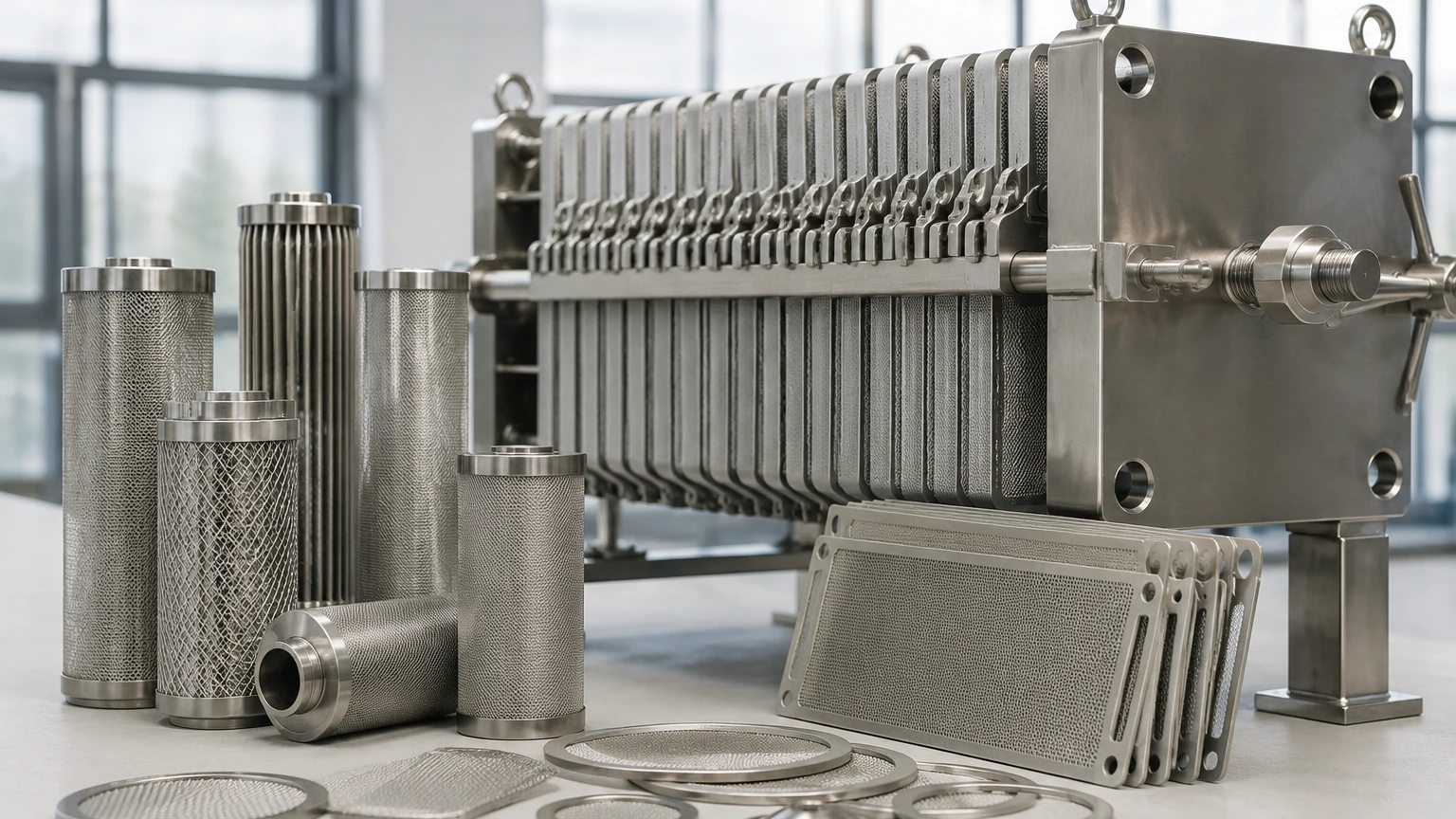
In applications involving high temperatures, high pressures, or aggressive chemical solvents, traditional fabric cloths may fail prematurely or lack the necessary precision. Stainless steel wire mesh and custom-designed metal filter elements offer superior mechanical strength and thermal stability. For engineers looking to optimize their systems, reviewing specialized product options and application support on a professional Main Page can provide insights into how custom metal components can enhance standard filter press operations.
Stainless steel filtration solutions provide several advantages:
* Durability: Resistance to abrasion from sharp or hard particles in the slurry.
* Cleanability: Metal mesh can be more effectively cleaned using back-washing or chemical cleaning, extending the service life compared to disposable cloths.
* Precision: Controlled pore sizes in wire mesh allow for exact particle size cutoff, which is critical in pharmaceutical and fine chemical sectors.
Comparing Recessed Chamber vs. Membrane Filter Presses
One of the most significant decisions during the procurement process is choosing between recessed chamber plates and membrane (diaphragm) squeeze plates. Filter press manufacturers in usa typically offer both, but the choice impacts the total cost of ownership and process efficiency.
Recessed Chamber Plates
These are the most common and cost-effective plate types. The chambers are formed by the recessed area of two adjacent plates. Filtration continues until the chambers are full of solids. While effective, the moisture content of the cake is determined solely by the feed pump pressure.
Membrane Squeeze Plates
Membrane plates feature a flexible diaphragm that can be inflated with air or water after the filtration cycle. This mechanical squeeze further compresses the filter cake, significantly reducing residual moisture. For many industrial users, the higher initial investment in membrane plates is offset by reduced cake disposal costs and shorter cycle times. When discussing these options with manufacturers, it is important to confirm the material compatibility of the membrane (e.g., EPDM, NBR, or specialized elastomers) with the process fluid.
Technical Specifications and Material Compatibility
Engineers must ensure that all wetted parts of the filter press are compatible with the process chemistry. While the plates themselves are often made of reinforced polypropylene, the manifold, valves, and internal conduits may require different materials.
In the food and beverage industry, for instance, 304 or 316L stainless steel is often mandated for all surfaces in contact with the product to prevent contamination and allow for Clean-in-Place (CIP) procedures. Similarly, in the chemical industry, the presence of chlorides may necessitate the use of high-nickel alloys or specialized coatings.
When sourcing components, it is beneficial to work with manufacturers who understand the nuances of metallurgy. Providing detailed slurry characteristics—including pH, temperature, particle size distribution, and chemical composition—allows the manufacturer to recommend the most appropriate material grades for both the press structure and the filtration media.
Common Risks and Procurement Challenges
Procuring a filter press involves navigating several risks that can impact project timelines and operational budgets. One common risk is the under-sizing of the press due to inaccurate pilot testing data. Slurry characteristics can vary significantly between a lab environment and full-scale production. It is advisable to conduct pilot tests using a rental unit that mimics the full-scale process as closely as possible.
Another challenge is the lead time for custom components. While many filter press manufacturers in usa assemble the frames domestically, specialized filtration media or high-precision metal components may have longer lead times. Proactive communication regarding the delivery schedule of long-lead items is essential for maintaining project milestones.
Total Cost of Ownership (TCO) should also be a primary consideration. A lower initial purchase price may be negated by high maintenance costs, frequent cloth replacements, or excessive energy consumption. Evaluating the reliability of the hydraulic system, the ease of cloth replacement, and the availability of technical support are key factors in minimizing TCO.
Sourcing Components and Custom Filtration Solutions
For many complex industrial applications, a standard filter press is only part of the solution. Integrating custom stainless steel filtration components can solve specific challenges such as cake washing efficiency or filtrate purity. Companies like Kaifil specialize in these high-performance components, providing the technical bridge between standard equipment and specialized process requirements.
Whether it is a custom-sized wire mesh filter for a unique plate design or precision-engineered cartridges for polishing the filtrate, the right components ensure that the filter press operates at peak efficiency. Engineers should look for partners who offer comprehensive engineering support, from material selection to the final design of the filtration element.
Conclusion: Making an Informed Decision
Identifying the most suitable filter press manufacturers in usa requires a balanced approach that considers mechanical engineering, process chemistry, and long-term operational goals. By focusing on technical specifications such as clamping force, plate technology, and material compatibility, and by recognizing the vital role of high-quality filtration media, procurement teams can secure equipment that delivers reliable performance.
Before finalizing a purchase, it is essential to confirm the manufacturer’s capability for customization and their track record in similar applications. Engaging with specialists in stainless steel filtration can further optimize the process, ensuring that the chosen system is equipped with the most durable and precise components available. For those seeking detailed technical specifications and support for custom filtration needs, visiting the Main Page of a specialized manufacturer provides a wealth of resources to assist in the selection process.
