


Filter Spin on
In the landscape of industrial filtration, the filter spin on design represents a critical evolution in fluid management. Primarily utilized in hydraulic systems, lubrication circuits, and fuel delivery lines, these self-contained units offer a balance of high-efficiency filtration and ease of maintenance. For engineers and procurement professionals, understanding the technical nuances of spin-on architecture is essential for ensuring system longevity and minimizing downtime in demanding environments such as chemical processing, food production, and heavy industrial manufacturing.
Kaifil, as a specialist in custom stainless steel filtration solutions, recognizes that while the spin-on format is standardized in many respects, the internal engineering and material selection determine the component's performance under pressure. This guide examines the technical specifications, selection criteria, and operational advantages of industrial spin-on filters.
Engineering Design and Construction of Spin-on Filters
A filter spin on assembly consists of two primary components: the permanent mounting head (or base) and the replaceable canister. The canister itself is a sophisticated pressure vessel containing the filter media, support structures, and often, internal valves.
The Canister Housing
The outer shell of an industrial spin-on filter must withstand significant internal pressures and external environmental stressors. In standard applications, heavy-duty steel is common, but for corrosive environments or high-purity applications like pharmaceutical or food processing, stainless steel canisters are preferred. The housing is designed with a rolled seam at the base plate to ensure a leak-proof seal under high-pressure pulses.
The Mounting Base and Threads
The interface between the filter and the system is the threaded center post. Common thread sizes include Unified National Fine (UNF) or Metric threads. Precision in thread machining is vital; a mismatch or poor tolerance can lead to cross-threading, which compromises the entire filtration assembly. The base plate also features an elastomer gasket, typically made of Nitrile (NBR) or Viton (FKM), depending on the chemical compatibility of the fluid being filtered.
Internal Components
Inside the canister, the filter media is wrapped around a perforated center tube. This tube provides the structural integrity necessary to prevent the media from collapsing under the differential pressure (ΔP) that increases as the filter captures contaminants. Many spin-on filters also incorporate an anti-drainback valve—a rubber flap that prevents fluid from exiting the filter when the system is shut down—and a bypass valve, which allows fluid to circumvent the media if it becomes completely clogged, preventing system starvation.
Selecting the Right Filter Media for Industrial Applications
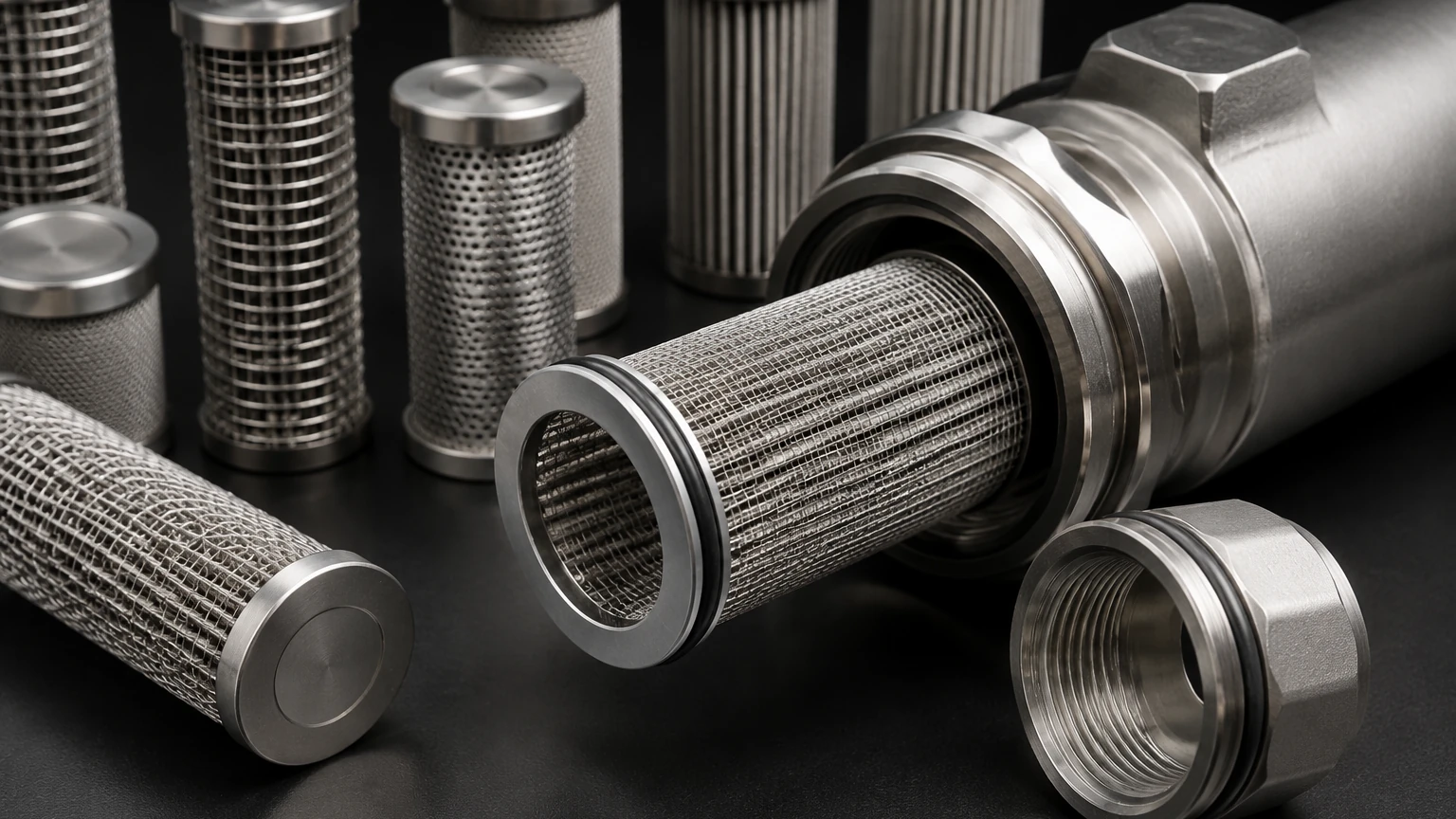
The heart of the filter spin on is the media. While many commercial filters use cellulose or synthetic glass fibers, industrial applications often require the durability of metal mesh. Kaifil specializes in integrating stainless steel wire mesh into filtration components to meet specific technical demands.
Stainless Steel Wire Mesh
For high-temperature applications or fluids with high acidity or alkalinity, stainless steel mesh is the superior choice. Unlike cellulose, which can degrade or swell, stainless steel maintains its pore size and structural integrity. It is also cleanable and reusable in certain configurations, though most spin-on designs are intended as disposable units to ensure maximum system cleanliness.
Synthetic and Glass Fiber Media
Synthetic media are often used when high dirt-holding capacity and precise micron ratings are required. These fibers are layered to create a gradient density, trapping larger particles on the surface and smaller particles deeper within the matrix. However, engineers must confirm that the resins used to bind these fibers are compatible with the industrial fluids in use.
Micron Ratings and Efficiency
When specifying a filter spin on, it is important to distinguish between nominal and absolute micron ratings. A nominal rating indicates the filter's ability to trap a major percentage of particles of a given size, whereas an absolute rating (often expressed via a Beta Ratio) indicates a much higher efficiency (typically 99.9%). For critical hydraulic components, an absolute-rated filter is often mandatory to prevent catastrophic wear from silt-sized particles.
Performance Metrics: Filtration Efficiency and Beta Ratios
To evaluate a filter spin on, engineers rely on the Beta Ratio (β), derived from the Multi-Pass Test (ISO 16889). The Beta Ratio is the number of particles of a specific size upstream of the filter divided by the number of particles of the same size downstream.
For example, a β10 = 1000 rating means that for every 1000 particles of 10 microns entering the filter, only one passes through. This represents 99.9% efficiency. In high-stakes industrial environments, such as the Main Page of a chemical processing plant's fluid management strategy, selecting a filter with a high Beta Ratio is non-negotiable for protecting sensitive downstream instrumentation.
Another critical metric is the Clean Pressure Drop. Every filter restricts flow to some degree. An ideal spin-on filter provides high efficiency with minimal resistance. If the initial pressure drop is too high, the system will reach the bypass valve setting prematurely, leading to unfiltered fluid circulating through the machinery.
Installation and Maintenance Best Practices
The primary advantage of the filter spin on is the simplicity of replacement. However, improper installation is a leading cause of leaks and system contamination.
1. Preparation: Before installing a new filter, the mounting base must be cleaned of all debris. The old gasket must be completely removed; "double-gasketing" (leaving the old gasket behind) is a common cause of high-pressure leaks.
2. Lubrication: A thin film of clean system fluid should be applied to the new gasket. This prevents the gasket from bunching or tearing during tightening and ensures a proper seal.
3. Tightening: Most spin-on filters should be tightened by hand until the gasket makes contact with the base, followed by an additional 3/4 to 1 full turn. Over-tightening with a wrench can deform the base plate or crush the gasket, while under-tightening leads to vibration-induced leaks.
4. Venting: In some hydraulic systems, it is necessary to bleed air from the filter housing after installation to prevent cavitation in the pump.
Replacement intervals should be determined by differential pressure indicators rather than simple calendar dates. A pressure gauge or electrical sensor that monitors the ΔP across the filter head will alert operators when the media is loaded, ensuring the filter is replaced only when necessary, thus optimizing the total cost of ownership.
Customization Options for Demanding Environments
Standard off-the-shelf spin-on filters often fail in specialized industrial settings. This is where custom manufacturing becomes essential. Kaifil provides OEM and customized filtration solutions that address specific environmental challenges:
* High-Pressure Canisters: Standard spin-on filters are typically rated for 150–500 PSI. For high-pressure hydraulic return lines, reinforced canisters with thicker walls and specialized thread designs are required to prevent bursting.
* Chemical Compatibility: In the chemical and pharmaceutical industries, standard Nitrile seals may fail. Custom filters can be fitted with Viton, EPDM, or PTFE gaskets to withstand aggressive solvents.
* Extreme Temperatures: For applications involving steam or high-temperature oils, the internal adhesives and seals must be rated for the operating range. All-metal construction, utilizing stainless steel mesh and welded components, eliminates the risk of adhesive failure.
* Custom Micron Sizes: While standard sizes (10, 25, 40 micron) are common, specific processes may require non-standard filtration levels to protect proprietary equipment.
Total Cost of Ownership and Procurement Considerations
When purchasing a filter spin on, the initial unit price is only one component of the total cost. Technical professionals must also consider:
* Dirt-Holding Capacity: A cheaper filter with less media surface area will clog faster, leading to more frequent replacements and higher labor costs.
* System Protection: The cost of a high-quality filter is negligible compared to the cost of repairing a damaged hydraulic pump or a contaminated batch of chemical product.
* Availability and Lead Times: For OEM applications, a reliable supply chain is vital. Working with a manufacturer like Kaifil ensures that custom specifications are met consistently, preventing production bottlenecks.
Engineers should confirm the housing burst pressure, the bypass valve cracking pressure, and the media's compatibility with the target fluid before finalizing a procurement agreement. For those seeking comprehensive technical data and a wide range of industrial filtration components, visiting the Main Page provides a starting point for exploring tailored solutions.
Conclusion
The industrial filter spin on is more than a simple commodity; it is a precision-engineered component vital to the reliability of modern industrial systems. By selecting the appropriate media, ensuring robust canister construction, and adhering to rigorous maintenance protocols, facilities can significantly reduce mechanical wear and operational risks. Whether for a standard hydraulic system or a specialized chemical process, the right spin-on filter provides a cost-effective, high-performance barrier against the contaminants that threaten industrial productivity.
