


Filtering Flasks in Laboratory
In the landscape of industrial research and chemical engineering, the process of separating solids from liquids is a fundamental operation. While large-scale production relies on heavy-duty stainless steel housings and automated systems, the initial stages of process development and quality control frequently depend on filtering flasks in laboratory settings. These specialized glass vessels, also known as vacuum flasks or Büchner flasks, serve as the primary interface for vacuum-assisted filtration, providing the empirical data necessary to scale up to industrial filtration solutions.
Understanding the technical specifications, safety requirements, and material limitations of filtering flasks is essential for engineers and laboratory managers. This knowledge ensures that the transition from a laboratory pilot to a full-scale industrial process—utilizing high-performance components such as those found on the Kaifil Main Page—is both seamless and scientifically sound.
Understanding Filtering Flasks in Laboratory Operations
A filtering flask is distinguished from a standard Erlenmeyer flask by its reinforced construction and a side-arm protrusion. This side arm, often referred to as a hose barb, allows for the attachment of a vacuum source, such as a water aspirator or a mechanical vacuum pump. The primary function of the flask is to act as a receiver for the filtrate (the liquid that has passed through the filter) while maintaining a pressure differential that accelerates the filtration process.
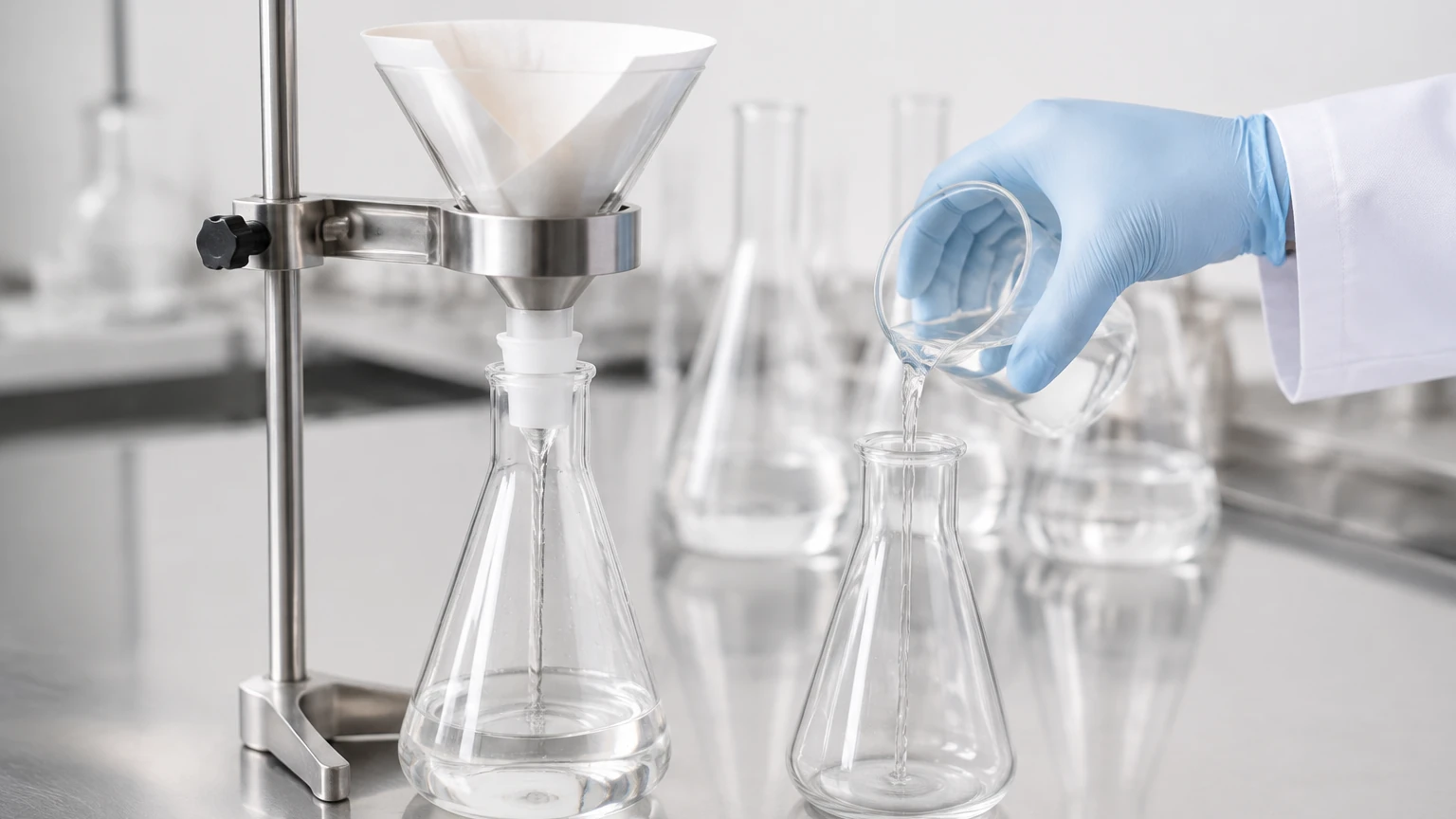
In a typical setup, a Büchner funnel or a sintered glass crucible is placed atop the flask, secured by a rubber stopper or an adapter to ensure an airtight seal. When the vacuum is applied, the atmospheric pressure above the funnel pushes the liquid through the filter media, significantly increasing the flow rate compared to gravity-fed filtration. This efficiency is critical when dealing with high-viscosity liquids or fine particulate matter that would otherwise clog the filter media prematurely.
Critical Design Features and Vacuum Mechanics
The engineering of filtering flasks in laboratory environments focuses heavily on structural integrity. Because the interior of the flask is subjected to a vacuum, the vessel must withstand the external atmospheric pressure, which exerts approximately 14.7 pounds per square inch (psi) at sea level.
1. Wall Thickness: Filtering flasks are manufactured with significantly thicker walls than standard laboratory glassware. This added mass is necessary to prevent implosion, a catastrophic failure where the glass collapses inward under pressure.
2. Geometry: The conical shape of the flask is designed to distribute mechanical stress evenly. The base is typically wider to provide stability, which is crucial when supporting the weight of a heavy funnel and the volume of the liquid sample.
3. The Side Arm: The hose barb is usually integrated into the neck of the flask. In high-end models, these barbs may be replaceable or made of plastic to reduce the risk of breakage, as the connection point to the vacuum tubing is a common site of mechanical stress.
From a fluid dynamics perspective, the vacuum creates a pressure gradient ($ΔP$). According to Darcy’s Law, the flow rate of the filtrate is directly proportional to this pressure gradient and the permeability of the filter media. Engineers must balance the vacuum strength to optimize flow without causing the filter cake to compress so tightly that it becomes impermeable.
Material Selection: Borosilicate Glass and Chemical Compatibility
Most filtering flasks in laboratory use are constructed from Type I, Class A borosilicate glass (commonly known by brand names like Pyrex or Duran). This material is chosen for several technical reasons:
* Thermal Resistance: Borosilicate glass has a very low coefficient of thermal expansion. This allows the flask to withstand rapid temperature changes, which is vital when filtering hot solutions or during sterilization cycles in an autoclave.
* Chemical Inertness: In B2B chemical processing, compatibility is paramount. Borosilicate glass is resistant to water, neutral and acid solutions, concentrated acids and their mixtures, as well as to chlorine, bromine, iodine, and organic substances. However, it is important to note that hydrofluoric acid, hot phosphoric acid, and strong alkaline solutions can cause surface erosion.
* Transparency: Visual monitoring of the filtrate clarity and volume is essential for process validation. Unlike opaque industrial housings, glass allows for immediate detection of "breakthrough," where solids bypass the filter media.
For applications involving highly corrosive substances or where glass breakage poses an unacceptable risk, alternative materials like Polypropylene (PP) or Perfluoroalkoxy (PFA) may be used, though they often lack the vacuum rating of heavy-walled glass.
Filtration Media: Integrating Stainless Steel Wire Mesh
While paper filters are common in general chemistry, industrial-grade laboratory processes often require more durable and precise media. This is where the transition to professional filtration components begins. Many engineers utilize stainless steel wire mesh discs within their laboratory funnels to simulate the performance of industrial filters.
Using stainless steel mesh in filtering flasks in laboratory tests offers several advantages:
* Precise Micron Ratings: Unlike paper, which has a nominal and often inconsistent pore size, stainless steel wire mesh provides a defined absolute micron rating. This allows for precise control over the particle size retention.
* Durability: Metal mesh does not tear or degrade when subjected to high vacuum pressures or aggressive solvents.
* Reusability: Stainless steel components can be cleaned and reused, making them more cost-effective for long-term pilot studies.
By testing with the same materials used in full-scale production—such as the custom wire mesh solutions highlighted on the Kaifil Main Page—engineers can more accurately predict the performance, pressure drop, and cleaning cycles of an industrial system.
Safety Protocols and Risk Mitigation in Vacuum Filtration
Operating vacuum equipment inherently involves risks. An implosion of a filtering flask can propel glass shards at high velocities, posing a significant hazard to personnel and equipment. To mitigate these risks, laboratory managers should implement the following protocols:
* Visual Inspection: Before every use, flasks must be inspected for "stars," scratches, or chips. Even a minor surface flaw can act as a stress concentrator, leading to failure under vacuum.
* Plastic Coating: Many modern filtering flasks are available with a plastic safety coating (such as PVC or PU). If the glass breaks, the coating contains the fragments, preventing them from scattering.
* Vacuum Regulation: Using a vacuum regulator ensures that the internal pressure does not exceed the flask's rated capacity. It also prevents the sudden "bumping" of liquids, which can lead to contamination of the vacuum lines.
* Shielding: In high-pressure or large-volume applications, placing the flask behind a transparent safety shield is a standard engineering control.
From Laboratory Pilot to Industrial Production: Scaling Filtration
The data gathered using filtering flasks in laboratory environments is the foundation for industrial system design. When scaling up, several factors must be translated from the lab bench to the factory floor:
1. Surface Area: In the lab, the filtration area is limited by the diameter of the funnel. Industrial systems use pleated cartridges or multi-layer wire mesh elements to maximize surface area within a compact footprint.
2. Continuous vs. Batch: Lab filtration is typically a batch process. Industrial applications often require continuous filtration, necessitating duplex systems where one filter can be cleaned while the other remains in operation.
3. Housing Material: While glass is suitable for the lab, industrial environments demand the robustness of 304 or 316L stainless steel to handle higher pressures, mechanical impacts, and CIP (Clean-In-Place) procedures.
For organizations ready to move beyond the laboratory scale, consulting with a specialized manufacturer is critical. Exploring the technical resources and product configurations on the Kaifil Main Page provides engineers with the necessary specifications for custom stainless steel filter cartridges and precision metal components designed for demanding industrial environments.
Technical Specification Checklist for Procurement
When procuring filtering flasks in laboratory settings or the industrial components they represent, purchasing teams should confirm the following technical details:
* Vacuum Rating: Ensure the flask is rated for the specific vacuum level (e.g., 100 mbar or full vacuum).
* Micron Retention: Define the absolute vs. nominal micron rating required for the process.
* Connection Type: Verify the hose barb size (e.g., 10mm or 12mm) matches the existing vacuum tubing.
* Chemical Resistance Data: Confirm that all seals (stoppers, O-rings) and the vessel itself are compatible with the process fluids.
* Compliance Standards: Check for adherence to international standards such as ISO 3585 for borosilicate glass or ASTM specifications for laboratory apparatus.
By maintaining a rigorous focus on these technical parameters, engineers can ensure that their laboratory filtration results are reproducible and scalable, ultimately leading to more efficient and reliable industrial production cycles.
