


Screening of Water Treatment
In the hierarchy of industrial liquid processing, the screening of water treatment serves as the primary defense mechanism for downstream equipment and process integrity. This mechanical separation process is designed to remove large solids, debris, and particulate matter that could otherwise damage sensitive components such as high-pressure pumps, reverse osmosis membranes, and heat exchangers. For engineers and facility managers, selecting the appropriate screening technology is not merely a matter of choosing a mesh size; it requires a comprehensive understanding of fluid dynamics, material science, and the specific chemical environment of the application.
As a specialized manufacturer of stainless steel filtration solutions, Kaifil emphasizes that the efficiency of any water treatment system is fundamentally limited by the performance of its initial screening stage. Whether the source is municipal intake, industrial process water, or wastewater discharge, the screening phase dictates the total cost of ownership and the operational lifespan of the entire filtration train.
Fundamental Principles of Screening in Water Treatment
The screening of water treatment is categorized into several stages, typically defined by the size of the openings and the method of particle capture. Coarse screening generally addresses particles larger than 6mm, while fine screening targets particles between 0.5mm and 6mm. Micro-screening, often utilizing precision-engineered wire mesh, handles particles down to the micron level.
The primary objective of these stages is to achieve a balance between filtration efficiency and hydraulic throughput. A screen with a high capture rate but insufficient open area will lead to excessive pressure drops (ΔP), necessitating frequent cleaning or causing system bypass. Conversely, a screen that is too coarse will allow bypass of solids that can clog fine-tuned downstream processes. Engineering teams must evaluate the "Open Area Ratio," which is the percentage of the total screen surface that allows for fluid passage. A higher open area reduces the approach velocity, which in turn minimizes the risk of particle impingement and screen blinding.
Material Selection: Why Stainless Steel Dominates Industrial Screening
In industrial environments, the choice of material for screening components is critical. While polymers and carbon steels are used in low-demand applications, stainless steel—specifically AISI 304 and 316L—is the industry standard for high-performance screening of water treatment.
Corrosion Resistance and Chemical Compatibility
Stainless steel provides the necessary resistance to oxidation and chemical attack found in chlorinated water, acidic process streams, and saline environments. For pharmaceutical and food-grade applications, 316L is preferred due to its low carbon content and enhanced resistance to pitting corrosion, ensuring that the screening process does not introduce contaminants into the fluid stream.
Mechanical Strength and Durability
Unlike synthetic meshes, stainless steel wire mesh maintains its structural integrity under high pressure and temperature fluctuations. This is particularly important in hydraulic systems and high-flow industrial intakes where mechanical stress can lead to "media migration"—the deformation or breakage of the filter material. Kaifil’s manufacturing process focuses on high-tensile wire weaving and precision welding to ensure that screens can withstand the rigors of backwashing and mechanical cleaning cycles.
Technical Parameters for Effective Screen Design
When designing or procuring components for the screening of water treatment, engineers must specify several technical parameters to ensure the component is fit for purpose.
1. Micron Rating and Mesh Count: The micron rating defines the largest particle that can pass through the screen. However, in B2B procurement, it is essential to distinguish between "nominal" and "absolute" ratings. An absolute rating ensures that 99.9% of particles above the specified size are retained, which is critical for protecting sensitive equipment.
2. Weave Types: The geometry of the weave significantly impacts performance. Plain weaves offer high open areas for low-pressure applications, while Dutch weaves (including Twilled Dutch and Reverse Dutch) provide higher mechanical strength and finer filtration levels by layering wires in a compact structure.
3. Pressure Drop (ΔP) Limits: Every screening element introduces resistance. Calculating the clean pressure drop and the maximum allowable terminal pressure drop is essential for pump sizing and energy efficiency.
4. Flow Velocity: High approach velocities can force deformable particles through the mesh or cause rapid erosion of the wire. Maintaining a laminar flow profile across the screen surface is a hallmark of a well-engineered system.
Application-Specific Requirements across Industries
The screening of water treatment is not a one-size-fits-all process. Different sectors impose unique demands on the filtration hardware.
Chemical and Petrochemical Processing
In these sectors, screens must handle aggressive solvents and high-temperature fluids. The screening of water treatment here often involves removing catalysts or protecting expensive reactors. Stainless steel cartridges with reinforced cores are standard to prevent collapse under sudden pressure surges.
Food and Beverage Industry
Hygiene is the paramount concern. Screening components must be designed with "clean-in-place" (CIP) capabilities. This means the mesh must be free of crevices where bacteria can proliferate. Electropolishing the stainless steel surface is a common requirement to reduce surface roughness and improve cleanability.
Power Generation and Cooling Towers
Large volumes of water are used for cooling, often sourced from rivers or lakes. The screening of water treatment in these facilities focuses on removing organic matter and debris to prevent the fouling of heat exchanger tubes. Robust, large-scale wire mesh panels are typically employed in these intake structures.
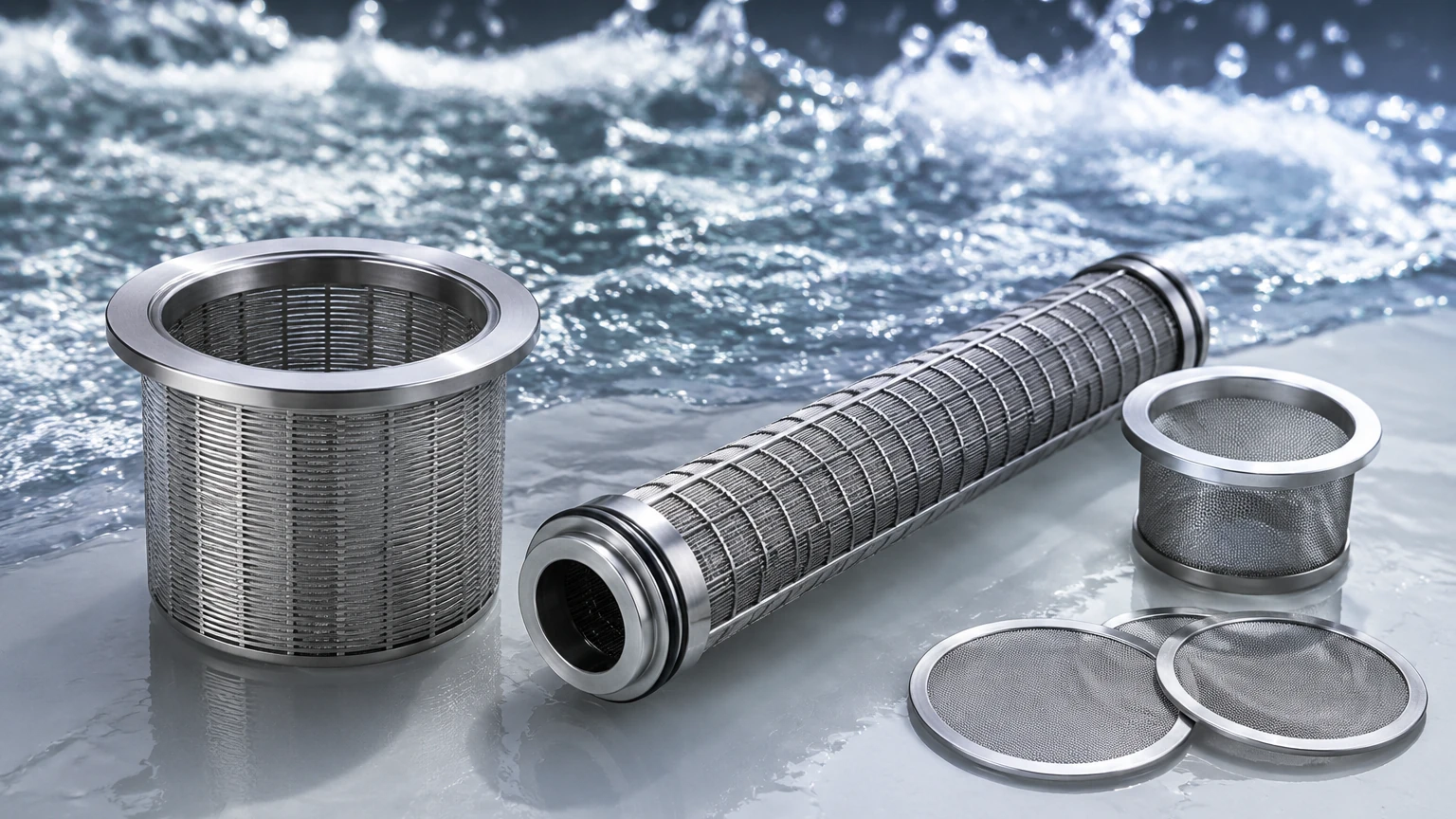
Maintenance and Longevity: Optimizing the Filtration Cycle
A common question from engineering teams concerns the replacement cycle of screening components. While stainless steel is durable, it is not indestructible. The longevity of a screen depends heavily on the maintenance regime.
Blinding and Fouling: Blinding occurs when particles near the size of the mesh opening become wedged in the screen. Fouling refers to the buildup of a "filter cake" or biological growth on the surface. Effective screening of water treatment systems incorporates automated backwashing or ultrasonic cleaning to restore the flow rate without manual intervention.
Wear Monitoring: In abrasive environments, such as those involving sand or mineral processing, the wire diameter will slowly decrease over time. Periodic inspection of the mesh integrity is vital to prevent catastrophic failure, which could lead to downstream contamination. High-quality manufacturers like Kaifil provide customized designs with reinforced edges and support structures to extend the service life in these demanding conditions.
Navigating the Procurement Process for Custom Filtration Components
For purchasing teams and engineers, the transition from a technical requirement to a physical component involves several verification steps. It is not enough to simply order a "stainless steel filter." To ensure the success of the screening of water treatment, the following information should be confirmed with the manufacturer:
* Detailed Fluid Analysis: What is the chemical composition, temperature range, and viscosity of the water being treated?
* Particle Characterization: Is the debris hard, soft, fibrous, or spherical? This determines the weave type and the necessity for surface coatings.
* Regulatory Compliance: Does the component need to meet FDA, NSF, or ISO standards for specific industrial applications?
* Customization Options: Many existing systems require non-standard dimensions. Working with an OEM provider allows for the creation of custom-fit cartridges or mesh panels that integrate seamlessly with legacy hardware.
By focusing on these technical boundaries, organizations can reduce downtime and improve the efficiency of their water treatment infrastructure. For those seeking a comprehensive overview of available technologies and engineering support, you may visit our Main Page to review product options and application support tailored to your specific industrial needs.
Total Cost of Ownership (TCO) Considerations
While the initial purchase price of a high-precision stainless steel screen may be higher than that of plastic or lower-grade metal alternatives, the Total Cost of Ownership (TCO) is significantly lower. The TCO includes the initial cost, energy consumption (related to pressure drop), maintenance labor, and the cost of replacement parts.
Precision-engineered screens reduce the frequency of replacement and protect more expensive downstream assets. In a B2B context, the reliability of the screening of water treatment is a risk management strategy. A single failure in the screening stage can result in millions of dollars in lost production time or equipment repair costs. Therefore, investing in high-quality, manufacturer-direct filtration components is a prudent engineering decision.
In conclusion, the screening of water treatment is a sophisticated engineering discipline that requires a balance of material science and fluid mechanics. By selecting the right stainless steel mesh, understanding the hydraulic requirements of the application, and partnering with a manufacturer capable of providing customized OEM solutions, industrial operators can ensure the long-term success and efficiency of their water treatment systems.
