


Filtration Element
In industrial process engineering, the filtration element is the functional core of any separation system. It is the specific component responsible for removing contaminants, recovering valuable solids, or protecting downstream equipment from particulate damage. Unlike disposable consumer filters, industrial filtration elements must often withstand extreme pressures, corrosive chemicals, and high thermal loads while maintaining precise micron ratings.
For engineers and procurement specialists, selecting the correct filtration element requires a deep understanding of fluid dynamics, material science, and mechanical design. This guide examines the technical variables that define high-performance metal filtration elements, focusing on stainless steel solutions designed for demanding industrial environments.
Engineering Fundamentals of Metal Filtration Elements
The performance of a filtration element is primarily dictated by its media construction. While polymer and paper elements are common in light-duty applications, industrial sectors such as chemical processing and oil and gas rely on metal elements for their structural integrity and longevity.
Wire Mesh vs. Sintered Metal
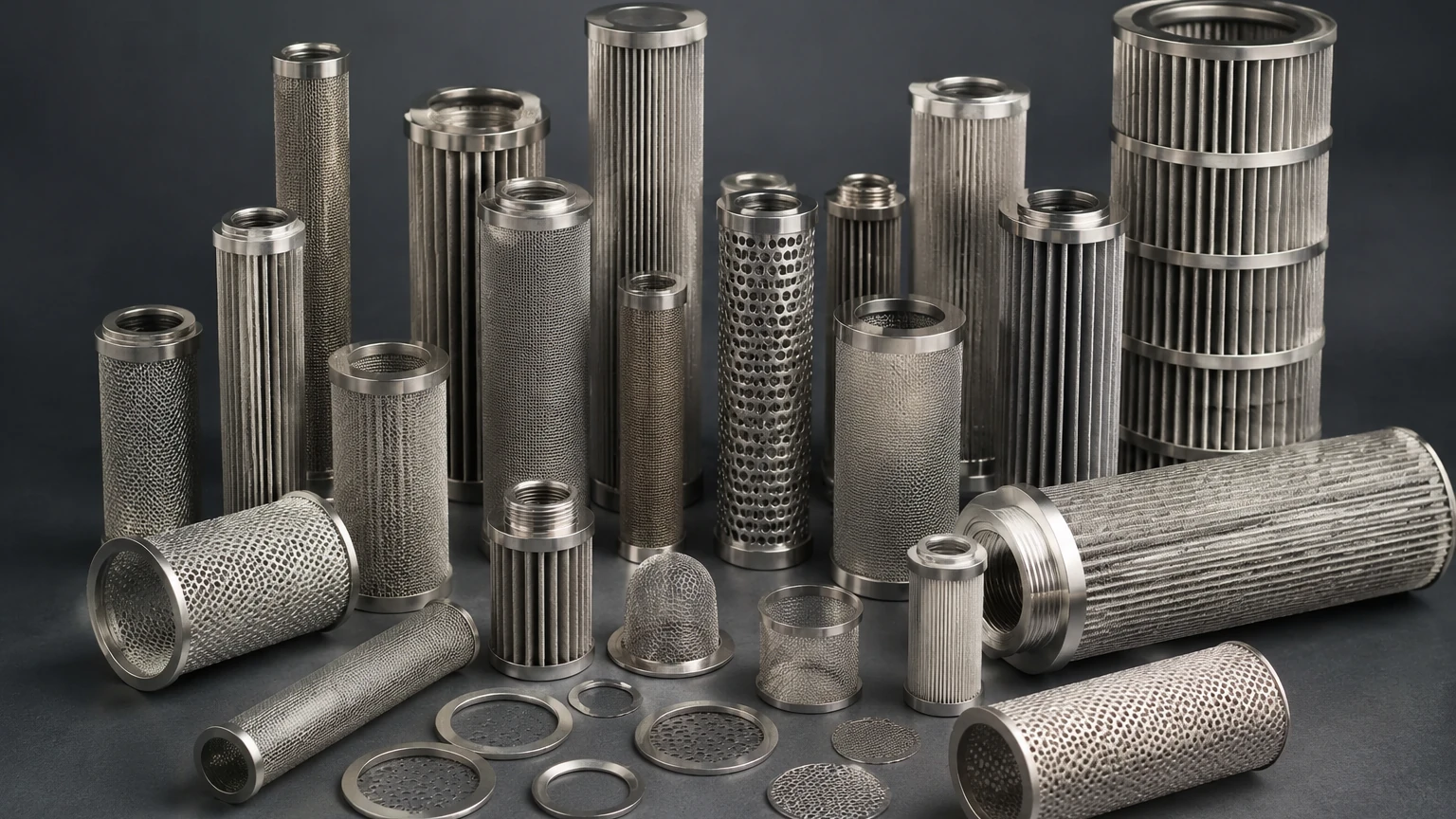
Most industrial metal filtration elements utilize one of two primary media types:
1. Stainless Steel Wire Mesh: Constructed from woven wires, this media offers precise pore sizes and high open areas. It is ideal for surface filtration where particles are trapped on the exterior of the mesh. It is easily cleaned via backwashing or ultrasonic methods.
2. Sintered Metal Media: This involves bonding multiple layers of wire mesh or metal fibers together using heat and pressure without melting the material. Sintering creates a robust, porous structure that excels in depth filtration and can handle significantly higher pressure differentials than standard mesh.
Micron Ratings: Absolute vs. Nominal
A critical distinction in element specification is the micron rating. A nominal rating indicates the element's ability to retain the majority of particles of a specific size (usually 60% to 90%). In contrast, an absolute rating represents the diameter of the largest hard spherical particle that will pass through the filter under specified test conditions. For critical pharmaceutical or hydraulic applications, absolute-rated elements are mandatory to ensure system safety.
Material Selection and Chemical Compatibility
The longevity of a filtration element is often determined by its resistance to the process fluid. Stainless steel is the industry standard due to its versatile corrosion resistance and mechanical strength.
304 vs. 316L Stainless Steel
* Grade 304: Suitable for general industrial use, water filtration, and less aggressive chemical environments. It provides excellent strength and cost-effectiveness.
* Grade 316L: Contains molybdenum, which significantly enhances resistance to chlorides and pitting corrosion. This is the preferred choice for marine environments, pharmaceutical manufacturing, and acidic chemical processing.
Beyond these common grades, specialized applications may require exotic alloys like Hastelloy or Monel when dealing with extreme oxidizers or high-temperature steam. Engineers must also consider the compatibility of sealing materials—such as Viton, EPDM, or PTFE—which prevent bypass at the element's connection points.
Structural Design and Mechanical Integrity
An industrial filtration element must do more than just filter; it must survive the mechanical stresses of the system. The design often incorporates several structural layers to ensure the media does not collapse or deform under load.
Support Cores and Outer Guards
Internal support cores, usually made of perforated stainless steel, provide the radial strength necessary to withstand high differential pressures ($ΔP$). In high-flow applications, an outer guard or shroud may also be used to protect the delicate filter media from turbulent incoming fluid or mechanical damage during installation.
Pleated vs. Cylindrical Geometry
* Cylindrical Elements: These have a simple smooth surface. They are easier to clean and are typically used in applications with low solids loading.
* Pleated Elements: By folding the filter media into a series of pleats, the effective surface area is increased significantly—often by a factor of three to nine times. This results in lower initial pressure drops, higher dirt-holding capacity, and longer service intervals. However, pleated elements require more sophisticated manufacturing to ensure the pleats remain stable and do not "blind" or pinch shut during operation.
Performance Metrics: Efficiency and Flow Rate
When evaluating a filtration element, engineers focus on the relationship between flow rate and pressure drop. Every filter introduces resistance to the system. An optimized element minimizes this resistance while maximizing particle capture.
Calculating Pressure Drop ($ΔP$)
The total pressure drop across a filter housing is the sum of the housing loss and the element loss. As the filtration element captures contaminants, the available flow paths decrease, and the $ΔP$ increases. It is standard practice to size an element so that the initial "clean" pressure drop does not exceed 2-3 PSI (0.14-0.21 bar). If the initial $ΔP$ is too high, the element will reach its terminal pressure drop (the point where it must be cleaned or replaced) too quickly, leading to excessive downtime.
Dirt-Holding Capacity
This metric defines the total mass of contaminants an element can trap before reaching its terminal pressure drop. Higher dirt-holding capacity directly correlates to longer on-stream life. In systems with high particulate loads, using a multi-layered depth media or a pleated design is essential to maintain economic viability.
Customization and OEM Integration
Standard off-the-shelf filters rarely meet the specific needs of complex industrial machinery. Most high-performance systems require a customized filtration element designed to fit unique housing dimensions or to meet specific flow characteristics.
Customization options typically include:
* End Cap Configurations: Threaded connections, NPT, flange mounts, or double open-ended (DOE) designs with gaskets.
* Reinforced Construction: For hydraulic systems subject to frequent pressure spikes or "water hammer" effects.
* Specialized Coatings: To enhance hydrophobicity or to prevent the adhesion of sticky biological materials in food and beverage processing.
For organizations seeking tailored solutions, the Main Page of specialized manufacturers like Kaifil provides a comprehensive overview of OEM capabilities and material options available for custom builds.
Operational Considerations: Cleaning and Replacement
One of the primary advantages of stainless steel filtration elements is that they are often cleanable and reusable, unlike polymer cartridges which are strictly consumable. This capability significantly reduces the long-term environmental impact and operational costs.
Cleaning Methodologies
1. Backwashing: Reversing the flow of fluid through the element to dislodge surface-bound particles. This can often be automated within the filtration system.
2. Ultrasonic Cleaning: Submerging the element in a specialized bath where high-frequency sound waves create cavitation bubbles that strip contaminants from deep within the mesh or sintered structure.
3. Chemical Cleaning: Using surfactants or mild acids to dissolve organic or mineral scaling that cannot be removed mechanically.
Determining Replacement Cycles
While metal elements are durable, they are not infinite. Repeated cleaning cycles can eventually lead to "media migration" or fatigue in the wire mesh. Engineers should establish a maximum number of cleaning cycles or monitor the "recovered" clean pressure drop. If an element's clean $ΔP$ begins to rise steadily after each cleaning, it indicates that fine particulates are permanently lodged in the media, and the element should be replaced to protect system efficiency.
Total Cost of Ownership (TCO) in Industrial Filtration
When purchasing a filtration element, the initial price is only one component of the total cost. A low-cost, low-quality element often results in higher TCO due to:
* Energy Costs: High pressure drops force pumps to work harder, increasing electricity consumption.
* Downtime: Frequent replacements or cleanings halt production lines.
* Downstream Damage: If an element fails or allows bypass, it can destroy expensive components like high-pressure pumps, spray nozzles, or heat exchangers.
Investing in a high-quality, precision-engineered metal filtration element ensures predictable performance and protects the broader capital investment of the processing plant.
Conclusion
The filtration element is a precision-engineered component that requires careful selection based on fluid chemistry, thermal conditions, and particulate characteristics. By prioritizing high-grade materials like 316L stainless steel and optimizing structural designs such as pleating, industrial operations can achieve superior fluid purity and operational reliability. Whether for a standard hydraulic system or a custom chemical reactor, understanding the technical boundaries of filtration media is the first step toward an efficient and cost-effective filtration strategy.
