


Filtration Mesh
In industrial processing, the efficiency of a filtration system is fundamentally determined by the quality and specifications of the filtration mesh employed. As a critical component in liquid and gas separation, filtration mesh—specifically stainless steel wire cloth—serves as the primary barrier against contaminants. For engineers and procurement professionals in sectors such as chemical processing, pharmaceuticals, and food production, selecting the correct mesh involves a complex balance of material science, mechanical engineering, and fluid dynamics.
Industrial filtration mesh is not a one-size-fits-all commodity. It is a precision-engineered material designed to withstand specific pressures, temperatures, and chemical environments while maintaining a consistent aperture size. Understanding the technical nuances of mesh construction is essential for optimizing system performance and ensuring the longevity of filtration equipment.
Technical Fundamentals: Defining Mesh Specifications
To accurately specify filtration mesh, one must understand the relationship between mesh count, wire diameter, and aperture. These three variables dictate the filtration accuracy and the structural integrity of the medium.
Mesh Count vs. Aperture Size
The "mesh count" refers to the number of openings per linear inch (25.4 mm). While a higher mesh count generally indicates finer filtration, it is the "aperture" (the clear distance between two adjacent wires) that determines the largest particle that can pass through the mesh. The relationship is expressed by the formula:
Aperture = (1 / Mesh Count) – Wire Diameter
When selecting a mesh for a specific application, engineers must prioritize the aperture size over the mesh count to ensure the required filtration micron rating is met. For instance, two different meshes might both be "100 mesh," but if they use different wire diameters, their filtration capabilities and flow rates will differ significantly.
Wire Diameter and Open Area
The wire diameter influences the mechanical strength of the mesh and the "percentage of open area." The open area is the ratio of the total area of the apertures to the total area of the mesh. A higher open area results in a lower pressure drop and higher flow rates but may compromise the mesh's resistance to physical deformation under high-pressure loads. In high-viscosity applications, balancing wire diameter to maintain structural stability without excessively restricting flow is a primary engineering challenge.
Material Selection for Corrosive and High-Heat Environments
The choice of alloy is perhaps the most critical factor in determining the service life of a filtration mesh. While various metals can be woven, stainless steel remains the industry standard due to its corrosion resistance and mechanical properties at extreme temperatures.
Grade 304 Stainless Steel
SS304 is the most common material for general industrial use. It offers excellent strength and good corrosion resistance for water treatment and standard food processing applications. However, it is susceptible to chloride pitting, making it less suitable for marine environments or highly acidic chemical processes.
Grade 316 and 316L Stainless Steel
For more demanding applications, Grade 316 is preferred due to the addition of molybdenum, which enhances resistance to pitting and crevice corrosion in chloride-rich environments. Grade 316L (low carbon) is often specified for components that require extensive welding, as it minimizes carbide precipitation that can lead to intergranular corrosion. These grades are standard in pharmaceutical and petrochemical filtration.
Specialized Alloys
In extreme cases involving highly aggressive chemicals or temperatures exceeding 800°C, specialized alloys such as Monel, Inconel, or Hastelloy may be required. These materials provide the necessary oxidation resistance and mechanical stability where standard stainless steels would fail.
Analysis of Weave Patterns and Their Applications
The method by which the wires are interlaced—the weave pattern—directly impacts the filtration mesh's performance characteristics, including its micron rating and backwashing efficiency.
Plain Weave
The simplest and most common weave, where each warp wire passes alternately over and under each weft wire. It provides high flow rates and is easy to clean, making it ideal for standard liquid filtration and particle separation.
Twill Weave
In a twill weave, each weft wire passes over and under two warp wires. This allows for the use of heavier wires in a given mesh count, resulting in a stronger mesh that can handle higher pressure loads. It is often used when a fine mesh requires additional mechanical support.
Dutch Weave (Plain and Twill)
Dutch weaves utilize different diameters for the warp and weft wires. The weft wires are driven together tightly, creating a dense, tortuous path for the fluid.
- Plain Dutch Weave: Offers high strength and is suitable for high-pressure filtration where a relatively high flow rate is still required.
- Twill Dutch Weave: Provides the finest filtration levels, often down to the sub-micron range. The overlapping wires create a very fine pore structure, making it the preferred choice for critical applications in hydraulic systems and fuel filtration.
Performance Metrics: Filtration Accuracy and Flow Dynamics
When evaluating a filtration mesh, engineers must distinguish between nominal and absolute filtration ratings. This distinction is vital for meeting regulatory standards and protecting downstream equipment.
Nominal vs. Absolute Ratings
- Nominal Rating: An arbitrary micron value based on the weight percentage of particles of a certain size that the mesh can retain (typically 60% to 90%). It does not guarantee that larger particles will not pass through.
- Absolute Rating: The diameter of the largest hard spherical particle that will pass through the mesh under specified test conditions. In critical pharmaceutical or chemical applications, an absolute rating is usually required to ensure process integrity.
Pressure Drop (Delta P)
The resistance to flow caused by the filtration medium is known as the pressure drop. A high initial pressure drop reduces the overall efficiency of the system and increases energy consumption. Factors affecting pressure drop include the fluid's viscosity, the flow velocity, and the mesh's open area. Engineers must design systems where the mesh provides sufficient filtration without causing a pressure drop that exceeds the pump's capabilities or triggers premature bypass valves.
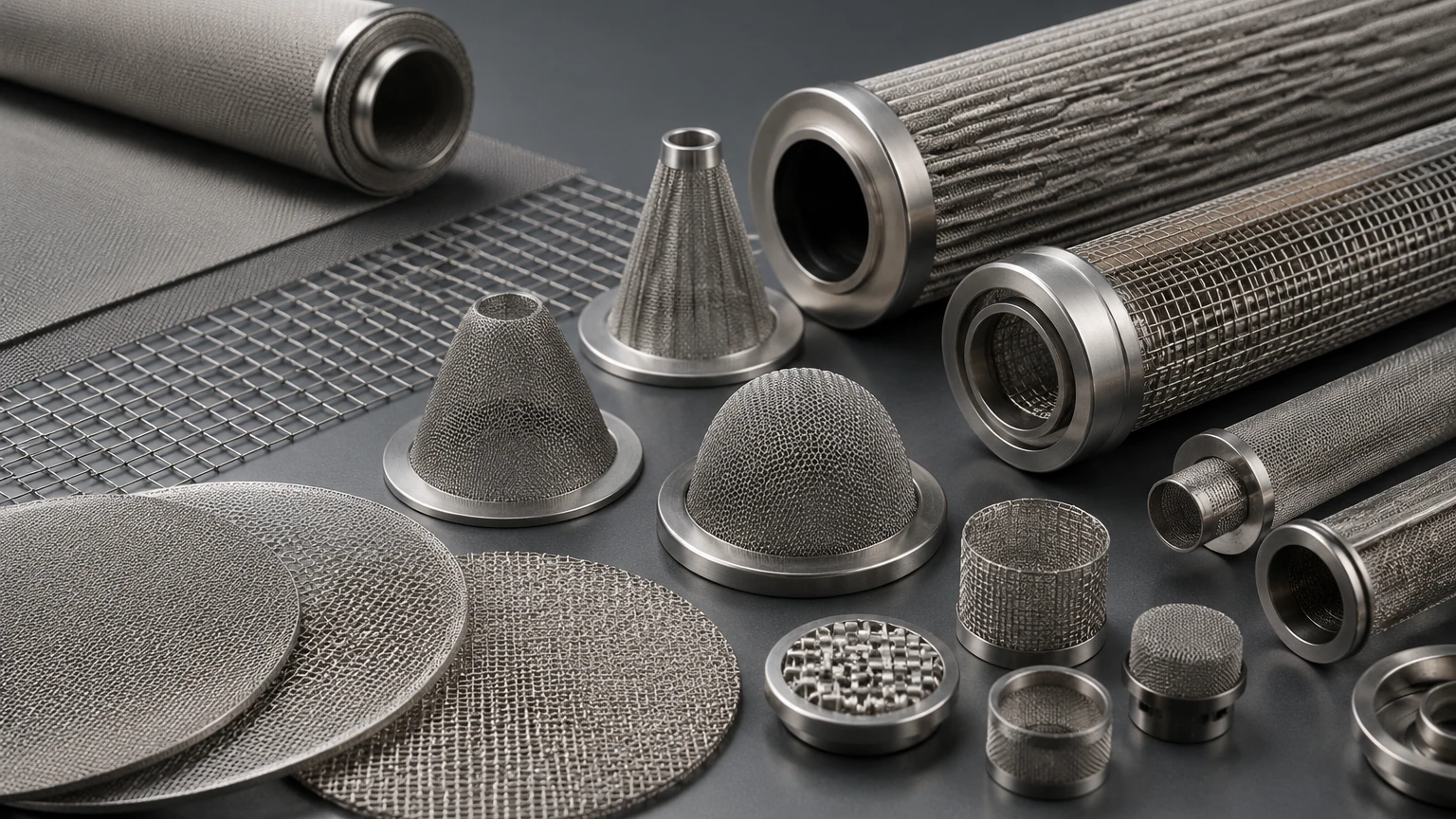
Custom Fabrication and Integration into Industrial Systems
Raw filtration mesh is rarely used in its flat, woven state. To be effective, it must be fabricated into specific components such as filter cartridges, discs, or pleated elements.
Pleated Filter Elements
Pleating the mesh significantly increases the effective filtration area within the same footprint. This allows for higher flow rates and longer service intervals (dirt-holding capacity) without increasing the size of the filter housing. Stainless steel pleated elements are widely used in hydraulic and chemical applications where high-capacity filtration is required.
Sintered Mesh Laminates
For applications involving extreme pressures or the need for ultra-fine filtration with high mechanical stability, multiple layers of mesh are sintered together. Sintering involves bonding the contact points of the wires through heat and pressure without melting them. This creates a porous metal plate that is incredibly strong, easy to clean, and resistant to migration (where individual wires might break off and contaminate the filtrate).
Custom OEM Solutions
Many industrial applications require bespoke filtration components. This includes custom-shaped strainers, reinforced baskets, or specialized fittings. Working with a manufacturer that understands the transition from raw filtration mesh to a finished, high-precision component is essential for achieving optimal system integration. You can Review product options and application support on our Main Page to see how these materials are transformed into industrial solutions.
Maintenance, Cleaning, and Total Cost of Ownership
One of the primary advantages of stainless steel filtration mesh over disposable media (such as paper or felt) is its cleanability. However, the total cost of ownership (TCO) depends on the ease of maintenance and the durability of the mesh.
Cleaning Methodologies
- Backwashing: Reversing the flow of the fluid to dislodge particles trapped on the surface of the mesh. This is highly effective for plain weave and surface-filtration Dutch weaves.
- Ultrasonic Cleaning: Using high-frequency sound waves in a cleaning solvent to remove fine particles embedded deep within the weave. This is often necessary for twill Dutch weaves or sintered laminates.
- Chemical Cleaning: Using acids or alkalis to dissolve organic or mineral scaling. The mesh material must be chemically compatible with the cleaning agents used.
Replacement Indicators
While stainless steel mesh is durable, it is not infinite. Factors such as fatigue from pressure cycling, erosion from abrasive particles, or chemical degradation will eventually necessitate replacement. Monitoring the pressure drop across the filter is the most reliable way to determine when a mesh is blinded beyond the point of effective cleaning.
Procurement Checklist for Engineering Teams
Before finalizing a purchase order for filtration mesh or mesh-based components, engineers should confirm the following technical details with their supplier:
1. Micron Requirement: Is the requirement for a nominal or absolute rating?
2. Chemical Environment: What is the pH, chloride concentration, and presence of oxidizing agents?
3. Operating Conditions: What are the maximum operating temperatures and surge pressures?
4. Flow Rate: What is the required flow rate, and what is the maximum allowable initial pressure drop?
5. Cleaning Protocol: How will the mesh be cleaned, and is the structure robust enough to withstand that process?
6. Compliance: Are there specific industry standards (e.g., FDA for food, USP Class VI for pharma) that the material must meet?
By addressing these factors, procurement teams can avoid the common pitfalls of underspecified filtration, such as frequent system downtime, contaminated end-products, or premature equipment failure. For comprehensive technical data and to explore the full range of custom stainless steel filtration components, visit our Main Page.
