


Filtration of Oil
In industrial environments, oil is far more than a simple lubricant; it is a critical medium for power transmission, heat transfer, and the protection of internal components against friction and wear. Whether in hydraulic systems, steam turbines, or heavy-duty gearboxes, the purity of the oil directly correlates with the reliability and lifespan of the machinery. Effective filtration of oil is the primary defense mechanism against premature component failure and system inefficiency.
For engineers and maintenance professionals, understanding the technical nuances of oil filtration is essential for optimizing system performance. This guide explores the engineering principles, material considerations, and selection criteria necessary to implement a robust filtration strategy, particularly through the use of high-performance stainless steel filtration components.
Understanding the Critical Role of Oil Filtration in Industrial Systems
The primary objective of oil filtration is to remove contaminants that can compromise the fluid's chemical properties or cause mechanical damage. In a closed-loop system, even microscopic particles can lead to a chain reaction of wear. For instance, in hydraulic systems, silt-sized particles can lodge in the tight clearances of valves and pumps, leading to "stiction" or abrasive wear that generates even more particulate matter.
Industrial oils, including hydraulic fluids, lubricating oils, and fuel oils, are susceptible to various forms of degradation. Effective filtration of oil ensures that the fluid maintains its intended viscosity, lubricity, and thermal stability. By removing solid particulates and, in some cases, moisture, filtration prevents the formation of sludge and varnish—byproducts of oil oxidation that can coat internal surfaces and restrict flow.
Types of Contaminants in Industrial Oils
To design or select an effective filter, one must first identify the types of contaminants present in the system. Contamination is generally categorized into three main groups:
1. Particulate Contamination
Solid particles are the most common and damaging contaminants. These can be "built-in" (leftover from manufacturing or assembly), "ingested" (drawn in through breathers or seals), or "generated" (produced by internal wear). Particulates are measured by size in microns (µm). In high-precision systems, even particles smaller than 5 microns can cause significant damage to sensitive components like servo valves.
2. Water Contamination
Water can exist in oil in three states: dissolved, emulsified, or free. Water reduces the oil's ability to lubricate, promotes rust and corrosion, and can lead to the depletion of additives. While standard particulate filters are not designed to remove water, specialized coalescing filters or vacuum dehydration systems are often used in conjunction with precision metal mesh filters to maintain dry oil.
3. Chemical Contamination and Oxidation Byproducts
Over time, heat and pressure cause oil to break down chemically. This process produces organic acids, resins, and sludges. While these are often sub-micron in size, they can agglomerate and clog fine filters or settle on cool surfaces, such as heat exchangers, reducing their efficiency.
Engineering Considerations for the Filtration of Oil
When specifying filtration components for oil-based applications, several engineering variables must be calculated to ensure the filter performs reliably under operational stresses.
Viscosity and Temperature Relationship
Unlike water, the viscosity of oil is highly sensitive to temperature changes. At low temperatures, oil becomes thicker (higher viscosity), which increases the pressure drop across the filter media. If a filter is sized based on the operating temperature (e.g., 60°C) but the system must start up in a cold environment (e.g., 10°C), the initial pressure drop might exceed the bypass valve setting or even damage the filter element. Engineers must size the filter based on the maximum expected viscosity during cold starts to ensure continuous filtration of oil.
Pressure Drop (ΔP)
Pressure drop is the difference in pressure between the inlet and outlet of the filter. It is influenced by the flow rate, oil viscosity, and the resistance of the filter media. A well-designed filtration system aims for a low initial pressure drop to provide a sufficient "dirt-holding capacity" before the filter reaches its terminal pressure drop and requires cleaning or replacement.
Flow Velocity and Flux Rates
High flow velocities through the filter media can cause "media migration" or force captured particles through the mesh. For viscous oils, maintaining a lower flux rate (flow per unit of surface area) is critical. This is often achieved by using pleated stainless steel filter cartridges, which significantly increase the available surface area within a compact housing.
Advantages of Stainless Steel Filter Media for Oil Applications
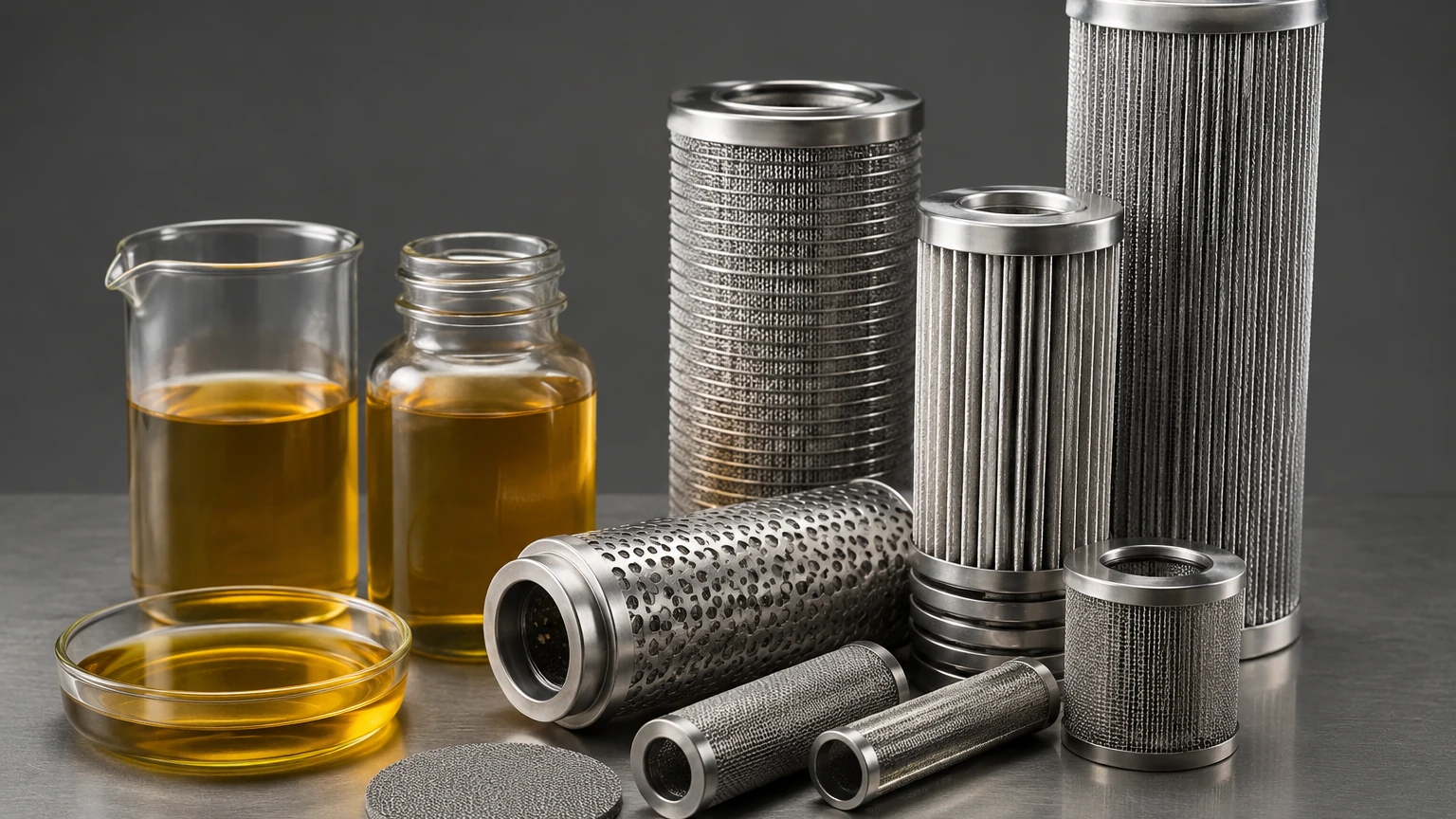
While disposable cellulose or synthetic fiber filters are common, many industrial oil applications demand the durability and precision of stainless steel. Kaifil specializes in manufacturing custom stainless steel filtration solutions that offer several technical advantages for the filtration of oil:
* Thermal Stability: Stainless steel filters can operate at temperatures far exceeding the limits of polymer-based media, making them ideal for hot lubricating oils or high-temperature process fluids.
* Chemical Compatibility: Stainless steel (typically 304 or 316L) is resistant to the additives found in modern synthetic oils and the aggressive cleaning chemicals sometimes used in system flushes.
* Structural Integrity: Under high-pressure or high-pulsation conditions, stainless steel wire mesh maintains its pore structure, preventing the "unloading" of contaminants that can occur when flexible media deforms.
* Cleanability and Reusability: Unlike disposable elements, stainless steel cartridges can be cleaned via ultrasonic baths or backwashing. This reduces the total cost of ownership and minimizes environmental waste in large-scale industrial operations.
For more information on specific filter configurations and technical specifications, you can visit the Main Page to review product options and application support.
Key Performance Metrics: Micron Ratings and Beta Ratios
Selecting a filter requires a clear understanding of how filtration efficiency is measured. In the B2B industrial sector, two metrics are paramount:
Nominal vs. Absolute Micron Rating
A nominal rating indicates the filter's ability to retain the majority of particles of a certain size (e.g., 95% of 10-micron particles). However, it does not guarantee that larger particles will not pass through. An absolute rating (often determined via the ISO 16889 multi-pass test) refers to the diameter of the largest hard spherical particle that will pass through the filter under specified test conditions. For critical oil systems, absolute-rated stainless steel mesh is preferred to ensure consistent protection.
The Beta Ratio (β)
The Beta Ratio describes the filtration efficiency for a specific particle size. It is the ratio of the number of particles upstream of the filter to the number of particles downstream. For example, if a filter has a β10 = 200, it means that for every 200 particles of 10 microns entering the filter, only one passes through. This represents a 99.5% efficiency. When evaluating solutions for the filtration of oil, engineers should request Beta Ratio data to accurately predict the downstream oil cleanliness.
Maintenance, Cleaning, and Replacement Cycles
The longevity of an oil filtration system depends on a proactive maintenance schedule. Because stainless steel filters are an investment in durability, understanding when to clean them is vital.
1. Differential Pressure Monitoring: The most reliable indicator of a loaded filter is the pressure gauge. Most industrial systems include a differential pressure switch that triggers an alarm when the ΔP reaches a pre-set limit.
2. Oil Analysis: Regular laboratory analysis of the oil (spectroscopy, particle counting, and viscosity testing) provides insight into the filter's performance. If particle counts (ISO 4406) begin to rise despite a low ΔP, it may indicate media bypass or a failed seal.
3. Cleaning Protocols: For stainless steel elements, cleaning must be performed carefully to avoid damaging the precision wire mesh. Ultrasonic cleaning is the industry standard, as it uses high-frequency sound waves to dislodge particles from deep within the mesh pores without mechanical abrasion.
Customization and OEM Solutions in Oil Filtration
Every industrial system has unique constraints, from space limitations in a hydraulic power unit to specific flow requirements in a chemical processing plant. Off-the-shelf filters often require compromises in performance or installation.
Customized filtration solutions allow engineers to specify the exact dimensions, end-cap configurations, and mesh weaves required for their specific oil type and flow conditions. Whether it is a pleated cartridge for maximum surface area or a robust cylindrical strainer for suction-line protection, custom manufacturing ensures that the filtration component integrates seamlessly into the existing infrastructure.
Conclusion
Effective filtration of oil is a multi-faceted engineering challenge that requires a balance of material science, fluid dynamics, and rigorous maintenance. By selecting high-quality stainless steel media and adhering to strict cleanliness standards, industrial operators can significantly reduce downtime and extend the service life of expensive machinery.
When evaluating your next filtration project, consider the long-term benefits of durability and precision. For detailed technical guidance and custom-engineered filter components, visiting the Main Page provides access to a wealth of resources and manufacturing expertise tailored to demanding industrial applications.
