


Filtre À Coalescence Principe
In industrial fluid management, the separation of immiscible liquids or the removal of liquid aerosols from gas streams is a critical process for protecting downstream equipment and ensuring product purity. The "filtre à coalescence principe" (coalescence filter principle) serves as the foundation for these separation technologies. Unlike standard particulate filtration, which relies on mechanical sieving to trap solid contaminants, coalescence is a physical process that encourages small droplets of a discontinuous phase to merge into larger droplets, allowing for separation based on density differences.
For engineers and procurement professionals in sectors such as chemical processing, oil and gas, and power generation, understanding the technical nuances of coalescence is essential for selecting the right filtration hardware. This guide examines the mechanics, material requirements, and engineering considerations necessary to implement effective coalescing solutions.
The Mechanics of the Coalescence Principle
The fundamental goal of a coalescing filter is to transform a fine mist or emulsion into a manageable liquid stream. The process occurs in three distinct stages: interception, coalescence, and drainage.
1. Interception and Capture
As the contaminated fluid (the continuous phase) passes through the filter media, the dispersed droplets (the discontinuous phase) come into contact with the fibers or the mesh structure. This contact is achieved through three physical mechanisms:
* Direct Interception: Occurs when a droplet follows a fluid streamline and comes within one droplet radius of a fiber.
* Inertial Impaction: Happens when heavier droplets cannot follow the rapid changes in fluid direction around a fiber and collide with it due to momentum.
* Brownian Diffusion: Affects extremely small droplets (typically sub-micron) that move erratically due to molecular collisions, eventually making contact with the filter media.
2. Coalescence (Droplet Growth)
Once captured by the media, the droplets adhere to the fibers. As more droplets are intercepted, they move along the fiber length and merge at the crossover points of the mesh or fiber matrix. This is the core of the filtre à coalescence principe. The media must have specific surface properties—often a combination of hydrophobic and oleophobic characteristics depending on the application—to facilitate this merging without permanently trapping the liquid within the pores.
3. Drainage and Separation
When the merged droplets reach a sufficient size and mass, the force of the fluid flow or gravity overcomes the adhesive forces holding them to the media. These larger droplets then migrate to the outer surface of the filter element (in out-to-in flow) or the inner core (in in-to-out flow) and fall into a collection sump. Because the droplets are now significantly larger than the original mist, they do not become re-entrained in the cleaned fluid stream.
Engineering Considerations for Media Selection
The efficiency of a coalescing system is heavily dependent on the material science behind the filter element. In demanding industrial environments, stainless steel is often the preferred material due to its structural integrity and resistance to corrosion.
Surface Tension and Wettability
For coalescence to be effective, the filter media must be "wettable" by the dispersed phase. If the goal is to remove water from fuel, the media should ideally be hydrophilic. If the goal is to remove oil from compressed air, the media must be oleophilic. Engineers must specify the surface energy of the stainless steel mesh or sintered components to ensure that droplets spread and merge rather than bead up and block the flow.
Pore Structure and Porosity
Precision metal filters, such as those manufactured by Kaifil, offer controlled porosity that is vital for balancing separation efficiency with pressure drop. A media that is too dense will result in a high differential pressure (Delta P), increasing energy costs and potentially causing droplet shearing—where large droplets are broken back down into smaller ones by the force of the flow. Conversely, a media that is too open will allow small aerosols to pass through without interception.
Mechanical Strength
In high-pressure hydraulic or gas systems, the filter element must withstand significant structural stress. Stainless steel wire mesh and perforated metal supports provide the necessary rigidity to prevent media migration or collapse during pressure surges. This durability is a primary reason why industrial operators move away from disposable glass fiber elements toward cleanable or long-life metal solutions.
Key Evaluation Criteria for Industrial Coalescers
When evaluating a coalescing system based on the filtre à coalescence principe, technical teams should prioritize the following metrics to ensure long-term operational stability:
1. Separation Efficiency: Usually expressed as a percentage of the dispersed phase removed at a specific droplet size (e.g., 99.9% removal of droplets > 0.3 microns).
2. Clean Pressure Drop: The initial resistance to flow. A well-designed coalescer should minimize this to reduce the load on pumps or compressors.
3. Saturation Pressure Drop: Unlike particulate filters, coalescers reach a "steady state" where the rate of liquid capture equals the rate of drainage. The pressure drop at this equilibrium is a critical design parameter.
4. Chemical Compatibility: The filter housing and media must be compatible with both the continuous and discontinuous phases, as well as any additives or surfactants present in the fluid.
For those seeking specific configurations or technical data sheets on industrial-grade filtration components, you can Review product options and application support to see how custom engineering meets these criteria.
Common Applications of Coalescence Technology
The versatility of the coalescence principle allows it to be applied across a wide range of industrial processes. Each application requires a specific approach to media density and housing design.
Compressed Air Treatment
In pneumatic systems, oil mist from compressors can contaminate end-use equipment or final products. Coalescing filters are used to remove these oil aerosols, ensuring the air meets ISO 8573-1 quality standards. Here, the flow is typically inside-to-outside to allow the oil to collect on the outer shroud and drain away.
Oil-Water Separation in Hydrocarbon Processing
In the oil and gas industry, water must be removed from refined products like diesel or jet fuel to prevent corrosion and microbial growth. Coalescers utilize the density difference between water (1.0 g/cm³) and fuel (approx. 0.8 g/cm³) after the droplets have been enlarged by the filter media.
Gas-Liquid Separation in Natural Gas Pipelines
Natural gas often contains liquid condensates and water. Removing these is essential before the gas enters turbines or transmission pipelines. Large-scale coalescing pressure vessels use multi-stage stainless steel elements to handle high flow velocities while maintaining high capture rates.
Risks and Operational Challenges
While the filtre à coalescence principe is highly effective, several factors can compromise performance if not properly managed during the design phase.
* Surfactants: Chemical agents that reduce surface tension can "poison" a coalescer. Surfactants cause droplets to become so stable that they will not merge upon contact with the media. In such cases, pre-treatment or specialized media coatings are required.
* Solid Contamination: Coalescing filters are not intended to be primary particulate filters. If the fluid contains high levels of solids, the coalescing media will plug rapidly. A dedicated pre-filter (typically a 5-10 micron pleated metal cartridge) should be installed upstream to protect the coalescer.
* Flow Velocity: Every coalescer has a maximum design velocity. If the flow rate exceeds this limit, the velocity of the fluid will strip droplets off the media before they can drain, leading to "carryover" or re-entrainment of the contaminant.
Customization and OEM Requirements
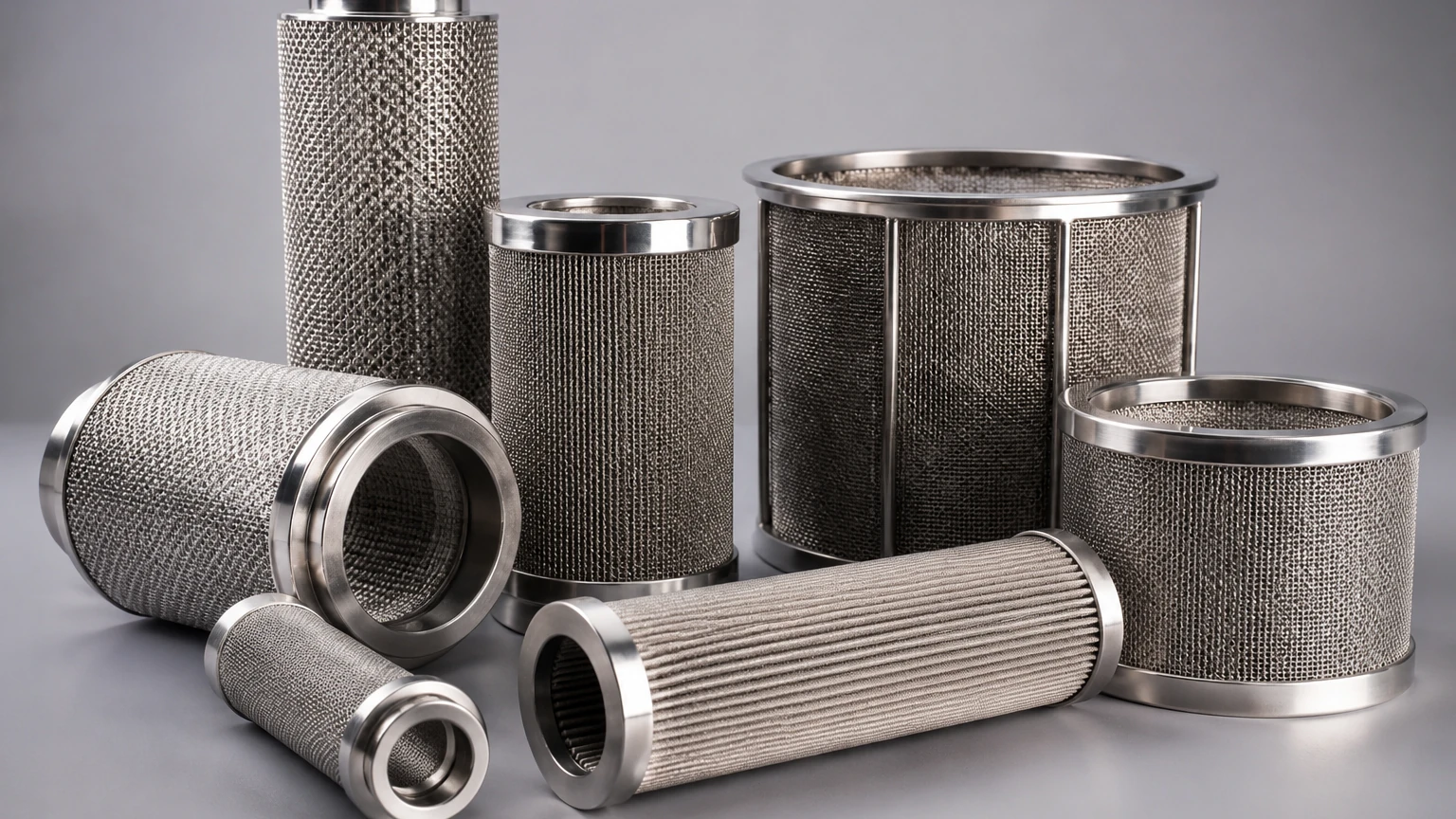
Standard off-the-shelf filters often fail to meet the specific spatial or performance constraints of complex industrial machinery. This is where custom manufacturing becomes necessary. When working with a partner like Kaifil, engineers can specify exact dimensions, end-cap configurations (such as DOE, 222, or 226), and micron ratings tailored to the specific viscosity and surface tension of their process fluids.
Customized stainless steel filtration solutions allow for:
* Optimized Pleat Geometry: Increasing the surface area to lower the flux rate and improve droplet capture.
* Alloy Selection: Using 304, 316L, or even exotic alloys for highly corrosive chemical environments.
* Integrated Supports: Adding internal cores or external cages to handle high-pressure differentials without deforming the coalescing layer.
Conclusion: Selecting the Right Solution
Implementing the filtre à coalescence principe effectively requires more than just a filter element; it requires a deep understanding of fluid dynamics and material science. By focusing on the physical mechanisms of capture and the importance of drainage, engineers can design systems that provide dry gas or pure liquids consistently.
Before finalizing a purchase, technical teams should confirm the fluid's physical properties (density, viscosity, and surface tension), the expected contaminant loading, and the required effluent quality. Choosing a manufacturer with expertise in stainless steel and precision metal filtration ensures that the resulting component is not only efficient but also durable enough for the rigors of industrial use.
For detailed specifications on custom metal filter cartridges and wire mesh solutions designed for these applications, visit the Main Page to explore technical resources and manufacturing capabilities.
