


Polyether Polyurethane Foam
In the landscape of industrial materials, polyether polyurethane foam stands as a critical component for filtration, cushioning, and acoustic insulation. For engineers and procurement specialists, selecting the right foam substrate requires a deep understanding of polymer chemistry, mechanical properties, and environmental resistance. Unlike its polyester-based counterparts, polyether polyurethane foam is specifically engineered for environments where moisture, microbial growth, and hydrolytic degradation are primary concerns.
At Kaifil, while our core expertise lies in precision stainless steel filtration, we recognize that many industrial systems utilize a multi-stage approach. Polyether foam often serves as a primary or pre-filtration layer, protecting downstream high-precision components like stainless steel wire mesh or sintered cartridges. Understanding the technical nuances of this material is essential for optimizing system longevity and filtration efficiency.
Chemical Composition and Hydrolytic Stability
Polyurethane foams are formed through the reaction of a polyol with an isocyanate. The distinction between "polyether" and "polyester" types lies in the polyol used during the synthesis process. Polyether polyurethane foam utilizes polyether polyols, which contain ether linkages (-C-O-C-) in the polymer backbone.
From an engineering perspective, the most significant advantage of the ether linkage is its inherent resistance to hydrolysis. Hydrolysis is the chemical breakdown of a compound due to reaction with water. Polyester-based foams are susceptible to "foam rot" or crumbling when exposed to high humidity or liquid water over extended periods because their ester linkages are easily cleaved by water molecules.
Polyether polyurethane foam, conversely, maintains its structural integrity in wet and humid conditions. This makes it the preferred choice for:
* Outdoor power equipment air filters.
* Water treatment pre-filtration.
* Marine engine components.
* HVAC systems in high-humidity climates.
Furthermore, polyether foams generally exhibit better resistance to microbial growth (mold and mildew) compared to polyester foams, as they do not provide a viable food source for fungi in damp environments.
The Reticulation Process in Filtration
For filtration applications, standard "closed-cell" or "partially open-cell" foam is insufficient. Industrial-grade polyether foam must undergo a process called reticulation. Reticulation involves removing the thin cell membranes (windows) that exist between the structural strands (struts) of the foam.
This is typically achieved through a controlled thermal explosion (zapping) or a chemical quenching process. The result is a 100% open-cell structure that resembles a three-dimensional net. Reticulated polyether polyurethane foam offers several critical advantages for fluid and gas dynamics:
1. Low Pressure Drop: The absence of cell membranes allows air or liquid to pass through the media with minimal resistance, which is vital for maintaining system efficiency and reducing energy consumption in fans and pumps.
2. High Dust Holding Capacity: The three-dimensional structure provides a large internal surface area, allowing the foam to trap and hold a significant volume of particulate matter before requiring cleaning or replacement.
3. Uniform Pore Distribution: Controlled manufacturing ensures a consistent number of pores per linear inch, allowing for predictable filtration performance.
Technical Specifications: PPI and Density
When specifying polyether polyurethane foam for an industrial project, two primary metrics define its performance: Pores Per Inch (PPI) and Density.
Pores Per Inch (PPI)
Filtering foam is categorized by its PPI rating, typically ranging from 10 PPI (very coarse) to 100 PPI (very fine).
* 10–30 PPI: Used for heavy-duty pre-filtration, trapping large debris like sand, leaves, or large dust particles. These grades offer the lowest pressure drop.
* 45–60 PPI: Common in general-purpose air filtration, such as small engine intake filters or electronics cooling.
* 80–100 PPI: Used for fine filtration where higher efficiency is required, though these grades necessitate more frequent maintenance due to faster loading.
Density and Hardness
Density is measured in pounds per cubic foot (lb/ft³) or kilograms per cubic meter (kg/m³). While density does not directly dictate filtration efficiency, it significantly impacts the foam's mechanical strength, durability, and cost. A higher-density foam will generally have thicker struts, providing better resistance to compression and tearing under high-flow velocities. Hardness (often measured by Indentation Force Deflection or IFD) determines how much the foam will deform under pressure, a critical factor when the foam is used as a gasket or seal within a filter housing.
Mechanical and Thermal Properties
Engineers must evaluate the mechanical limits of polyether polyurethane foam to ensure it survives the operational stresses of the application.
* Tensile Strength and Elongation: Polyether foams generally have lower tensile strength than polyester foams but offer sufficient durability for most filtration applications. They can typically withstand significant stretching and compression without permanent deformation.
* Temperature Range: Most polyether foams can operate continuously at temperatures up to 200°F (93°C). Beyond this limit, the polymer may begin to soften or lose its structural elasticity. For high-temperature industrial exhaust or steam applications, engineers should transition to metallic media, such as those found on the Main Page of our product catalog.
* Chemical Compatibility: Polyether foam is resistant to dilute acids and alkalis, as well as many petroleum-based lubricants. However, it can be degraded by strong oxidizing agents, certain solvents (like chlorinated hydrocarbons), and prolonged exposure to intense UV radiation unless UV stabilizers are added during manufacturing.
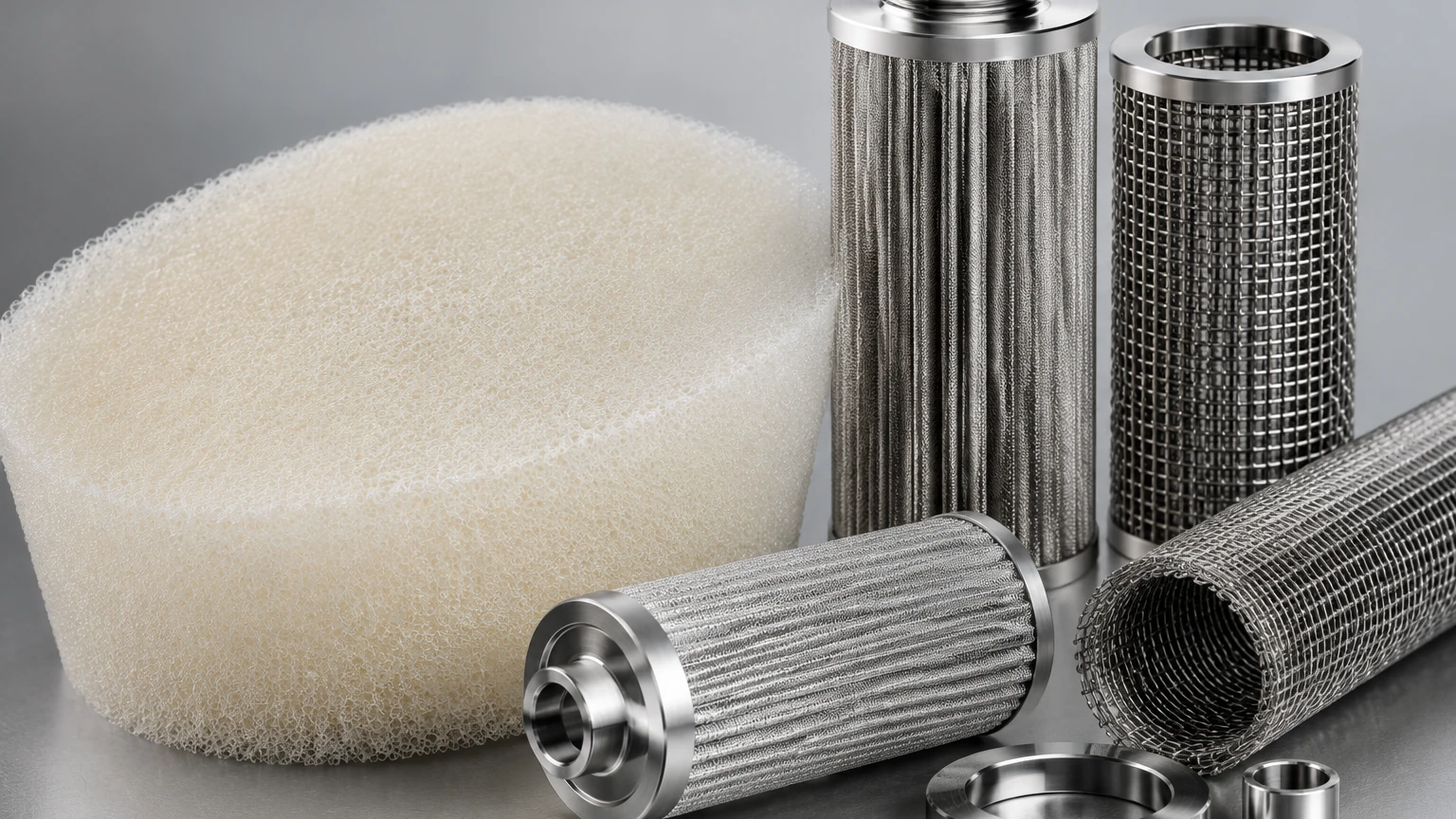
Polyether Foam vs. Stainless Steel Filtration
In many B2B industrial scenarios, a common question arises: when should an engineer choose polyether polyurethane foam over stainless steel wire mesh? The answer usually depends on the "Total Cost of Ownership" and the specific cleanliness requirements of the process.
When to Use Polyether Foam:
* Cost-Sensitive Pre-filtration: Foam is significantly less expensive than stainless steel. Using it as a sacrificial layer to capture large contaminants can extend the life of expensive downstream filters.
* Acoustic Dampening: If the filtration stage also needs to reduce noise (e.g., in a vacuum pump or air compressor), the cellular structure of polyether foam provides excellent sound absorption.
* Disposable Applications: In environments where contaminants are hazardous or impossible to clean from a permanent filter, disposable foam inserts are more practical.
When to Transition to Stainless Steel:
* High Pressure and Flow: Foam can deform or collapse under high differential pressure ($ΔP$). Stainless steel cartridges provide the structural rigidity needed for high-pressure hydraulic or process systems.
* Aggressive Chemicals: For highly corrosive environments or extreme pH levels, 304 or 316L stainless steel is required.
* Cleanability: Stainless steel filters can be ultrasonically cleaned or backwashed, making them a permanent asset. Foam, while washable to an extent, eventually degrades and loses its pore structure after repeated cleaning cycles.
* Precise Micron Ratings: While foam is rated by PPI (an approximation), stainless steel mesh can be manufactured to precise micron absolute ratings, ensuring 100% capture of specific particle sizes.
Maintenance and Replacement Cycles
For maintenance teams, the primary indicator for polyether foam replacement is the pressure drop across the filter. As the open cells become loaded with particulate, the resistance to flow increases. Unlike metal filters, which can often be returned to near-original pressure drop through professional cleaning, polyether foam has a finite lifespan.
Over time, the physical struts of the foam may become brittle due to chemical exposure or thermal cycling. If the foam begins to shed particles (linting), it must be replaced immediately to prevent downstream contamination. In critical applications, it is standard practice to replace polyether foam inserts during every scheduled maintenance interval rather than attempting to wash and reuse them, as the cost of the foam is negligible compared to the risk of system failure.
Customization and Procurement Considerations
When ordering polyether polyurethane foam for industrial use, providing a complete specification sheet is vital to ensure the material performs as expected. Procurement teams should confirm the following with their suppliers:
1. Reticulation Verification: Ensure the foam is 100% reticulated (completely open-cell) if it is intended for fluid or air flow.
2. Dimensional Tolerances: Foam is flexible and can be difficult to cut to precise tolerances. Specify whether the foam will be compressed into a housing, which may allow for looser tolerances.
3. Environmental Additives: Determine if the application requires flame retardants (e.g., UL 94 HF-1 rating), UV stabilizers, or anti-microbial treatments.
4. Packaging: Foam is bulky. Discussing compression packaging options can significantly reduce shipping costs for high-volume orders.
By carefully evaluating these factors, engineers can integrate polyether polyurethane foam into their systems as a reliable, cost-effective solution for moisture-prone and general-purpose filtration tasks. For applications requiring higher precision, extreme temperatures, or permanent cleanable solutions, exploring advanced metal filtration components remains the gold standard for industrial reliability.
