


Filtre Coalescent Huile
In industrial fluid dynamics and gas processing, the separation of liquid aerosols from gas streams or the removal of emulsified water from hydrocarbons is a critical requirement for equipment longevity and process integrity. The technology behind a filtre coalescent huile (oil coalescer filter) is engineered to address these specific challenges. Unlike standard particulate filters that simply trap solids, a coalescer utilizes a multi-stage physical process to merge sub-micron droplets into larger masses that can be easily drained from the system. For engineers and procurement teams, understanding the technical nuances of these components is essential for optimizing filtration efficiency and reducing operational downtime.
The Fundamental Principles of Oil Coalescence
The operation of a filtre coalescent huile is governed by the physics of droplet interaction and fluid velocity. Coalescence is essentially the reverse of atomization. While an atomizer breaks liquid into fine mist, a coalescer takes that mist and reconstructs it into bulk liquid. This process typically occurs in three distinct stages within the filter media: interception, impaction, and diffusion.
Interception and Impaction
As the contaminated gas or fluid passes through the filter matrix—often composed of borosilicate microfibers or specialized stainless steel mesh—larger oil droplets are unable to follow the tortuous path of the flow. These droplets collide with the fibers (impaction) or are caught by the fiber structure (interception). Because the media is designed with specific surface tension properties, the oil droplets adhere to the fibers rather than passing through.
Brownian Motion and Diffusion
For extremely small aerosols, typically those under 0.1 microns, the particles do not move in a straight line but follow a random path known as Brownian motion. This movement increases the probability that these tiny particles will eventually make contact with the filter media. Once a particle is captured, it begins to move along the fiber, eventually meeting other captured droplets.
The Coalescing Phase
As droplets accumulate at the fiber intersections, they merge to form larger drops. This growth continues until the droplets reach a mass where the force of the fluid flow or gravity overcomes the surface tension holding them to the media. In gas filtration, these large drops are pushed to the outer "drainage layer" of the element, where they fall into a collection sump. In liquid-liquid applications, such as removing water from fuel, the heavier liquid settles to the bottom of the housing.
Structural Components and Material Engineering
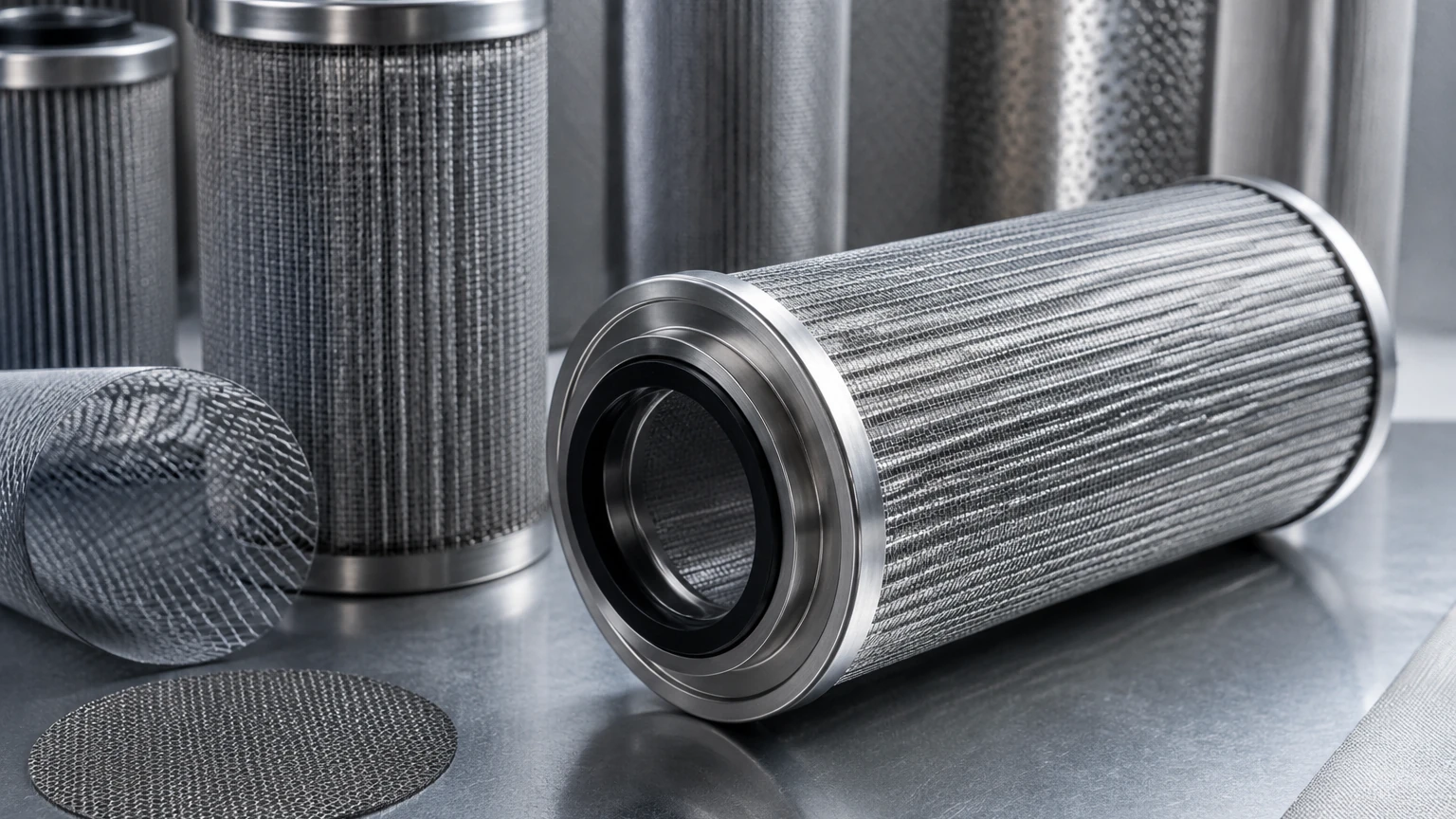
The efficiency of a filtre coalescent huile is heavily dependent on the materials used in its construction. While disposable glass-fiber elements are common in light-duty applications, industrial environments often demand the durability and chemical resistance provided by metal filtration solutions. As a specialist in custom stainless steel filtration, Kaifil provides engineered components that withstand high pressures and corrosive environments.
Stainless Steel Media
Stainless steel wire mesh and sintered metal fibers are frequently employed in coalescing applications where temperature or chemical compatibility prevents the use of synthetic fibers. 304 and 316L stainless steel are the industry standards due to their resistance to oxidation and their ability to be cleaned and reused. The geometry of the mesh is precisely calculated to provide the necessary surface area for droplet capture while maintaining a low pressure drop.
The Support Core and Outer Cage
Because coalescing elements often operate under significant differential pressure, they require a robust internal support core. This core, typically made of perforated or expanded metal, prevents the filter media from collapsing. An outer cage or shroud is also used to protect the media during installation and to assist in the drainage process by preventing the re-entrainment of captured oil back into the gas stream.
Sealing and End Caps
Proper sealing is vital to ensure that no bypass occurs. End caps are usually constructed from stainless steel or high-grade polymers, bonded to the media using specialized adhesives or through mechanical welding. For high-temperature applications, metal-to-metal seals or Viton O-rings are preferred to maintain integrity.
Key Technical Specifications and Performance Metrics
When evaluating a filtre coalescent huile, engineers must look beyond simple micron ratings. The performance of a coalescer is measured by its ability to handle specific flow rates while achieving a target cleanliness level.
1. Filtration Efficiency (Aerosol Removal): This is often expressed as the percentage of oil remaining in the stream after filtration, typically measured in parts per million (ppm) or milligrams per cubic meter (mg/m³). High-efficiency coalescers can reduce oil content to as low as 0.01 ppm.
2. Saturated Pressure Drop ($ΔP$): Unlike dry particulate filters, a coalescing filter operates in a "saturated" state. The pressure drop will increase as the media fills with oil and then stabilize once the drainage rate equals the capture rate. Minimizing this saturated $ΔP$ is crucial for energy efficiency in compressed air systems.
3. Flow Velocity: Coalescence is highly sensitive to velocity. If the flow is too fast, the air can "strip" the oil off the fibers before it has a chance to drain, leading to carryover. Conversely, if the flow is too slow, the impaction mechanism is less effective.
4. Temperature Resistance: High temperatures can lower the viscosity of oil, making it harder to coalesce. It can also affect the structural integrity of the filter media and seals.
Industrial Applications of Oil Coalescer Filters
The versatility of the filtre coalescent huile makes it a staple in various industrial sectors. Any process involving the compression of gases or the handling of mixed-phase fluids likely requires coalescing technology.
Compressed Air Systems
Most industrial air compressors are oil-lubricated. As the air is compressed, oil becomes entrained as a fine mist. If this oil reaches pneumatic tools, paint sprayers, or food processing lines, it can cause equipment failure or product contamination. Coalescing filters are the primary line of defense in these systems, often installed in series with a general-purpose pre-filter and an activated carbon adsorber.
Vacuum Pump Exhaust
Vacuum pumps used in laboratory and industrial settings often discharge oil mist into the environment. A coalescing exhaust filter captures this oil, protecting the air quality of the facility and allowing the captured oil to be returned to the pump's reservoir, thereby reducing oil consumption.
Natural Gas Processing
In the oil and gas industry, coalescers are used to remove liquid hydrocarbons and water from natural gas streams. This is critical for protecting downstream turbines and compressors, as well as preventing the formation of hydrates which can block pipelines.
Hydraulic and Lube Oil Systems
Water is a common contaminant in hydraulic systems, leading to corrosion and fluid degradation. Liquid-liquid coalescers are used to remove free and emulsified water from the oil, extending the life of the fluid and the mechanical components it lubricates.
Engineering Selection and Customization Strategies
Selecting the right filtre coalescent huile requires a detailed analysis of the specific application environment. Standard off-the-shelf solutions may not always meet the requirements of specialized industrial processes. This is where custom manufacturing becomes essential. For those looking to explore specific configurations, you can Review product options and application support to find a solution tailored to your engineering constraints.
Fluid Compatibility
The first step in selection is ensuring that all materials in the filter—media, adhesives, and seals—are compatible with the fluid being filtered. For example, certain synthetic lubricants used in modern compressors can degrade standard nitrile seals, necessitating the use of fluorocarbon elastomers.
Contaminant Loading
Coalescers are designed to handle liquid aerosols, not high concentrations of solid particulates. If the process stream contains significant dust or scale, a particulate pre-filter must be installed upstream. Failure to do so will lead to the premature clogging of the coalescing media, as the solids will become trapped in the oil-saturated fibers.
Housing Design and Flow Direction
For gas coalescing, the flow direction is typically inside-to-out. This allows the oil to migrate to the outer surface of the element and drain into the housing bowl. The housing must be designed with sufficient "quiet zone" space at the bottom to prevent the collected oil from being picked up by the exiting gas stream.
Maintenance Protocols and Total Cost of Ownership
While the initial purchase price of a filtre coalescent huile is a factor, the total cost of ownership (TCO) is driven by maintenance frequency and energy consumption. A high-quality filter might have a higher upfront cost but offer a lower saturated pressure drop, saving thousands of dollars in energy costs over its lifespan.
Monitoring Differential Pressure
Differential pressure gauges are the most effective tool for monitoring filter health. A sudden increase in $ΔP$ usually indicates solid particulate loading, while a steady, high $ΔP$ suggests the filter has reached the end of its functional life. Most manufacturers recommend replacement when the pressure drop reaches a specific threshold, typically between 0.5 and 0.8 bar (7 to 12 psi).
Replacement Cycles
In a well-maintained system with proper pre-filtration, a coalescing element can last for 4,000 to 8,000 operating hours. However, this varies significantly based on the quality of the compressor oil and the environmental conditions. Regular oil analysis and air quality testing can help refine these replacement cycles.
The Role of OEM and Custom Solutions
For many specialized machines, the original equipment manufacturer (OEM) filter may be difficult to source or may not perform optimally under specific site conditions. Working with a manufacturer like Kaifil allows for the development of custom-designed stainless steel filter cartridges that match or exceed OEM specifications. Customization can include adjustments to the mesh density, the addition of reinforced support structures for high-pressure surges, or the use of specific alloys for extreme chemical resistance.
By focusing on the technical requirements of the application—such as flow rates, fluid properties, and environmental stresses—engineers can ensure they select a filtre coalescent huile that provides reliable, long-term performance. Whether it is protecting a high-speed turbine or ensuring the purity of food-grade compressed air, the right coalescing technology is a cornerstone of modern industrial efficiency. For more information on custom metal filtration components, visit the Main Page to consult with filtration experts.
