


Filtri Industriali Per Acqua
Industrial water filtration is a critical component in modern manufacturing and processing environments. Whether the objective is to protect sensitive downstream equipment, ensure the purity of a final product, or manage wastewater for environmental compliance, the selection of appropriate filtri industriali per acqua (industrial water filters) is an engineering decision that directly impacts operational efficiency and total cost of ownership.
In high-demand sectors such as chemical processing, food and beverage production, and pharmaceutical manufacturing, water is often used as a solvent, a cleaning agent, or a heat transfer medium. Each of these applications requires specific filtration parameters to remove contaminants ranging from large debris to microscopic particulates. This guide examines the technical considerations, material requirements, and engineering standards necessary for selecting high-performance stainless steel filtration solutions.
Technical Fundamentals of Industrial Water Filtration
Effective filtration is defined by the ability to remove specific particle sizes while maintaining a required flow rate and managing pressure differentials. When evaluating industrial filters, engineers must prioritize several key performance indicators:
1. Micron Rating (Absolute vs. Nominal): The micron rating determines the size of particles the filter will capture. A nominal rating indicates the filter can capture a percentage of particles of a given size, whereas an absolute rating guarantees the capture of nearly all particles (typically 99.9%) at that size. For critical applications like pharmaceutical water loops, absolute ratings are mandatory.
2. Flow Rate and Pressure Drop: Every filter media introduces resistance to the fluid flow, known as pressure drop ($ΔP$). An efficient system balances high filtration accuracy with a low initial pressure drop to minimize energy consumption by pumps.
3. Dirt Holding Capacity: This refers to the volume of contaminants a filter can retain before the pressure drop reaches a terminal level, necessitating cleaning or replacement. High dirt-holding capacity reduces the frequency of maintenance cycles.
For those seeking comprehensive technical specifications and customized engineering support, visiting the Main Page provides access to detailed product catalogs and manufacturing capabilities.
Material Selection: The Case for Stainless Steel
While various materials are used in industrial filtration, stainless steel remains the industry standard for demanding water treatment applications. The choice of material is dictated by the chemical composition of the water, the operating temperature, and the required durability.
Stainless Steel 304 vs. 316L
* Grade 304: Suitable for general-purpose water filtration where corrosion risk is moderate. It offers excellent mechanical strength and cost-effectiveness for standard industrial water loops.
* Grade 316L: Contains molybdenum, which provides superior resistance to chlorides and pitting corrosion. This is the preferred material for saline environments, chemical processing, and high-purity water systems where material leaching must be prevented.
Stainless steel filters are preferred over polymer-based alternatives because they are non-shedding, resistant to high temperatures, and capable of withstanding high differential pressures without structural failure. Furthermore, they are compatible with various sterilization methods, including Clean-in-Place (CIP) and Steam-in-Place (SIP) protocols.
Types of Industrial Water Filter Media
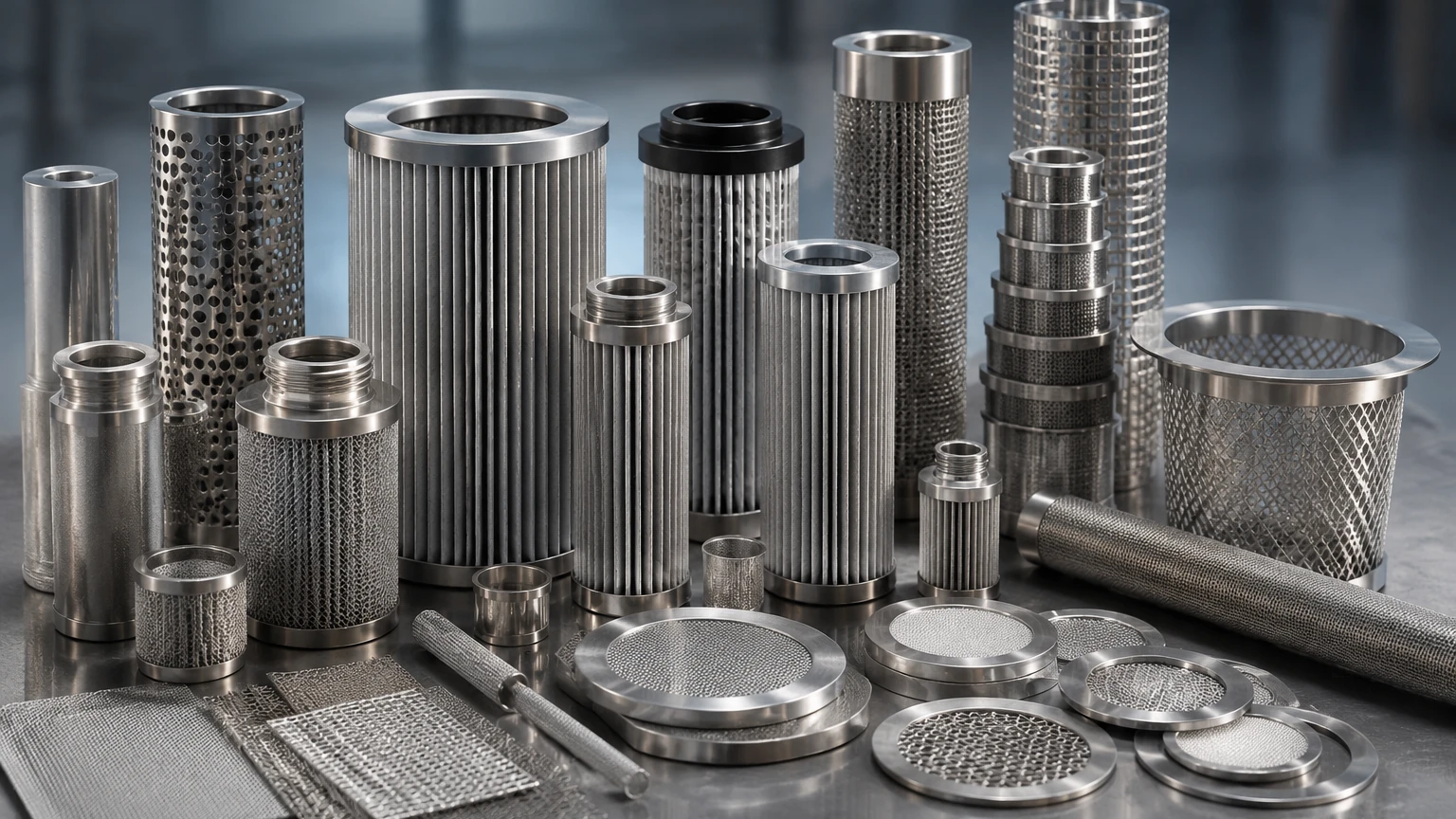
Selecting the right media structure is essential for optimizing the filtration process. Common configurations for filtri industriali per acqua include:
Wire Mesh Filters
Stainless steel wire mesh is a versatile medium available in various weaves, such as plain, twilled, or Dutch weave. It provides precise aperture sizes and is highly effective for surface filtration. Wire mesh is easily cleaned through backwashing or ultrasonic baths, making it a sustainable choice for long-term operations.
Sintered Metal Cartridges
Sintered metal filters are created by fusing multiple layers of wire mesh or metallic powder under high heat and pressure. This process creates a porous, rigid structure with exceptional mechanical strength. Sintered cartridges are ideal for high-pressure applications and fine filtration where the media must maintain its integrity under extreme stress.
Wedge Wire Screens
Constructed from V-shaped profiles, wedge wire screens are designed to be non-clogging. The narrow gap at the surface widens inwardly, allowing particles to pass through or be easily washed away during a backwash cycle. These are frequently used in intake water systems and large-scale industrial pre-filtration.
Engineering Considerations for System Integration
Integrating a filter into an industrial water system requires more than just matching pipe sizes. Engineers must consider the mechanical and chemical environment of the installation.
Chemical Compatibility
Industrial water is rarely pure H2O. It may contain dissolved gases, minerals, or residual chemicals from upstream processes. The filter media and housing gaskets (EPDM, Viton, or PTFE) must be compatible with these substances to prevent premature degradation.
Temperature and Pressure Fluctuations
Industrial processes often involve thermal cycling or pressure surges (water hammer). Stainless steel filter elements are engineered to maintain their pore geometry under these conditions, unlike plastic filters which may deform and allow "bypass"—where unfiltered water leaks through gaps caused by deformation.
Customization and OEM Requirements
Standard off-the-shelf filters often fail to meet the specific spatial or performance constraints of specialized machinery. Custom filtration solutions allow for the adjustment of flange types, housing dimensions, and internal support structures to fit existing infrastructure perfectly. This is particularly relevant for OEM manufacturers who need to integrate filtration components into their own equipment designs.
Application-Specific Requirements
The requirements for filtri industriali per acqua vary significantly across different sectors:
* Food and Beverage: Filters must meet stringent hygiene standards (such as FDA or 3A). The focus is on removing particulates that could affect taste, clarity, or shelf-life while ensuring the media does not harbor bacterial growth.
* Pharmaceuticals: Water for Injection (WFI) and purified water systems require ultra-fine filtration. Stainless steel components are used to ensure that no fibers or chemicals migrate into the process stream.
* Cooling Towers and Heat Exchangers: In these systems, filtration is used to remove suspended solids that cause scaling and fouling. Effective filtration maintains heat transfer efficiency and reduces the need for chemical descaling agents.
* Wastewater Treatment: Industrial discharge must be filtered to remove heavy metals, oils, or solids before being released or recycled. Durable metal filters are required to handle the high solids loading often found in these applications.
Maintenance, Cleaning, and Lifecycle Costs
One of the primary advantages of stainless steel industrial water filters is their cleanability. Unlike disposable depth filters (such as polypropylene melt-blown cartridges), stainless steel elements can be restored to near-original performance levels through various cleaning methods:
* Backwashing: Reversing the flow of water to dislodge accumulated debris from the surface of the media.
* Chemical Cleaning: Using mild acids or bases to dissolve scale or organic buildup.
* Ultrasonic Cleaning: Using high-frequency sound waves in a solvent bath to remove fine particles trapped deep within the pores of sintered media.
While the initial investment in stainless steel filtration is higher than disposable options, the total cost of ownership is significantly lower. By eliminating the recurring cost of replacement cartridges and reducing the environmental impact of waste disposal, facilities can achieve a faster return on investment (ROI).
Selecting the Right Partner for Filtration Solutions
Choosing a manufacturer for industrial filtration components involves evaluating their technical expertise and production quality. A reliable partner should provide:
* Material Traceability: Verification of stainless steel grades and compliance with international standards.
* Precision Manufacturing: Advanced welding and assembly techniques to ensure structural integrity.
* Technical Support: Assistance in calculating flow rates, pressure drops, and selecting the appropriate micron rating for specific applications.
Engineers and purchasing teams looking for reliable, high-performance filtration components can explore the extensive range of options available on the Main Page. Accessing professional guidance early in the design phase ensures that the filtration system is optimized for both performance and longevity.
Conclusion
In the context of industrial operations, water is a vital resource that demands precise management. The implementation of robust filtri industriali per acqua is essential for maintaining process stability, protecting equipment, and ensuring product quality. By focusing on high-quality stainless steel materials, understanding the nuances of filter media, and considering the long-term operational costs, engineers can implement filtration solutions that provide reliable service in even the most demanding environments.
Whether the application involves simple sediment removal or complex chemical processing, the right filtration strategy is built on a foundation of technical accuracy and high-quality manufacturing. For those ready to specify or purchase custom filtration components, the Main Page serves as a primary resource for industrial-grade stainless steel solutions.
