


Filtros Automáticos
In modern industrial processing, the transition from manual filtration systems to automated solutions represents a critical shift toward operational efficiency and process stability. Industrial automatic filters, or filtros automáticos, are designed to remove suspended solids from fluids without requiring frequent manual intervention or process downtime. For engineers and facility managers, selecting the right automatic filtration system involves a deep understanding of fluid dynamics, material compatibility, and the mechanical nuances of self-cleaning mechanisms.
As a specialist in custom stainless steel filtration, Kaifil provides the precision-engineered components that serve as the heart of these systems. Whether it is a self-cleaning suction scanner or a backwash system, the performance of the filter is ultimately dictated by the quality and design of the internal mesh or cartridge. For more information on custom filtration components, you can visit our Main Page.
Understanding the Role of Automatic Filtration in Industrial Processes
Manual filtration systems, while cost-effective in terms of initial capital expenditure, often introduce hidden costs related to labor, downtime, and consumable waste. In high-flow or high-load environments, a manual filter may clog rapidly, requiring the system to be bypassed or shut down for cleaning. This is where filtros automáticos provide a distinct advantage.
Automatic filters operate on a continuous or semi-continuous basis. They utilize integrated sensors—typically differential pressure (DP) transmitters—to monitor the buildup of contaminants on the filter element. Once a pre-set pressure threshold is reached, the system initiates a cleaning cycle. This cycle can involve backwashing (reversing the flow), mechanical scraping, or suction scanning. The primary goal is to maintain a consistent flow rate and protect downstream equipment, such as heat exchangers, spray nozzles, or high-pressure pumps, from particulate damage.
Technical Mechanisms of Filtros Automáticos
There are several mechanical approaches to automatic filtration, each suited to specific types of contaminants and fluid properties. Understanding these mechanisms is essential for engineering the correct solution.
Backwash Systems
Backwash filters use a portion of the filtered fluid (or an external clean fluid source) to wash away the accumulated cake from the filter element. When the DP sensor triggers the cycle, a valve opens to create a pressure drop across the filter media in the reverse direction. This reverse flow dislodges particles from the mesh and flushes them out through a drain valve. These systems are highly effective for water treatment and low-viscosity fluids.
Mechanical Cleaning (Scraper Systems)
For fluids with high viscosity or sticky contaminants (such as oils, resins, or food products), mechanical cleaning is often preferred. These filtros automáticos employ a brush or a scraper blade that moves across the surface of a cylindrical stainless steel filter element. The scraper physically removes the debris, which then settles into a collection chamber at the bottom of the housing to be purged periodically. This method ensures that the filtration process is never interrupted, as the scraping occurs while the fluid continues to flow through the element.
Suction Scanning Technology
Suction scanning is a high-precision cleaning method often used in fine filtration applications. A scanner head moves in a spiral or linear motion across the inner surface of the filter screen. By opening a flush valve to the atmosphere, a high-velocity suction effect is created at the scanner nozzles, localized to a small area of the screen. This allows for deep cleaning of the mesh without requiring a high volume of backwash water.
Engineering Considerations for Filter Element Selection
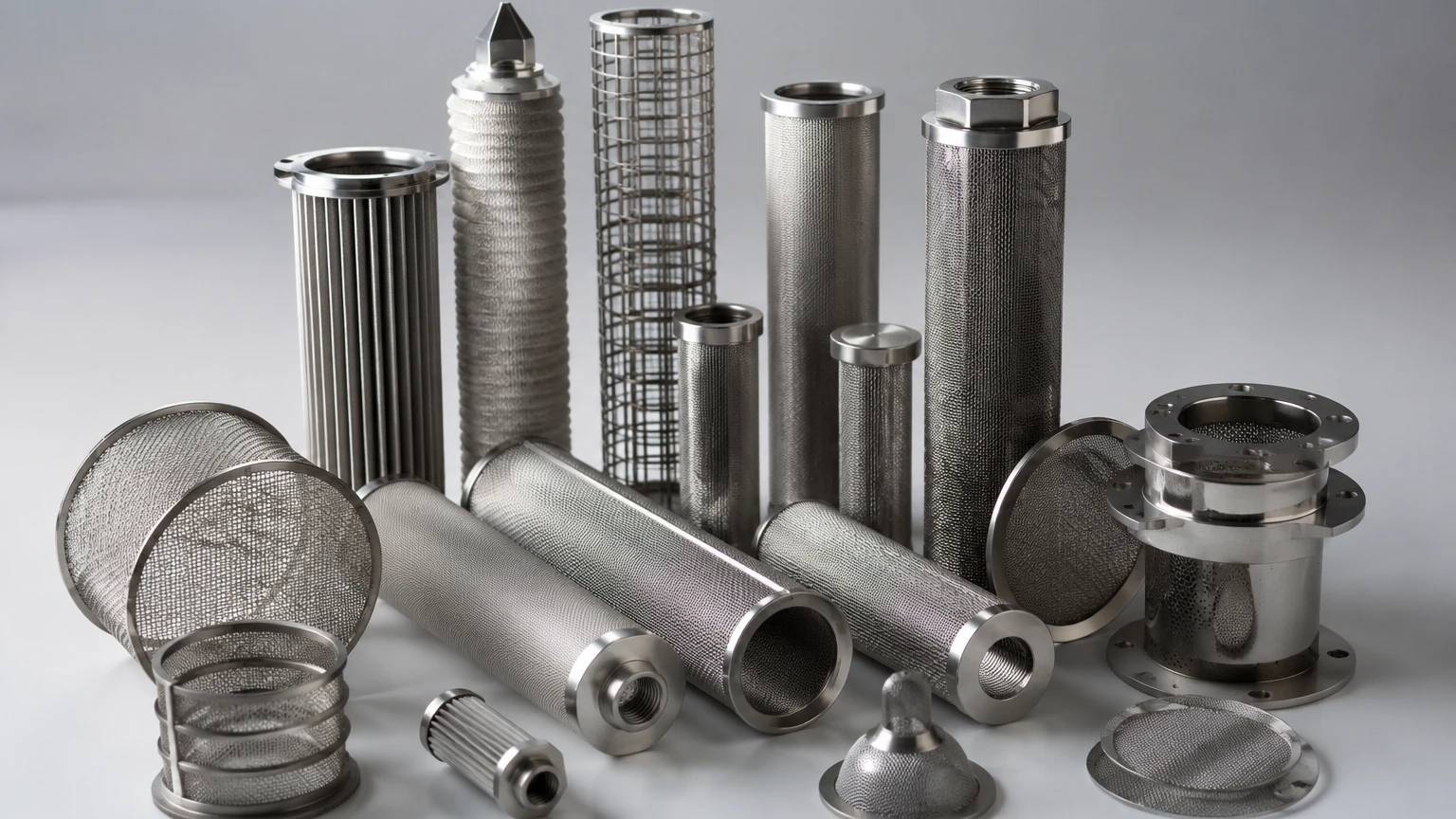
The efficiency of filtros automáticos is inseparable from the design of the filter element itself. At Kaifil, we emphasize that the geometry and material of the wire mesh or sintered metal determine the longevity of the entire system.
Wire Mesh Weave Types
* Plain Square Weave: Offers high flow rates and low pressure drop, ideal for coarse filtration and high-velocity systems.
* Dutch Weave: Provides a denser structure with higher mechanical strength, suitable for fine filtration where pressure resistance is critical.
* Sintered Mesh: For the most demanding applications, multiple layers of stainless steel wire mesh are sintered together. This creates a robust, multi-layered structure that can withstand high differential pressures and repeated cleaning cycles without deforming.
Wedge Wire Elements
In many automatic scraper filters, wedge wire (V-wire) is the preferred media. The V-shaped profile of the wire prevents particles from wedging themselves into the gaps, making the cleaning process significantly more efficient. The smooth surface allows the scraper to pass over the element with minimal wear, extending the service life of both the scraper and the filter media.
Material Science: Why Stainless Steel is the Standard
In industrial filtration, the choice of material is non-negotiable. Filtros automáticos must resist corrosion, withstand thermal expansion, and maintain structural integrity under pressure. Stainless steel remains the industry standard for several reasons:
1. Corrosion Resistance: Grade 304 stainless steel is suitable for general industrial use, while Grade 316L is mandatory for applications involving chlorides, acids, or pharmaceutical-grade purity. For extreme environments, such as seawater filtration, Duplex or Super Duplex steels may be required.
2. Durability: Unlike plastic or fabric media, stainless steel elements can be cleaned thousands of times. This durability is essential for the high-frequency cleaning cycles found in automated systems.
3. Temperature Stability: Industrial processes often operate at elevated temperatures where synthetic materials would fail. Stainless steel maintains its mechanical properties from cryogenic temperatures up to several hundred degrees Celsius.
Performance Metrics: Flow Rate, Pressure Drop, and Micron Rating
When specifying filtros automáticos, engineers must balance three competing factors: flow rate, filtration fineness (micron rating), and allowable pressure drop.
* Micron Rating: This defines the size of the smallest particle the filter is designed to capture. It is important to distinguish between "nominal" and "absolute" ratings. An absolute rating ensures that 99.9% of particles above the specified size are captured, which is critical for protecting sensitive downstream components.
* Flow Rate (Flux): The total volume of fluid passing through the filter per unit of time. High flow rates require larger surface areas to prevent excessive velocity through the mesh, which could drive contaminants through the pores or cause premature clogging.
* Differential Pressure (ΔP): This is the difference in pressure between the inlet and the outlet. An optimized automatic filter should operate with a low initial ΔP. As the filter loads with contaminants, the ΔP increases until the cleaning cycle is triggered. If the initial ΔP is too high, the cleaning frequency will be inefficient, leading to excessive wear and fluid loss.
Integration and Control Systems
The "automatic" aspect of filtros automáticos relies on a robust control architecture. Most modern systems are integrated into the facility's broader SCADA or PLC network. Key components include:
* DP Switches/Transmitters: These provide the primary data input for the cleaning cycle.
* Timer Overrides: Even if the pressure hasn't reached the limit, a timer ensures the filter is cleaned periodically to prevent biological growth or "caking" of solids.
* Actuators: Pneumatic or electric actuators control the flush valves and the movement of the cleaning mechanism (scrapers or scanners).
* Safety Interlocks: These protect the system in the event of a power failure or a sudden surge in contaminant loading, preventing damage to the filter elements.
Total Cost of Ownership and Maintenance Cycles
While the initial cost of filtros automáticos is higher than manual housings, the Total Cost of Ownership (TCO) is generally lower over a 3-to-5-year period. Factors contributing to a lower TCO include:
* Reduced Labor: Eliminating the need for manual cleaning or filter bag/cartridge replacement saves hundreds of man-hours annually.
* Minimal Consumable Costs: Permanent stainless steel elements replace the need for disposable bags or cartridges, reducing both purchasing costs and waste disposal fees.
* Process Continuity: By avoiding shutdowns for filter maintenance, facilities can maintain higher production yields.
Maintenance for automatic filters typically involves inspecting seals and O-rings, checking the alignment of mechanical scrapers, and ensuring that the control sensors are calibrated. Because the filter elements are made of high-quality stainless steel, they rarely need replacement if the system is operated within its design parameters.
Industry-Specific Application Requirements
Different sectors have unique demands for filtros automáticos:
* Chemical Processing: Requires high chemical compatibility and the ability to handle hazardous fluids in a closed-loop system to prevent operator exposure.
* Food and Beverage: Demands sanitary designs with polished surfaces (Ra < 0.8 µm) and compliance with FDA or EHEDG standards. The filters must be capable of Clean-in-Place (CIP) cycles.
* Water Treatment: Focuses on high-volume throughput and the removal of organic matter, sand, and scale. These systems often use backwash mechanisms to handle large volumes of suspended solids.
* Hydraulic Systems: Precision is paramount here to protect valves and actuators from microscopic wear particles. Sintered mesh elements are frequently used for their high strength and fine filtration capabilities.
Pre-Purchase Checklist for Engineers
Before finalizing a specification for filtros automáticos, engineers should confirm the following technical details:
1. Fluid Characteristics: What is the viscosity at operating temperature? Is the fluid Newtonian or non-Newtonian?
2. Contaminant Profile: Are the solids hard, soft, fibrous, or gelatinous? What is the particle size distribution (PSD)?
3. Operating Pressure: What are the minimum, maximum, and design pressures? Will there be pressure spikes?
4. Cleaning Fluid Loss: How much fluid can be lost during a backwash or flush cycle without affecting the downstream process?
5. Customization Needs: Does the housing need specific flange types (ANSI, DIN, JIS) or a specific orientation to fit into existing piping?
By addressing these factors, technical teams can ensure they select a system that provides reliable, long-term performance. At Kaifil, we specialize in the manufacturing and customization of the stainless steel components that make these systems possible. From material selection to precision mesh engineering, our focus is on delivering durability and accuracy for demanding industrial environments. To explore our full range of filtration solutions and technical support, please visit our Main Page.
