


Fluidized Bed Fermenter
In the landscape of industrial bioprocessing and chemical engineering, the fluidized bed fermenter represents a sophisticated alternative to traditional stirred-tank reactors. This technology leverages the principles of fluid mechanics to suspend solid particles—typically microorganisms, immobilized enzymes, or cell-laden carriers—in an upward-moving stream of gas or liquid. By achieving a state of fluidization, these systems provide exceptional mass and heat transfer rates while minimizing the mechanical shear stress that can damage sensitive biological cultures.
For engineers and procurement teams, understanding the nuances of fluidized bed fermenter design is essential for optimizing yield and ensuring process stability. A critical component of these systems is the filtration and distribution hardware, which dictates the uniformity of the fluid bed and the efficiency of the overall reaction. As a specialist in custom stainless steel filtration, Kaifil provides the precision components necessary to maintain these demanding environments.
Understanding the Mechanics of Fluidized Bed Fermentation
The operation of a fluidized bed fermenter hinges on the balance between gravitational forces acting on solid particles and the drag force exerted by a rising fluid. When the fluid velocity reaches a specific threshold, known as the minimum fluidization velocity, the solid bed transitions from a static state to a fluid-like state. In this phase, the particles move semi-randomly, creating a highly turbulent environment that maximizes the contact surface area between the biocatalyst and the nutrient medium.
In bioprocessing, these reactors are often used for aerobic fermentations where oxygen transfer is the limiting factor. The gas phase (usually air or oxygen-enriched air) is introduced at the bottom of the vessel through a distributor plate. This plate must be engineered with high precision to ensure that the gas is dispersed evenly across the entire cross-section of the reactor. Uneven distribution leads to "channeling," where gas bypasses large sections of the bed, or "slugging," where large bubbles cause violent fluctuations in the bed height. Both phenomena significantly degrade the efficiency of the fermentation process.
Key Advantages Over Stirred-Tank Reactors
While stirred-tank reactors (STRs) remain the industry standard for many applications, the fluidized bed fermenter offers distinct advantages in specific industrial contexts:
1. Low Shear Stress: Many microorganisms and mammalian cell lines are sensitive to the mechanical shear generated by impellers in STRs. In a fluidized bed, the energy for mixing is provided by the fluid flow, which is generally much gentler on the biological components.
2. Superior Heat Transfer: The high turbulence within a fluidized bed ensures that heat generated during exothermic biological reactions is rapidly dissipated. This allows for tighter temperature control, which is vital for maintaining optimal metabolic rates.
3. High Biomass Concentration: By using immobilized cells on carriers (such as porous beads or microcarriers), fluidized beds can achieve much higher biomass densities than suspended cultures. This leads to higher volumetric productivity and smaller reactor footprints.
4. Continuous Operation: Fluidized bed systems are well-suited for continuous processing. Spent media can be removed and fresh nutrients added without the need to stop the reaction, provided that effective filtration systems are in place to retain the biocatalysts.
The Role of Precision Filtration in Fluidized Bed Systems
The performance of a fluidized bed fermenter is inextricably linked to the quality of its internal filtration components. These components serve several critical functions, ranging from fluid distribution to sterile boundary maintenance.
Gas and Liquid Distribution
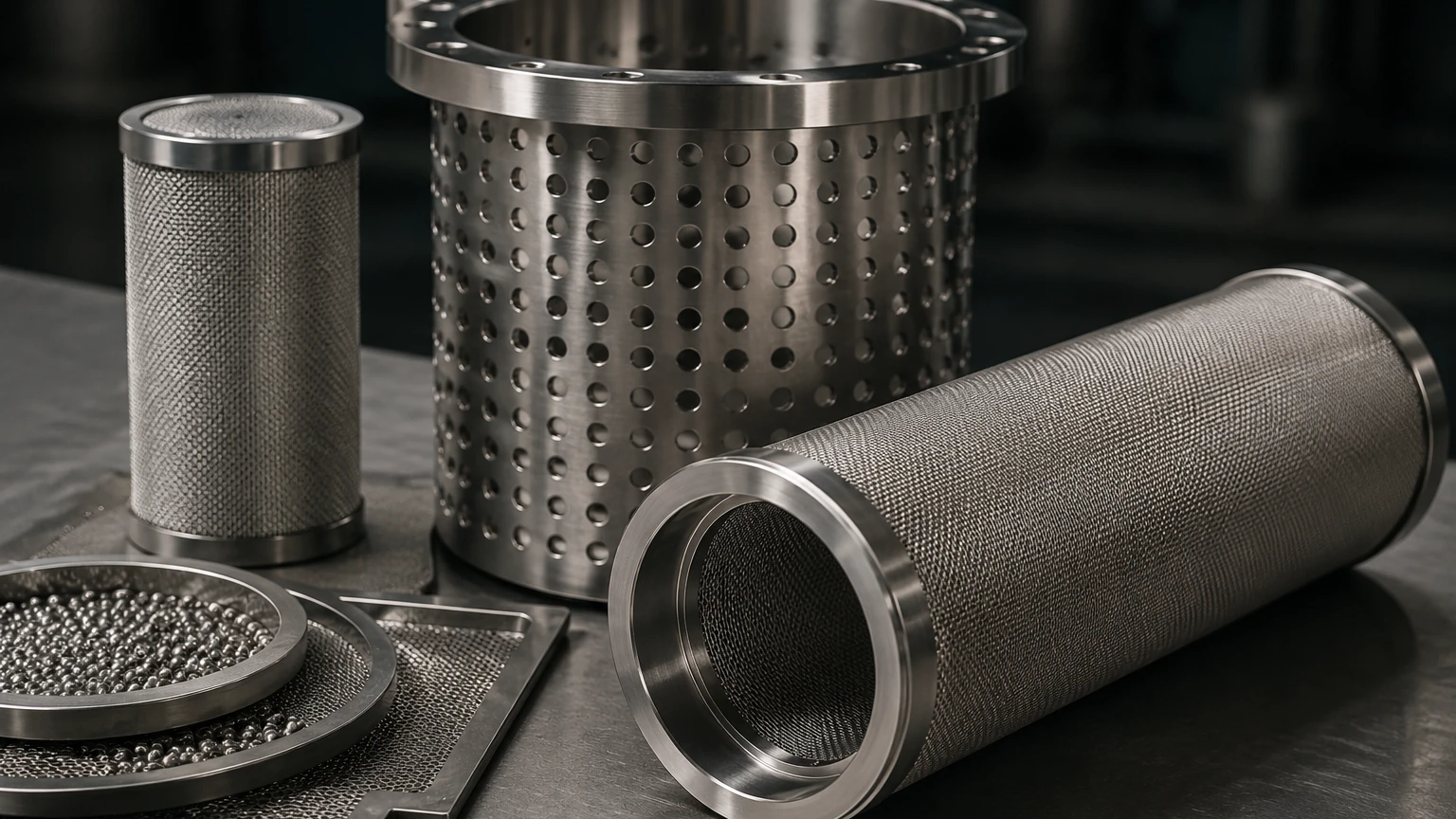
At the base of the fermenter, the distributor plate (often referred to as a sparger or plenum plate) is the most critical mechanical element. Engineers must select materials that offer uniform porosity to prevent dead zones. Stainless steel wire mesh laminates and sintered metal plates are preferred for these applications because they provide controlled pore sizes and high structural integrity. Unlike ceramic or polymer distributors, stainless steel components can withstand high pressure differentials and the thermal stress of repeated sterilization cycles.
Biomass Retention
In systems utilizing immobilized enzymes or cells, it is imperative to prevent the loss of these expensive biocatalysts during media exchange or product harvest. Internal filtration cartridges, often made from multi-layer sintered wire mesh, act as barriers that allow liquid and gas to pass while retaining solid carriers. The selection of the micron rating is a balance between retention efficiency and the prevention of pressure drop increases due to biofouling.
Sterile Air Supply and Off-gas Filtration
Maintaining a sterile environment is the primary challenge in any fermentation process. The air entering the fluidized bed fermenter must be filtered to remove contaminants, and the off-gas exiting the system must be filtered to prevent the release of aerosols or microorganisms into the environment. High-efficiency stainless steel filter cartridges are frequently used in these positions because they can be sterilized in place (SIP) using high-pressure steam.
Engineering Considerations for Material Selection
When specifying components for a fluidized bed fermenter, material science plays a pivotal role. The biological environment is often corrosive, involving organic acids, high salt concentrations, and fluctuating pH levels. Furthermore, the requirement for frequent cleaning and sterilization necessitates materials that are chemically and thermally robust.
* Stainless Steel 316L: This is the industry standard for fermentation equipment due to its excellent corrosion resistance and ability to achieve high-quality surface finishes (electropolishing). It resists pitting and crevice corrosion, which are common failure points in saline fermentation media.
* Sintered Wire Mesh: For filtration and distribution, sintered wire mesh offers a unique combination of permeability and mechanical strength. By bonding multiple layers of mesh together through a heat-treatment process, manufacturers like Kaifil create a stable structure that will not migrate or deform under pressure.
* Pore Size and Geometry: Engineers must calculate the required pore size based on the particle size distribution of the carriers used in the fluidized bed. A common rule of thumb is to select a filter with a pore size approximately one-third the diameter of the smallest particle to be retained, though this must be weighed against the risk of clogging.
Addressing Operational Risks: Clogging and Biofouling
The most significant operational risk in a fluidized bed fermenter is the gradual accumulation of biological matter on the filter surfaces, known as biofouling. This leads to an increase in differential pressure, reduced flow rates, and potential process failure.
To mitigate this, the filtration components must be designed for effective Cleaning-in-Place (CIP). Smooth surface finishes are essential to prevent microorganisms from adhering to the metal. Additionally, the internal structure of the filter should allow for backwashing or back-pulsing, where a reverse flow of fluid is used to dislodge accumulated debris. Factual data from industrial applications suggests that stainless steel filters with a wedge wire or sintered mesh design are significantly easier to clean than depth filters or polymer membranes.
Evaluation Criteria for Purchasing and Customization
When sourcing filtration components for a fluidized bed fermenter, purchasing teams should confirm several technical parameters with their supplier. Because every fermentation process has unique requirements regarding flow rates, viscosity, and particle size, off-the-shelf solutions are rarely optimal. Customization is often necessary to ensure the filter fits the specific geometry of the reactor vessel and meets the required flow dynamics.
Key questions to address during the procurement phase include:
* Pressure Drop Calculations: What is the expected pressure drop across the distributor plate at the maximum fluidization velocity?
* Mechanical Loading: Can the filter support the weight of the solid bed when the system is not fluidized?
* Sterilization Compatibility: Is the component rated for repeated Steam-in-Place (SIP) cycles at 121°C or higher?
* Customization Options: Can the manufacturer provide custom flange connections or specialized shapes to integrate seamlessly with the fermenter's internal housing?
As a professional manufacturer, Kaifil specializes in addressing these technical requirements. For those seeking detailed specifications or custom engineering support for their filtration needs, visiting the Main Page provides access to a wide range of stainless steel filter cartridges and precision metal components tailored for industrial applications.
Conclusion
The fluidized bed fermenter is a powerful tool for modern bioprocessing, offering a unique set of advantages for shear-sensitive and high-productivity applications. However, its success is heavily dependent on the precision of its internal components. By focusing on high-quality stainless steel filtration and distribution hardware, engineers can ensure uniform fluidization, maintain sterility, and extend the operational life of their equipment. As industrial demands for efficiency and reliability continue to grow, the partnership between bioprocess engineers and specialized filtration manufacturers remains a cornerstone of successful reactor design.
