


Foam Air Filters
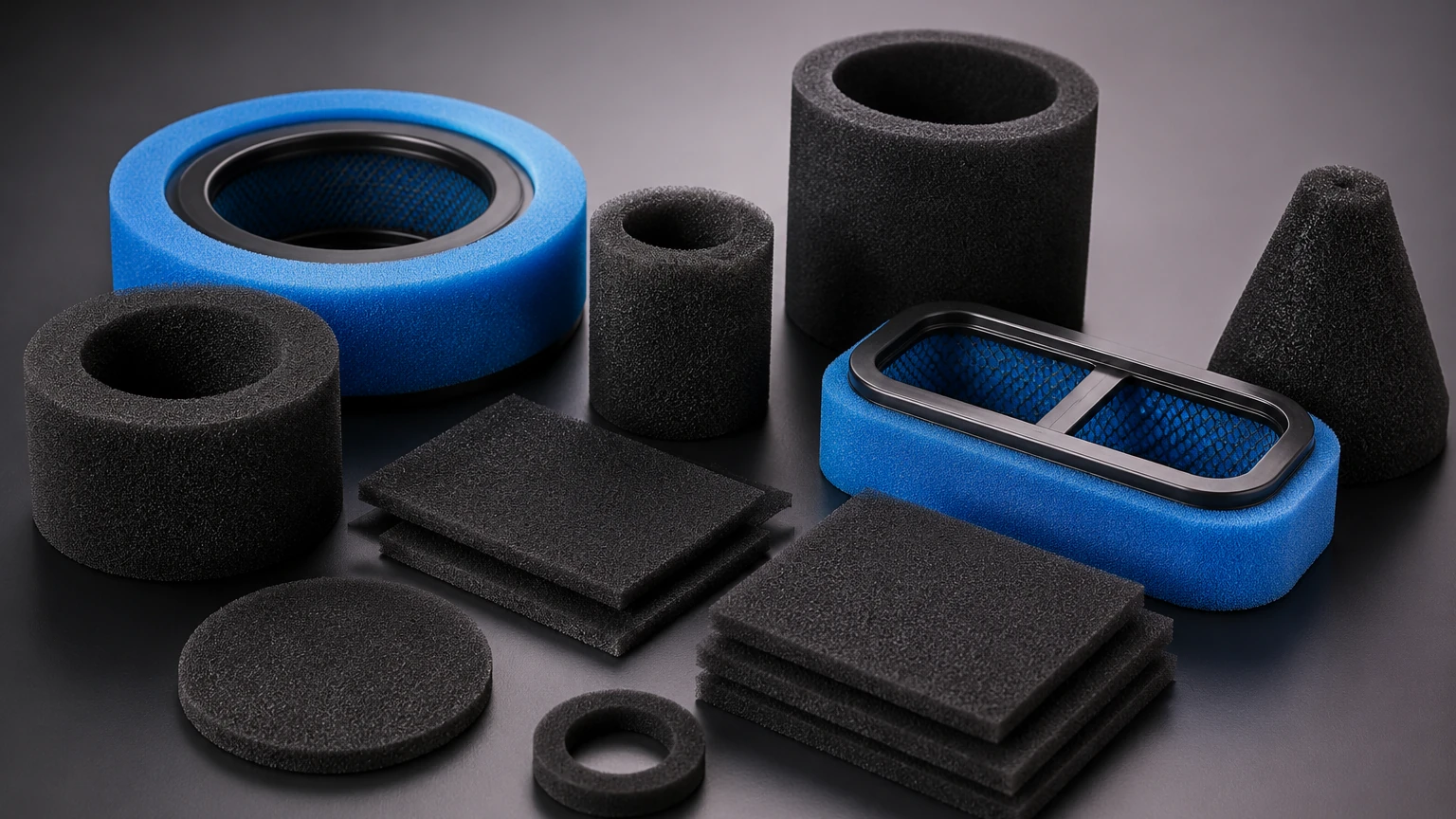
In industrial air filtration, selecting the appropriate media is a balance between particle retention efficiency, airflow resistance, and environmental durability. Foam air filters, specifically those utilizing reticulated polyurethane foam, represent a versatile solution for a wide range of applications, from small engine intakes to sophisticated industrial electronics cooling. Unlike surface-loading paper filters, foam provides depth filtration, allowing for significant contaminant loading before a critical pressure drop occurs.
For engineers and procurement teams, understanding the technical specifications of foam media—such as pore density, chemical compatibility, and thermal limits—is essential for optimizing equipment performance and minimizing maintenance overhead. While Kaifil specializes in high-performance stainless steel and metal filtration components, understanding the role of foam air filters in the broader industrial landscape allows for better decision-making when designing multi-stage filtration systems or selecting replacements for specific operating environments.
Understanding Foam Air Filter Construction and Materials
The performance of foam air filters is primarily dictated by the structure of the foam itself. Most industrial foam filters are made from reticulated polyurethane foam. Reticulation is a manufacturing process (often involving a thermal or chemical treatment) that removes the thin membranes or "windows" between the cells of the foam. This leaves only the skeletal structure, or "struts," creating an open-cell network that allows air to pass through with minimal resistance.
Pores Per Inch (PPI)
The most critical specification for foam media is Pores Per Inch (PPI). This metric defines the coarseness or fineness of the filter.
* 10 to 30 PPI: Coarse foam used primarily as pre-filters to capture large debris, insects, and heavy dust. These offer the lowest pressure drop and are often used in high-velocity air intakes.
* 45 to 60 PPI: Medium-grade foam used in standard industrial applications, providing a balance between airflow and the capture of mid-sized particulates.
* 80 to 100+ PPI: Fine foam used for high-efficiency filtration. While these capture much smaller particles, they also exhibit higher initial resistance to airflow and require more frequent cleaning or replacement.
Polyether vs. Polyester Foam
Polyurethane foam for air filters typically comes in two chemical varieties: polyether and polyester.
1. Polyether Foam: Known for its excellent resistance to moisture and hydrolysis. It is the preferred choice for humid environments or applications where the filter may be exposed to water or high humidity.
2. Polyester Foam: Offers superior resistance to hydrocarbons, oils, and many chemicals. However, it is susceptible to hydrolytic degradation (breaking down in the presence of moisture and heat), making it less suitable for wet environments.
Performance Characteristics: Airflow vs. Efficiency
The primary advantage of foam air filters in an industrial context is their ability to provide depth filtration. In a paper or mesh filter, particles are often trapped on the surface. Once the surface is covered, the pressure drop increases rapidly. In a foam filter, the three-dimensional network of struts creates a tortuous path for the air. Particles are trapped throughout the entire thickness of the material.
Dust Holding Capacity
Because of this depth-loading characteristic, foam air filters possess a high dust-holding capacity. This is particularly valuable in environments with high concentrations of airborne particulates, such as woodworking facilities, textile mills, or construction sites. A foam filter can often hold several times its own weight in contaminants before the airflow is significantly restricted.
Pressure Drop and Face Velocity
Engineers must calculate the face velocity (the speed of air moving toward the filter face) to ensure the foam media does not deform or collapse. Foam is inherently flexible; under high vacuum or high-pressure conditions, the media can compress, which reduces the pore size and causes an exponential increase in pressure drop. Supporting foam filters with a rigid internal or external structure—often utilizing stainless steel wire mesh or perforated metal—is a common engineering practice to maintain the filter's geometric integrity.
Oil-Wetted vs. Dry Foam
In many industrial engine and compressor applications, foam air filters are "wetted" with a specialized filter oil. The oil acts as a tackifier, significantly increasing the filter's ability to capture and retain fine dust that might otherwise bounce through the dry struts of the foam. However, in electronics cooling or HVAC applications, dry foam is preferred to prevent oil migration into sensitive components.
Industrial Applications and Environment Suitability
Foam air filters are utilized across a spectrum of industries due to their low cost and reusability. However, their application is limited by the physical properties of polyurethane.
Common Applications
* Small Engines and Compressors: Foam is the standard for air intake filtration in portable power equipment and industrial air compressors where vibration and heavy dust are prevalent.
* HVAC and Air Handling Units: Used as pre-filters to protect more expensive HEPA or secondary bag filters from large particulate loading.
* Electronics and Server Cooling: Fine PPI foam is used in server racks and industrial control panels to prevent dust accumulation on heat sinks and circuit boards.
* Medical Equipment: Reticulated foam is often found in respiratory devices and diagnostic equipment where quiet airflow and basic filtration are required.
Limitations
While versatile, foam air filters have clear boundaries. They are generally not suitable for high-temperature environments (typically limited to below 90°C/194°F) as the polymer will soften and eventually melt. Additionally, they lack the structural rigidity required for high-pressure hydraulic systems or high-velocity steam applications, where a Main Page stainless steel filter would be the necessary technical choice.
Foam Air Filters vs. Stainless Steel Mesh Filters
When designing a filtration system, engineers often compare foam air filters with stainless steel wire mesh filters. The choice depends on the specific demands of the application.
| Feature | Foam Air Filters | Stainless Steel Mesh Filters |
| :— | :— | :— |
| Filtration Type | Depth Filtration | Surface/Depth (depending on weave) |
| Temperature Range | Low (< 90°C) | High (up to 600°C+) |
| Chemical Resistance | Limited (Polymer dependent) | Excellent (304/316L) |
| Structural Strength | Low (Requires support) | High (Self-supporting) |
| Cleanability | Washable (limited cycles) | Ultrasonic/Backwash (Infinite cycles) |
| Initial Cost | Low | Moderate to High |
| Lifespan | 6–24 months | Years to Decades |
For applications involving corrosive gases, high-pressure differentials, or extreme temperatures, stainless steel mesh is the superior engineering choice. However, for low-temperature air intake where cost-effectiveness and high dust loading are the priorities, foam air filters remain a staple component.
Engineering Selection Criteria for Foam Filtration
To specify the correct foam filter for an industrial project, the following technical parameters must be confirmed:
1. Required Micron Rating: While PPI is the standard measure, it correlates to a nominal micron rating. For instance, 100 PPI foam generally captures particles in the 30-50 micron range with reasonable efficiency.
2. Airflow Volume (CFM): The total volume of air the filter must handle determines the required surface area. Oversizing the filter reduces the face velocity, which improves filtration efficiency and extends the service interval.
3. Environmental Exposure: Will the filter be exposed to UV light, ozone, or specific chemical vapors? Standard polyurethane can degrade rapidly under UV exposure unless treated with stabilizers.
4. Housing Integration: How will the foam be secured? In many industrial designs, foam is die-cut to fit into a frame or wrapped around a perforated metal core. Ensuring a proper seal at the edges is critical to prevent "dirty air bypass."
Maintenance and Replacement Cycles
One of the primary selling points of foam air filters is that they are often washable and reusable. However, in a B2B industrial context, the labor cost of cleaning a filter must be weighed against the cost of a new component.
Cleaning Protocols
If cleaning is chosen, it typically involves washing the foam in a mild detergent or a specialized solvent (for oiled filters), followed by thorough drying. It is vital to inspect the foam for "crumbling" or loss of elasticity. Over time, the polymer chains in the foam break down due to oxidation and thermal cycling. If the foam struts become brittle, the filter can shed particles into the downstream airflow, potentially causing catastrophic damage to engines or sensitive machinery.
Total Cost of Ownership (TCO)
When evaluating foam filters, procurement teams should look beyond the unit price. A low-quality foam filter that requires monthly replacement may end up costing more than a high-durability stainless steel mesh filter that lasts for the entire lifecycle of the equipment. For mission-critical industrial processes, the reliability of the filter media is paramount.
Conclusion
Foam air filters serve as a critical first line of defense in many industrial air handling and engine applications. Their ability to manage high dust loads with low initial pressure drop makes them an efficient choice for non-extreme environments. However, as application requirements move toward higher temperatures, aggressive chemicals, or permanent service life, the transition to precision metal filtration becomes necessary.
By understanding the material properties and performance limitations of foam, engineers can better design systems that protect downstream components and maintain operational efficiency. For those requiring more robust, custom-engineered filtration solutions that exceed the capabilities of polymer foam, exploring advanced metal mesh options is the logical next step in system optimization.
