


Funnel Filtering
In industrial processing, funnel filtering refers to the use of conical or tapered filtration components designed to separate solids from liquids or gases within a pressurized or gravity-fed system. Unlike simple laboratory funnels used for manual pouring, industrial funnel filters are precision-engineered components integrated into complex machinery, pipelines, and batch processing units. These filters must withstand significant mechanical stress, chemical exposure, and temperature fluctuations while maintaining precise micron ratings.
Selecting the right solution for funnel filtering requires a deep understanding of fluid dynamics, material science, and the specific requirements of the application. For engineers and procurement teams, the goal is to balance filtration efficiency with structural durability to ensure long-term operational reliability. To explore a wide range of industrial filtration components, professionals often visit the Main Page of specialized manufacturers to evaluate available configurations and material specifications.
Understanding the Mechanics of Funnel Filtering
The primary advantage of a funnel-shaped filter is its geometry. The tapered design allows for a larger surface area relative to the diameter of the piping or housing in which it is installed. This increased surface area is critical for reducing the velocity of the fluid as it passes through the mesh, which in turn minimizes the pressure drop across the filter media.
In industrial settings, funnel filtering is often employed in "Y-strainers," basket strainers, or as standalone conical inserts. The conical shape naturally directs the flow of the medium, often trapping larger particles at the apex or along the walls depending on the flow direction (inside-to-outside or outside-to-inside). This geometric efficiency makes funnel filters ideal for high-flow applications where downtime for cleaning must be minimized.
Material Selection: The Foundation of Performance
The effectiveness of funnel filtering is largely dictated by the material used in construction. In most industrial environments, stainless steel is the standard due to its mechanical strength and resistance to environmental degradation.
304 Stainless Steel
Grade 304 is the most common choice for general industrial applications. It offers excellent strength and good corrosion resistance for water treatment, hydraulic oils, and non-acidic food processing. It is a cost-effective solution for environments where extreme chemical resistance is not the primary concern.
316 and 316L Stainless Steel
For more demanding environments, such as chemical processing or pharmaceutical manufacturing, 316 or 316L (low carbon) stainless steel is preferred. The addition of molybdenum enhances resistance to pitting and crevice corrosion, particularly in chloride-rich environments. 316L is specifically chosen for applications involving welding, as its low carbon content prevents carbide precipitation during the welding process, ensuring the structural integrity of the funnel filter's seams.
Specialized Alloys
In extreme cases involving highly corrosive acids or ultra-high temperatures, specialized alloys like Monel, Hastelloy, or Inconel may be utilized. These materials ensure that the funnel filtering process remains consistent even under conditions that would cause standard stainless steel to fail.
Engineering the Mesh: Weave Types and Micron Ratings
The "filtering" in funnel filtering happens at the mesh level. The choice of weave pattern significantly impacts the flow rate, particle retention, and cleaning characteristics of the filter.
1. Plain Weave: The most straightforward design where wires cross over and under each other. It provides high flow rates and is easy to clean, making it suitable for coarse filtration.
2. Twilled Weave: Each shute wire passes successively over and under two warp wires. This allows for a heavier wire diameter and higher strength for a given mesh count, which is useful for high-pressure funnel filtering.
3. Dutch Weave (Plain and Twilled): These weaves use different wire diameters in the warp and shute directions, creating a much tighter, denser mesh. Dutch weave is essential for precision funnel filtering where fine micron ratings (down to 5-10 microns) are required.
When specifying a filter, engineers must distinguish between nominal and absolute micron ratings. A nominal rating indicates the filter's ability to retain a majority of particles of a certain size, while an absolute rating guarantees that no particles larger than the specified size will pass through. In critical applications like pharmaceutical production, absolute ratings are mandatory.
Design Variations in Funnel Filtering Components
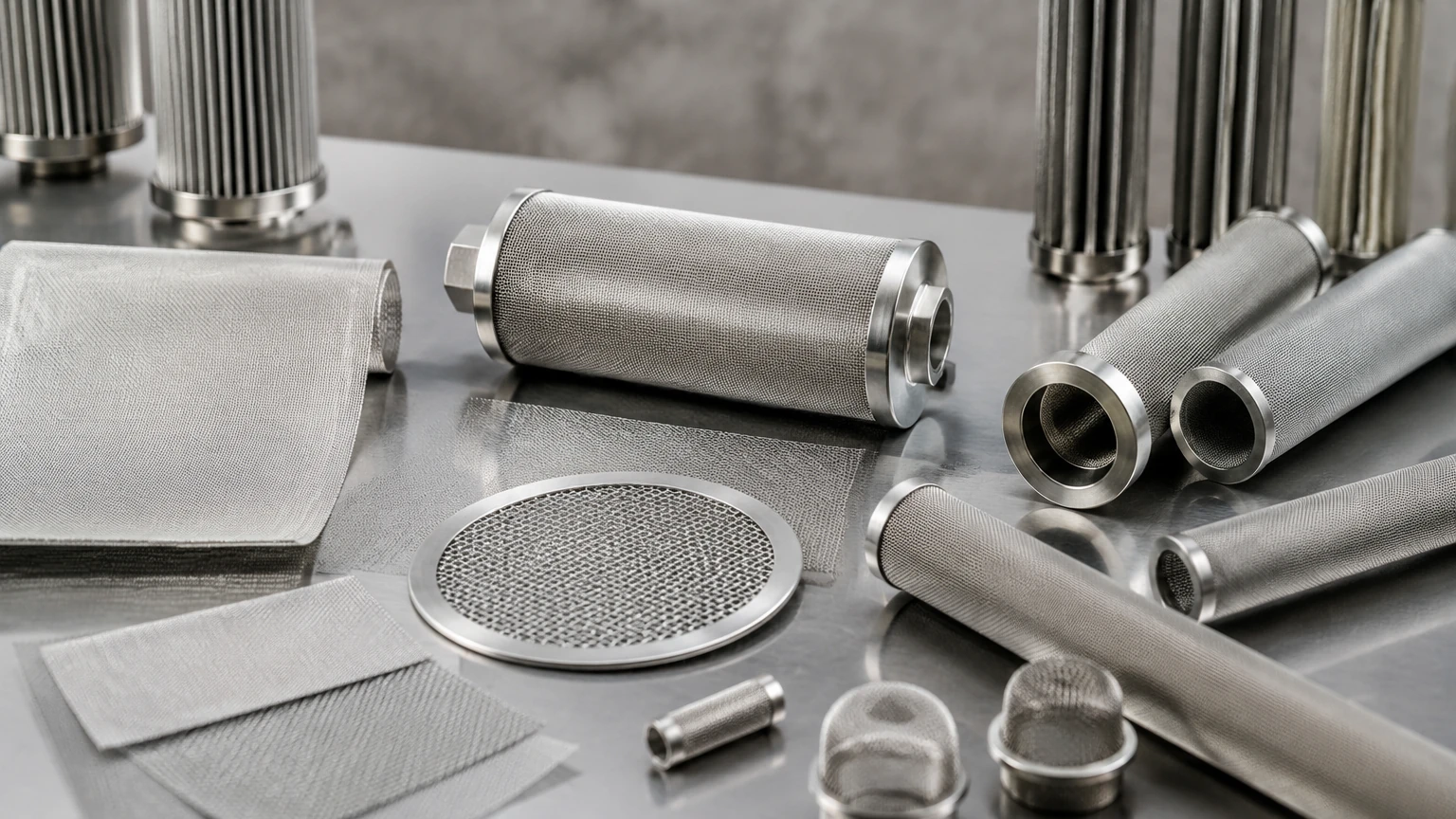
Industrial funnel filters are rarely "one size fits all." Customization is a core requirement for ensuring the component fits the existing infrastructure and meets performance targets.
Conical Strainers (Temporary and Permanent)
Temporary conical strainers are often used during the commissioning of a new piping system to capture construction debris like welding slag or scale. Once the system is clean, they may be removed. Permanent funnel filters, however, are designed for continuous operation and often feature reinforced structures to handle long-term debris loading.
Basket and Hat Filters
While similar to a standard cone, "hat" filters or basket filters feature a flat or rounded bottom. This design is often used when the depth of the housing is limited but a high filtration area is still required. The choice between a sharp cone and a flat-bottomed funnel depends on the available space and the expected volume of solids to be captured.
Multi-Layer Sintered Mesh
For high-pressure funnel filtering, a single layer of wire mesh may not be sufficient. Sintered mesh—where multiple layers of mesh are fused together using heat and pressure—provides exceptional structural rigidity. This allows the filter to maintain its shape and micron rating even under extreme differential pressure.
Performance Metrics: Flow Rate and Pressure Drop
One of the most critical engineering considerations in funnel filtering is the relationship between the flow rate and the pressure drop ($ΔP$). As the filter captures contaminants, the open area of the mesh decreases, leading to an increase in $ΔP$. If the pressure drop becomes too high, it can lead to several issues:
* Pump Strain: The system's pumps must work harder to overcome the resistance, leading to higher energy costs and potential mechanical failure.
* Media Migration: Excessive pressure can force particles through the mesh or, in extreme cases, cause the mesh to tear or collapse.
* System Shutdown: Many industrial systems are equipped with sensors that trigger an automatic shutdown if a certain $ΔP$ threshold is reached.
To optimize funnel filtering, engineers calculate the "Effective Filtration Area" (EFA). By using a conical design, the EFA is maximized, which keeps the initial pressure drop low and extends the time between cleaning cycles.
Maintenance and Reusability of Stainless Steel Filters
A major advantage of using stainless steel for funnel filtering is reusability. Unlike disposable paper or polymer filters, metal filters can be cleaned and returned to service, significantly lowering the total cost of ownership (TCO).
Cleaning Methods
* Backwashing: Reversing the flow of the fluid to dislodge particles from the mesh surface.
* Ultrasonic Cleaning: Using high-frequency sound waves in a cleaning solvent to remove fine particulates trapped deep within the weave of a Dutch weave mesh.
* Chemical Cleaning: Using specific solvents or acids to dissolve accumulated organic or inorganic scale without damaging the stainless steel substrate.
* Burn-off/Pyrolysis: For filters used in polymer or resin processing, high heat can be used to burn off the contaminants.
Proper maintenance protocols ensure that the funnel filter retains its original flow characteristics and filtration accuracy over many years of service.
Key Considerations for OEM and Custom Integration
When sourcing components for funnel filtering, technical professionals should confirm several parameters with the manufacturer to ensure a successful integration:
1. Dimensional Accuracy: Precise measurements of the flange diameter, cone length, and taper angle are essential for a leak-free fit within the housing.
2. Structural Support: For large filters or high-pressure applications, a perforated metal backup tube or internal ribs may be necessary to prevent the mesh from collapsing.
3. Connection Types: Whether the filter requires a ring-type joint (RTJ), flat face, or raised face flange for installation between pipe segments.
4. Compliance and Certification: In industries like food and beverage or pharmaceuticals, the filter must meet specific regulatory standards (e.g., FDA or 3A) regarding surface finish and material purity.
By focusing on these technical details, engineers can ensure that the selected funnel filtering solution provides the necessary protection for downstream equipment while maintaining efficient system throughput. For those seeking specialized manufacturing expertise, reviewing the capabilities on a provider's Main Page is a recommended first step in the procurement process.
