


Hepa Filter Industrial
In the landscape of industrial manufacturing, the requirement for ultra-pure air and gas streams is a fundamental engineering necessity. High-Efficiency Particulate Air (HEPA) technology serves as the gold standard for removing airborne contaminants, providing the precision required for sensitive processes. However, a hepa filter industrial application involves significantly more complexity than standard commercial or residential air purification. It requires a deep understanding of fluid dynamics, material compatibility, and structural integrity to ensure that the filtration system can withstand the rigors of a factory environment while maintaining its rated efficiency.
For engineers and procurement specialists, selecting and integrating HEPA systems involves balancing filtration efficiency with operational costs and system longevity. At the core of these high-performance systems are the structural components and pre-filtration stages that protect the delicate HEPA media. By visiting the Main Page of a specialized manufacturer like Kaifil, technical teams can explore the stainless steel components and custom filtration solutions that form the backbone of durable industrial air management systems.
The Technical Foundations of HEPA Filtration
To effectively implement a hepa filter industrial solution, one must first understand the mechanics of how these filters capture particles. Unlike simple sieve-like filters, HEPA filters utilize a dense mat of randomly arranged fibers—typically fiberglass or specialized synthetic materials—to capture particles through four primary mechanisms:
1. Inertial Impaction: Larger particles, due to their inertia, cannot adjust to the rapid changes in airflow direction around the fibers. They continue on a straight path and collide directly with the fiber surface.
2. Interception: Mid-sized particles follow the airstream but come close enough to a fiber to be captured by its surface.
3. Diffusion: The smallest particles (typically below 0.1 microns) exhibit Brownian motion, moving erratically. This increases the likelihood that they will eventually strike and adhere to a fiber.
4. Electrostatic Attraction: Some advanced media use charged fibers to attract oppositely charged particles, though this is less common in high-temperature industrial settings where mechanical capture is preferred.
The standard benchmark for a HEPA filter is its ability to remove at least 99.97% of particles with a diameter of 0.3 micrometers. This specific size is known as the Most Penetrating Particle Size (MPPS) because it is the most difficult for the combined mechanisms of diffusion and interception to capture.
Material Selection and Structural Integrity
While the filtration media itself is critical, the housing and support structures are what define a hepa filter industrial grade unit. In demanding environments such as chemical processing or pharmaceutical manufacturing, standard aluminum or plastic frames are often insufficient.
Stainless Steel Housings and Frames
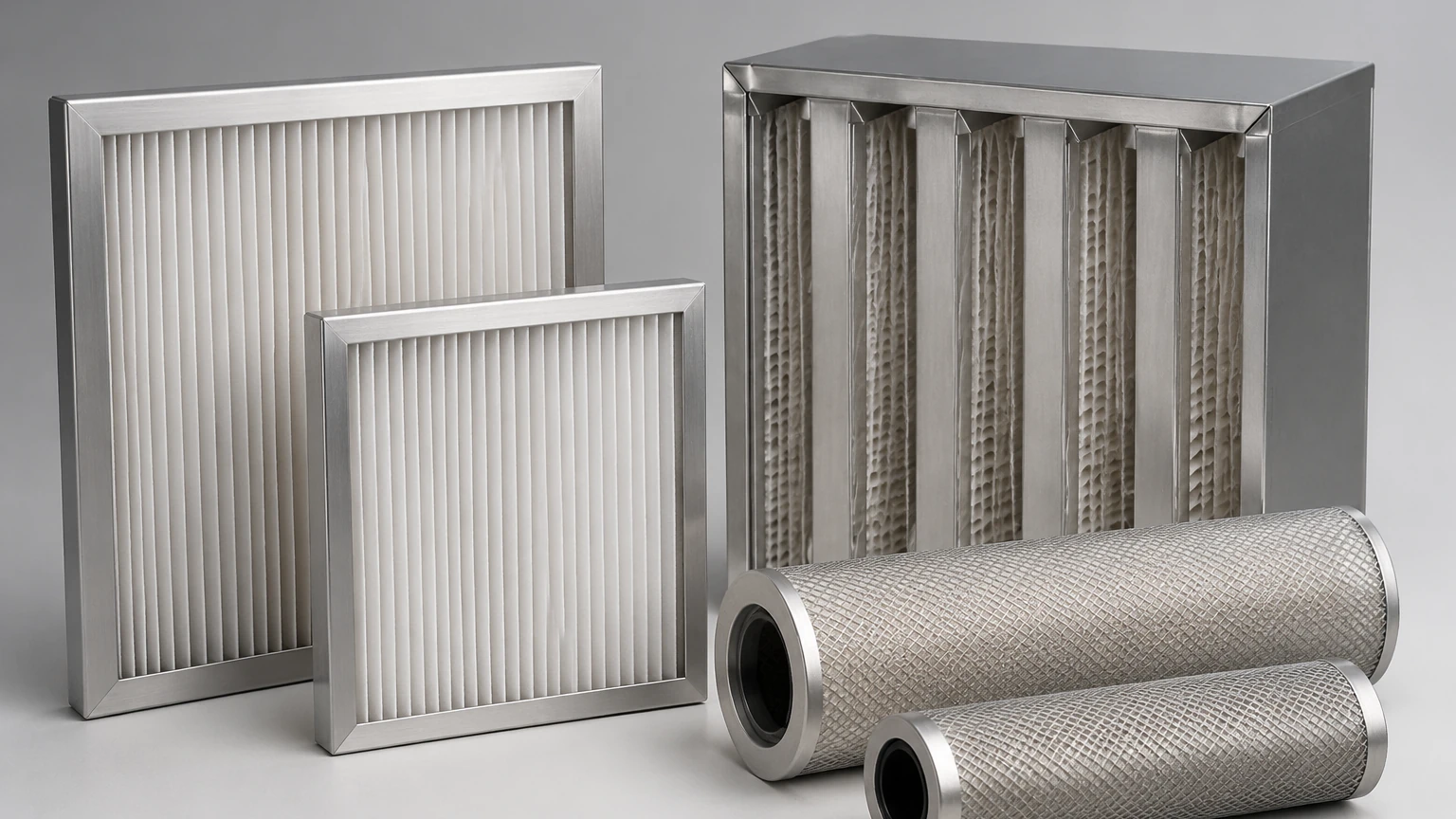
In industrial settings where corrosive vapors, high humidity, or frequent sterilization cycles are present, stainless steel (typically Grade 304 or 316L) is the preferred material for filter frames and housings. Stainless steel provides the necessary rigidity to prevent bypass leakage—a common failure point where air escapes around the edges of the filter rather than passing through the media. The precision-machined surfaces of metal housings ensure a perfect seal with gaskets or fluid seals.
The Role of Pre-Filtration
One of the most significant engineering considerations in industrial HEPA applications is the protection of the primary HEPA element. HEPA media is relatively fragile and can be quickly blinded by large particulate loads. To optimize the total cost of ownership, engineers implement multi-stage filtration.
Using stainless steel wire mesh filters as a pre-filtration stage is an effective strategy. These durable, cleanable metal filters capture larger debris and moisture droplets, significantly extending the service life of the expensive HEPA stage. This approach is particularly vital in hydraulic systems and air intake systems for heavy machinery where particle concentrations are high.
Engineering Considerations for System Integration
Integrating a hepa filter industrial system into an existing process requires careful calculation of several variables to ensure performance does not degrade over time.
Pressure Drop and Energy Consumption
Every filter introduces resistance to airflow, known as pressure drop (ΔP). HEPA filters naturally have a higher initial pressure drop than lower-grade filters. Engineers must size fans and blowers to account for the "dirty" pressure drop—the resistance the filter will offer just before it needs replacement. If the system is under-powered, airflow will drop as the filter loads, potentially compromising the cleanroom environment or process cooling.
Face Velocity and Airflow Uniformity
Face velocity refers to the speed at which air enters the filter face. For HEPA filters, maintaining a uniform face velocity (typically around 90 feet per minute for cleanroom applications) is essential for consistent particle capture. Turbulent or uneven airflow can cause "hot spots" on the filter media, leading to premature localized loading and potential media rupture.
Sealing Mechanisms
In industrial filtration, a filter is only as good as its seal. There are two primary types of seals used in industrial HEPA installations:
* Gasket Seals: High-quality neoprene or silicone gaskets are compressed between the filter frame and the housing. This requires a robust mechanical clamping system.
* Gel Seals: The filter frame features a knife-edge that sinks into a channel filled with specialized silicone gel. This provides a leak-proof, airtight connection that is easier to maintain in high-vibration environments.
Applications in Critical Industrial Sectors
The deployment of hepa filter industrial technology is mandatory across several sectors where contamination can lead to catastrophic product failure or safety risks.
Pharmaceutical and Biotechnology
In drug manufacturing, HEPA filters are used in sterile filling suites and laboratories to prevent microbial contamination. These systems must often be integrated with stainless steel ductwork and components that can withstand Vaporized Hydrogen Peroxide (VHP) decontamination cycles.
Food and Beverage Processing
Sterile air is required for packaging and fermentation processes. In these applications, filters must handle high humidity without promoting mold growth. Stainless steel components are essential here to meet stringent food safety regulations and to allow for high-temperature steam sterilization.
Chemical and Petrochemical
Vent filters on chemical storage tanks often require HEPA-level efficiency to prevent hazardous particulates from escaping into the atmosphere. Because these filters are exposed to aggressive chemical vapors, the use of corrosion-resistant metal supports and housings is a non-negotiable requirement.
Maintenance and Performance Verification
An industrial HEPA system is not a "set it and forget it" installation. Continuous monitoring is required to ensure the integrity of the filtration barrier.
Differential Pressure Monitoring
Installing differential pressure gauges (such as Magnehelic gauges) across the filter bank allows operators to track the loading of the filter. A sudden drop in pressure may indicate a media rupture or seal failure, while a rapid increase suggests an upstream process failure or the need for pre-filter cleaning.
In-Situ Integrity Testing
In many industries, HEPA filters must be tested after installation and at regular intervals (usually every 6 to 12 months). This often involves a Dispersed Oil Particulate (DOP) test, where a controlled aerosol is introduced upstream, and a photometer is used downstream to detect any leakage. Proper system design must include upstream injection ports and downstream sampling points to facilitate this testing.
Customization and OEM Solutions
Many industrial machines require non-standard filtration footprints. Whether it is a compact hydraulic vent or a high-capacity air intake for a turbine, off-the-shelf HEPA solutions may not fit. This is where the capability for custom manufacturing becomes vital.
By collaborating with specialists who understand both the media requirements and the mechanical demands of metal fabrication, companies can develop bespoke filtration components. For those seeking detailed specifications on custom metal filter cartridges and structural components that support high-efficiency systems, the Main Page provides a comprehensive overview of available manufacturing capabilities.
Conclusion
Implementing a hepa filter industrial solution is a sophisticated engineering task that extends far beyond simple air purification. It requires a holistic view of the process environment, including the chemical nature of the air stream, the physical stresses on the filter housing, and the long-term maintenance strategy. By prioritizing high-quality materials like stainless steel for housings and pre-filters, and by adhering to strict engineering standards for pressure and sealing, industrial facilities can achieve the high levels of purity necessary for modern manufacturing excellence. Protecting the HEPA stage through robust pre-filtration and precision engineering not only ensures compliance with safety and quality standards but also optimizes the operational lifespan of the entire filtration system.
