


Industrial Liquid Filters
In the landscape of modern process engineering, industrial liquid filters serve as the primary line of defense for equipment protection, product purity, and environmental compliance. Unlike standard commercial filtration, industrial-grade systems must withstand extreme pressures, corrosive chemical environments, and high-temperature fluctuations while maintaining precise micron-level separation. For engineers and procurement specialists, selecting the appropriate filtration technology is not merely a matter of sizing a housing; it requires a deep understanding of fluid dynamics, material science, and the specific rheological properties of the liquid being processed.
Industrial liquid filtration is a critical requirement across sectors such as chemical processing, pharmaceuticals, food and beverage production, and hydraulic systems. The efficiency of these systems directly impacts the total cost of ownership (TCO) by influencing energy consumption, maintenance intervals, and the lifespan of downstream components like pumps and high-precision valves.
Core Technologies in Metal Liquid Filtration
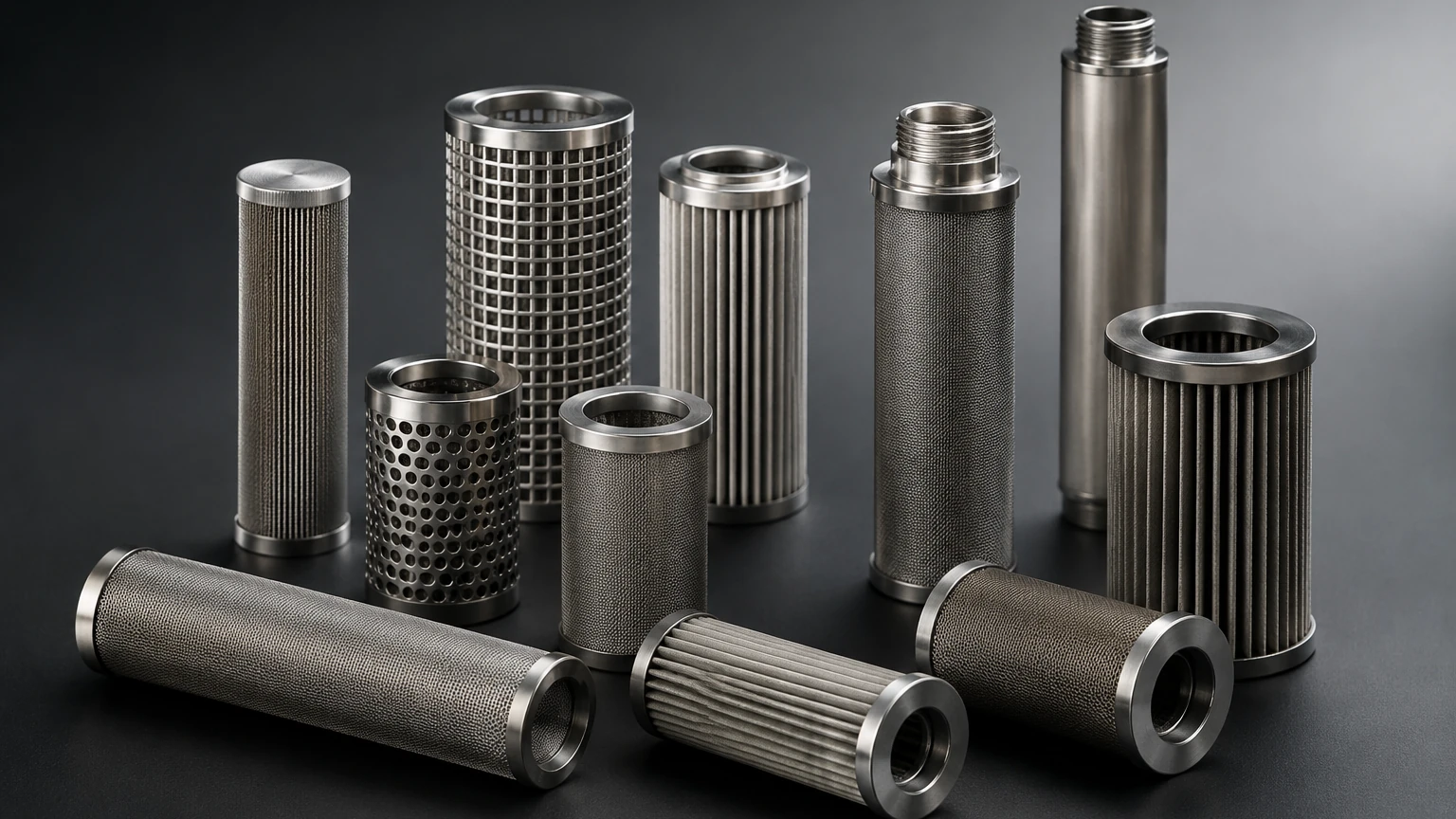
While various media types exist, stainless steel remains the gold standard for industrial liquid filters due to its mechanical strength and thermal stability. Within the category of metal filtration, several distinct structures are utilized depending on the required filtration accuracy and the nature of the contaminants.
Stainless Steel Wire Mesh
Wire mesh filters are constructed from woven metallic cloth. They are categorized by their weave type—such as plain, twill, or Dutch weave—each offering different flow characteristics and mechanical strength. Plain weaves provide a straight-through flow path, making them ideal for high-flow applications with relatively low solids loading. In contrast, Dutch weaves offer a more complex, tortuous path that enhances fine particle retention while maintaining structural integrity under high pressure.
Sintered Metal Media
Sintering involves bonding multiple layers of wire mesh or metallic fibers through a high-temperature heat treatment process without melting the base material. This creates a porous, rigid structure that is significantly stronger than a single layer of mesh. Sintered industrial liquid filters are preferred in applications involving high-pressure differentials or where the filter must undergo frequent high-pressure backwashing cycles.
Wedge Wire Elements
Wedge wire, or V-wire, filters are manufactured by wrapping a profile wire around longitudinal support rods. The V-shaped profile creates a slot that widens inwardly, reducing the risk of blinding (clogging) because particles that pass through the initial gap are unlikely to get stuck further in the element. This design is particularly effective for heavy-duty industrial liquid filters used in water treatment and pulp and paper processing.
Engineering Considerations for Filter Selection
Selecting the right filter requires more than matching a pipe size. Engineers must evaluate several technical parameters to ensure the filtration system does not become a bottleneck in the production line.
Micron Rating: Absolute vs. Nominal
A common point of confusion in industrial procurement is the distinction between nominal and absolute micron ratings. A nominal rating refers to the filter’s ability to retain a specific percentage of particles (e.g., 90% of 10-micron particles). An absolute rating, however, indicates that 99.9% or more of particles at that size will be captured. For critical applications like pharmaceutical sterile filtration or fine chemical processing, absolute-rated industrial liquid filters are mandatory to ensure process consistency.
Pressure Drop (ΔP)
The pressure drop is the difference between the upstream and downstream pressure. Every filter introduces some resistance to flow. An oversized filter may be unnecessarily expensive, while an undersized filter will lead to a high initial pressure drop, reducing the available flow rate and increasing the energy load on pumps. Engineers must calculate the "clean pressure drop" and determine the "terminal pressure drop"—the point at which the filter is considered fouled and must be cleaned or replaced.
Chemical and Thermal Compatibility
Industrial liquids can range from high-purity water to aggressive solvents and concentrated acids. Stainless steel 304 is suitable for general-purpose applications, but 316L is often required for its superior resistance to pitting and crevice corrosion, especially in the presence of chlorides. For extremely high temperatures, such as those found in polymer melt filtration or steam filtration, specialized alloys like Hastelloy or Monel may be integrated into the filter design.
The Importance of Customization in Industrial Systems
Off-the-shelf filtration solutions often fail to meet the unique constraints of specialized industrial environments. Customization allows for the optimization of the filter’s surface area, housing configuration, and seal materials to match the specific footprint and operational demands of a facility.
When evaluating a manufacturer, it is essential to consider their ability to provide tailored engineering support. A Main Page for a professional manufacturer like Kaifil highlights the importance of custom-engineered stainless steel filtration solutions that address specific industrial challenges, from material selection to precise filtration accuracy. Custom designs ensure that the filter interface integrates seamlessly with existing piping while maximizing the effective filtration area within a limited space.
Maintenance and Total Cost of Ownership
One of the primary advantages of stainless steel industrial liquid filters over disposable polymer cartridges is their cleanability. In high-volume industrial processes, the cost of disposing of used cartridges and the associated downtime for replacement can be staggering. Permanent metal filters offer a more sustainable and cost-effective alternative.
Cleaning Methods
- Backwashing: Utilizing a reverse flow of clean liquid or gas to dislodge particles from the surface of the filter media.
- Ultrasonic Cleaning: Using high-frequency sound waves in a chemical bath to remove fine particles embedded deep within the pores of sintered media.
- Chemical Cleaning: Circulating specialized solvents to dissolve organic or inorganic scaling without damaging the stainless steel structure.
Replacement Cycles
While metal filters are durable, they are not infinite. Over time, repeated cleaning and exposure to high pressures can lead to material fatigue or irreversible blinding. A robust maintenance program should include periodic integrity testing to ensure the filter still meets its original micron rating. Monitoring the rate at which the pressure drop increases after each cleaning cycle can help engineers predict the end-of-life for a filter element, allowing for planned procurement rather than emergency shutdowns.
Application-Specific Requirements
Different industries impose different regulatory and functional requirements on industrial liquid filters. Understanding these nuances is vital for compliance and performance.
Food and Beverage
Filters used in this sector must adhere to FDA or EU food-contact regulations. They require sanitary finishes (often electropolished) and must be designed to eliminate "dead zones" where bacteria could proliferate. These filters are frequently used for the clarification of juices, syrups, and the filtration of process water.
Chemical and Petrochemical
In these environments, the primary concern is often the handling of hazardous materials. Industrial liquid filters must be housed in pressure vessels that meet ASME or PED standards. The filtration of catalysts, solvents, and fuels requires high mechanical strength to prevent media migration, which could contaminate the final product or damage downstream reactors.
Hydraulic and Lube Oil Systems
Precision hydraulic systems are highly sensitive to particulate contamination, which can cause catastrophic pump failure. Industrial liquid filters in these systems must provide high-efficiency removal of metallic wear particles and silicates while handling high-viscosity fluids and rapid pressure fluctuations.
Common Risks in Industrial Filtration Procurement
Failure to account for the specific characteristics of the process liquid can lead to several common issues:
1. Media Migration: In low-quality filters, fragments of the filter media itself can break off and enter the downstream flow. Using high-quality, sintered stainless steel or properly welded wire mesh minimizes this risk.
2. Bypassing: If the seals or gaskets (O-rings) are not compatible with the liquid, they may swell or degrade, allowing unfiltered liquid to bypass the element entirely.
3. Premature Blinding: If the particle size distribution of the liquid is not accurately assessed, a filter with too fine a micron rating may be selected, leading to frequent clogging and excessive maintenance.
Conclusion
Industrial liquid filters are indispensable tools for maintaining process efficiency and product quality in demanding industrial sectors. By focusing on material integrity, precise engineering calculations, and the benefits of reusable stainless steel media, facilities can achieve significant long-term savings and operational reliability. When selecting a filtration partner, engineers should prioritize manufacturers who offer deep technical expertise and the ability to customize solutions to the specific needs of the application. For those seeking reliable, high-performance filtration components, reviewing technical specifications and OEM capabilities on a dedicated manufacturer's site is the first step toward optimizing liquid process systems.
