


High Pressure Filter
In industrial fluid power and process engineering, the high pressure filter serves as a critical line of defense for sensitive downstream components. These filtration units are specifically engineered to withstand the mechanical stresses of high-operating pressures while maintaining precise particulate removal. Whether utilized in hydraulic systems, chemical processing, or high-pressure gas filtration, the selection of a high pressure filter requires a deep understanding of fluid dynamics, material science, and mechanical integrity. For those seeking comprehensive technical specifications and custom engineering support, visiting the Main Page of a specialized manufacturer like Kaifil provides a foundation for informed procurement.
Understanding the Role of High Pressure Filters in Industrial Systems
A high pressure filter is typically installed in the pressure line of a system, situated between the pump and the critical components it protects, such as servo valves, actuators, or high-precision nozzles. Unlike suction or return-line filters, these units must handle the full system pressure, which can range from 1,000 PSI to well over 10,000 PSI in specialized applications.
The primary function of these filters is to eliminate "built-in" contamination (from manufacturing) and "generated" contamination (from component wear). Because high-pressure systems often feature tight tolerances, even microscopic particles can cause catastrophic failure, stiction, or accelerated abrasive wear. By capturing these contaminants immediately before the fluid enters high-value components, the filter ensures system reliability and extends the mean time between failures (MTBF).
Material Engineering and Structural Integrity
The construction of a high pressure filter housing and its internal element is governed by the need for fatigue resistance and burst strength. In many industrial environments, stainless steel—specifically AISI 304 and 316L—is the material of choice due to its excellent strength-to-weight ratio and corrosion resistance.
Housing Design
High-pressure housings are often machined from solid bar stock or high-strength forgings to eliminate the risk of porosity or casting defects. The wall thickness is calculated based on the maximum allowable working pressure (MAWP) with a significant safety factor, often 3:1 or 4:1. Furthermore, the sealing interfaces must be robust; high-durometer O-rings or specialized metallic seals are used to prevent bypass or external leakage under fluctuating pressure loads.
Element Support
The filter element itself must be supported by a rigid inner core, usually a perforated stainless steel tube, to prevent collapse under high differential pressure (ΔP). In applications where pressure surges or cold starts are frequent, the structural integrity of the filter media and its longitudinal seam becomes the most critical engineering factor.
Filtration Media: Wire Mesh vs. Sintered Metal
Selecting the correct media for a high pressure filter depends on the required micron rating, the nature of the fluid, and the operating temperature. Kaifil specializes in various metal-based media that offer distinct advantages over disposable synthetic alternatives.
Stainless Steel Wire Mesh
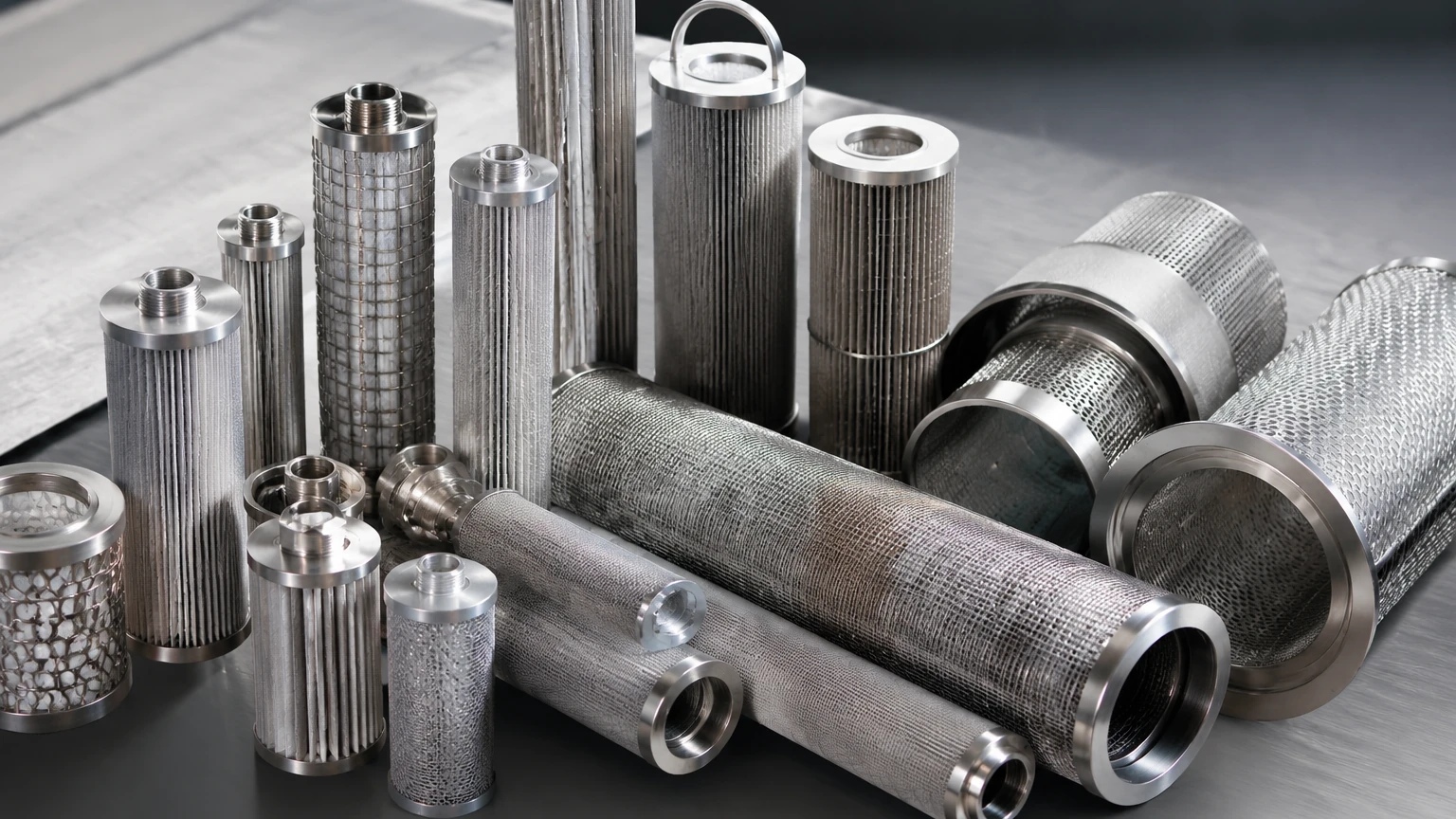
Woven wire mesh is a surface filtration medium that provides a precise, uniform pore size. It is ideal for applications where the contaminant size is predictable and where the filter element needs to be cleaned and reused. In high-pressure environments, multi-layered mesh is often used, where finer filtration layers are protected by coarser support layers to prevent deformation.
Sintered Metal Media
Sintered metal filters are created by bonding multiple layers of wire mesh or metallic fibers through a thermal diffusion process. This creates a porous structure with high mechanical strength and fixed pore geometry. Sintered media are particularly effective in high-pressure gas applications or high-temperature chemical processes where traditional binders or adhesives would fail. They offer excellent depth filtration characteristics, allowing for higher dirt-holding capacity compared to simple mesh.
Pleated vs. Cylindrical Elements
To maximize the filtration area within a compact housing, many high pressure filters utilize pleated designs. Pleating increases the surface area by several factors, which reduces the face velocity of the fluid and lowers the initial pressure drop. This is essential for maintaining system efficiency and extending the interval between cleaning or replacement cycles.
Key Performance Parameters for Selection
When specifying a high pressure filter, engineers must evaluate several performance metrics to ensure the component meets the application's demands. These parameters define the filter's efficiency and its impact on the overall system energy consumption.
1. Micron Rating (Absolute vs. Nominal): In high-pressure systems, absolute ratings are generally preferred. An absolute rating indicates the diameter of the largest hard spherical particle that will pass through the filter under specified test conditions. For protecting servo-valves, ratings as fine as 3 to 10 microns are common.
2. Differential Pressure (ΔP): This is the difference in pressure between the inlet and outlet of the filter. A high initial ΔP indicates that the filter is undersized or the media is too dense for the flow rate, which can lead to energy loss and premature bypass.
3. Beta Ratio (β): This is a measure of filtration efficiency based on particle counts. A higher Beta ratio indicates a more efficient filter. For example, a βx = 200 means that for every 200 particles of size 'x' entering the filter, only one passes through.
4. Flow Fatigue: Since high-pressure systems often involve rapid cycling, the filter element must be rated for flow fatigue. This ensures the media does not crack or delaminate under the repeated stress of pressure pulses.
For a detailed look at how these parameters are applied to specific industrial models, you can review the product options and application support available on the Main Page.
Application-Specific Challenges and Solutions
Different industries present unique challenges for high pressure filtration. Engineering the right solution requires accounting for chemical compatibility, fluid viscosity, and environmental conditions.
Hydraulic and Lubrication Systems
In hydraulic circuits, high pressure filters are often equipped with bypass valves. These valves allow fluid to circumvent the filter element if it becomes clogged, preventing the element from collapsing and sending a burst of contaminants downstream. However, in "non-bypass" applications, the filter element must be designed to withstand the full system pressure differential.
Chemical and Petrochemical Processing
In these environments, the primary concern is often corrosion and chemical degradation. Utilizing 316L stainless steel or exotic alloys ensures that the filter maintains its structural integrity when exposed to aggressive solvents or acidic fluids. High-pressure gas filtration in refineries also requires media that can handle high velocities without shedding fibers.
Food and Pharmaceutical Production
Filters used in these sectors must meet stringent sanitary standards. Stainless steel high pressure filters are preferred because they can be sterilized (SIP) or cleaned-in-place (CIP). The absence of adhesives or resins in sintered metal elements prevents extractables from contaminating the product stream.
Maintenance, Monitoring, and Total Cost of Ownership
The long-term value of a high pressure filter is not just in its purchase price, but in its total cost of ownership (TCO). This includes the cost of replacement elements, the labor for maintenance, and the potential cost of system downtime.
Differential Pressure Monitoring
Most high-pressure housings include ports for differential pressure indicators. These can be visual gauges, electrical switches, or continuous transmitters. Monitoring ΔP is the most effective way to determine when a filter element is reaching its dirt-holding capacity. Replacing or cleaning the element at the right time prevents unnecessary energy consumption and protects the system from bypass events.
Cleaning and Regeneration
One of the significant advantages of stainless steel high pressure filters is their cleanability. Depending on the contaminant, elements can be cleaned using ultrasonic baths, chemical solvents, or backflushing. This reusability significantly reduces the environmental impact and long-term operational costs compared to disposable glass-fiber or paper elements.
Customization and OEM Solutions
Every industrial system has unique spatial and performance constraints. Working with a manufacturer that offers OEM and customized filtration solutions allows for the integration of filters into existing manifolds or the development of specialized housings for extreme environments. Kaifil’s expertise in material selection and precision manufacturing ensures that custom components meet the same rigorous standards as catalog items.
Conclusion
Selecting a high pressure filter is a technical decision that impacts the safety, efficiency, and longevity of an entire industrial operation. By focusing on robust materials like stainless steel, understanding the nuances of sintered and woven media, and strictly adhering to pressure and flow requirements, engineers can mitigate the risks associated with fluid contamination. For technical professionals and purchasing teams looking to optimize their filtration strategy, the Main Page serves as a gateway to professional product information and engineering guidance tailored to demanding industrial applications.
