


High-pressure Filtration
In industrial fluid dynamics, high-pressure filtration represents a critical engineering challenge where the necessity for particle removal intersects with the demand for extreme structural integrity. Unlike standard low-pressure or gravity-fed systems, high-pressure environments—often exceeding 3,000 to 6,000 PSI—require filtration components that can withstand significant mechanical stress without deforming, bypassing, or failing catastrophically. For engineers and procurement specialists, selecting the right filtration solution involves a deep understanding of fluid mechanics, material science, and the specific rigors of the application environment.
High-pressure filtration is a staple in industries such as hydraulic power generation, oil and gas extraction, chemical processing, and aerospace. In these sectors, the cost of filtration failure is not merely the presence of contaminants; it is the potential for downstream component damage, system-wide downtime, and safety hazards. This guide examines the technical parameters, material requirements, and design considerations essential for implementing effective filtration in high-pressure systems.
The Fundamentals of High-Pressure Filtration Systems
At its core, high-pressure filtration is defined by the system's operating pressure and the resulting differential pressure (ΔP) across the filter media. In a closed-loop hydraulic system or a high-pressure chemical reactor, the fluid is forced through the filter media at high velocities. As the filter captures contaminants, the resistance to flow increases, leading to a rise in differential pressure.
In a high-pressure context, the filter element must be designed to handle both the system's static pressure and the dynamic pressure drop. If a filter is rated for a specific micron level but lacks the structural support to maintain its geometry under pressure, the pores of the media may enlarge, a phenomenon known as "pore migration," or the media may rupture entirely. Therefore, high-pressure filtration is as much about mechanical engineering as it is about separation science.
Engineers must also account for pressure surges or "spikes." In many industrial applications, valves opening and closing or pumps cycling on and off can create instantaneous pressure peaks that far exceed the steady-state operating pressure. A robust filtration solution must be rated for these fatigue cycles to ensure long-term reliability.
Engineering Structural Integrity: Collapse and Burst Pressure
The most critical technical specification in high-pressure filtration is the collapse pressure rating. This refers to the maximum differential pressure a filter element can withstand before the internal support structure fails and the media collapses inward. For return-line filters, this might be relatively low, but for pressure-line filters located immediately downstream of a pump, collapse ratings often need to exceed 3,000 PSI.
To achieve this level of durability, manufacturers like Kaifil utilize heavy-duty internal support cores. These cores are typically constructed from perforated stainless steel or high-strength alloys. The thickness of the core, the hole pattern, and the welding technique used to join the core to the end caps are all vital factors. A core that is too thin will buckle under the compressive force of the fluid, while a core with insufficient open area will contribute to an excessive initial pressure drop.
Burst pressure is the counterpart to collapse pressure, referring to the housing's ability to contain the internal pressure without leaking or exploding. In high-pressure filtration, the filter housing is usually machined from solid bar stock or heavy-walled castings to ensure it meets safety factors (often 3:1 or 4:1) relative to the operating pressure.
Material Selection for High-Pressure Environments
Material compatibility and mechanical strength dictate the success of high-pressure filtration. While polymer-based media are common in low-pressure water treatment, high-pressure industrial applications almost exclusively rely on metal-based media, specifically stainless steel.
Stainless Steel 304 and 316L
Stainless steel is the industry standard due to its high tensile strength and excellent resistance to corrosion. Grade 304 is suitable for many general industrial applications, but Grade 316L is preferred in chemical processing and marine environments due to its superior resistance to pitting and chloride-induced stress corrosion cracking. The "L" in 316L denotes low carbon content, which is essential for components that require welding, as it prevents carbide precipitation that could weaken the joints under high pressure.
Specialized Alloys
In extreme cases involving highly corrosive fluids or temperatures exceeding 500°C, engineers may specify exotic alloys such as Hastelloy, Inconel, or Monel. These materials maintain their structural properties under high-pressure filtration conditions where standard steels would undergo creep or chemical degradation.
The Role of Sintered Wire Mesh in High-Pressure Applications
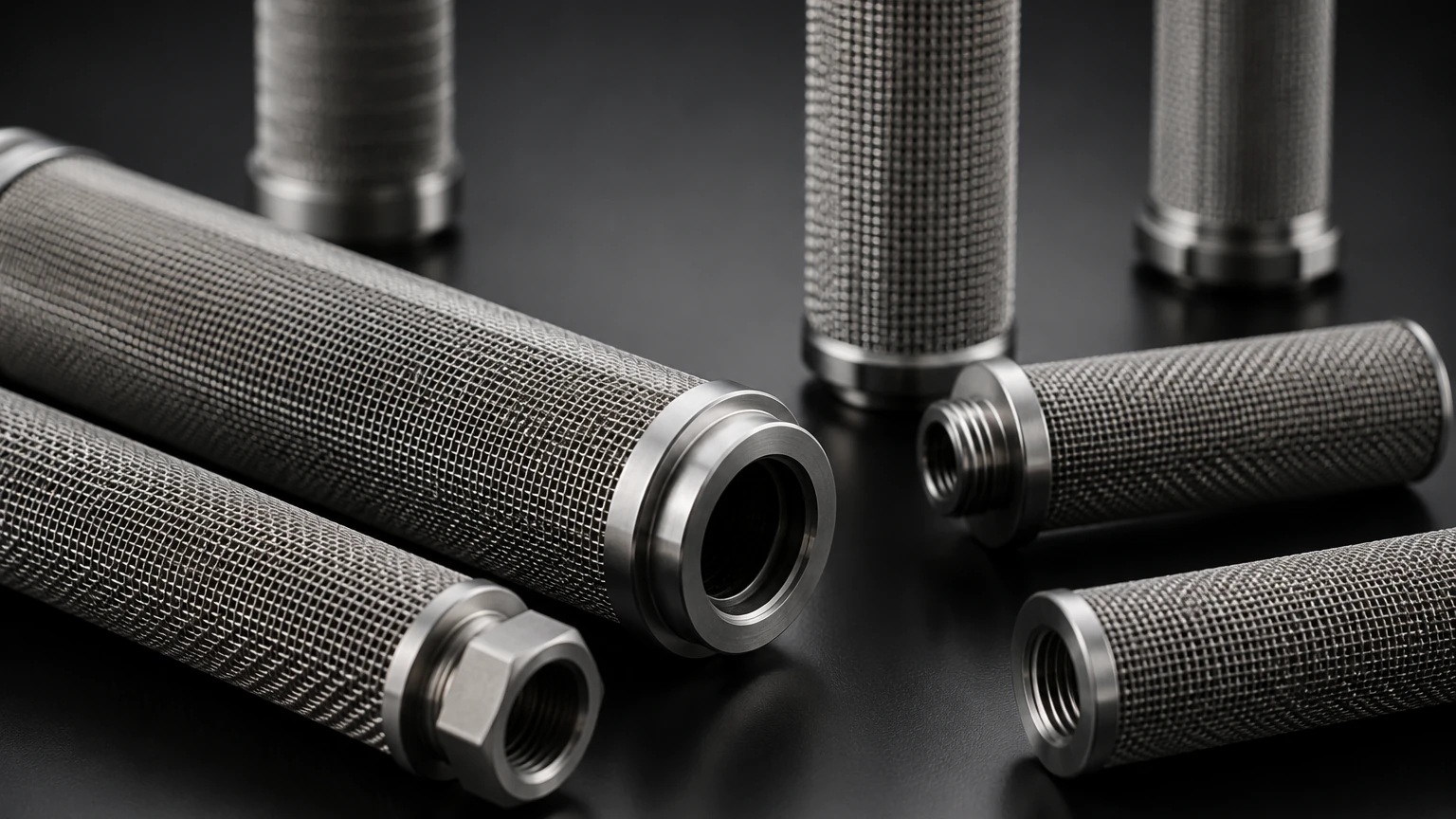
One of the most effective media for high-pressure filtration is sintered wire mesh. Sintering is a process where multiple layers of stainless steel wire cloth are bonded together through heat and pressure in a vacuum furnace. This process creates molecular bonds at every wire intersection, resulting in a monolithic structure that is significantly stronger than individual mesh layers.
Sintered mesh offers several advantages for high-pressure environments:
1. Fixed Pore Geometry: Unlike soft media, the pores in sintered mesh cannot shift or enlarge under pressure, ensuring consistent filtration accuracy.
2. Mechanical Strength: The multi-layer construction (often including a fine filtration layer, a distribution layer, and several heavy support layers) provides inherent resistance to collapse.
3. Cleanability: Sintered metal filters can be backwashed or ultrasonically cleaned, making them a cost-effective long-term solution compared to disposable cartridges.
For those seeking technical specifications on various mesh configurations, the Main Page provides detailed insights into how different weave patterns—such as Plain Dutch or Twilled Dutch—impact flow rates and pressure resistance.
Design Considerations: Pleated vs. Wrapped Filter Elements
The geometry of the filter element significantly impacts its performance in high-pressure filtration. There are two primary configurations: cylindrical (wrapped) and pleated.
Cylindrical Elements
Cylindrical elements consist of one or more layers of media wrapped around a support core. These are typically used in applications where flow rates are lower, or the fluid is highly viscous. The simplicity of the design makes them extremely robust against high differential pressures, as there are fewer stress concentration points.
Pleated Elements
Pleating the media increases the available surface area within the same footprint. In high-pressure filtration, increasing the surface area is a strategic way to manage pressure. By spreading the flow over a larger area, the "flux" (flow per unit area) is reduced, which lowers the initial pressure drop and significantly extends the dirt-holding capacity. However, pleating requires expert manufacturing; if the pleats are not properly supported, they can "bunch" together under high pressure, effectively sealing off parts of the filter and causing a premature pressure spike.
Managing Differential Pressure and Dirt-Holding Capacity
In any high-pressure filtration system, the relationship between the micron rating and the dirt-holding capacity is a delicate balance. A finer micron rating will capture more particles but will also cause the differential pressure to rise more quickly.
Engineers must calculate the "Terminal ΔP," which is the maximum pressure drop allowed before the filter must be cleaned or replaced. In high-pressure systems, this terminal point is often set well below the collapse pressure of the element to provide a safety margin. Monitoring this is typically done via differential pressure transducers or mechanical gauges equipped with electrical switches that trigger an alarm when the filter reaches a pre-set contamination level.
To optimize high-pressure filtration, it is often beneficial to use a graduated density approach. This involves using a coarser "pre-filter" layer to capture large debris, followed by the primary fine filtration layer. This prevents the fine layer from becoming blinded by large particles, thereby maximizing the service life of the element.
Common Risks and Failure Modes in High-Pressure Systems
Understanding how high-pressure filtration systems fail is essential for preventative maintenance and system design. Some of the most common risks include:
* Fatigue Failure: Constant pressure fluctuations can cause the metal wires in the mesh to work-harden and eventually crack. This is why the quality of the wire and the sintering process is so critical.
* Media Migration: In poorly manufactured filters, fragments of the filter media itself can break off and enter the downstream flow. In high-pressure systems, these metal fragments can act like shrapnel, destroying precision-machined valves or pumps.
* Seal Bypass: High pressure can cause O-rings or gaskets to deform or "extrude" out of their seats. If the seal fails, the fluid will take the path of least resistance, bypassing the filter entirely. High-pressure filters often require specialized back-up rings to support the primary seals.
* Channeling: If the filter media is not uniform, the high-velocity fluid may create "channels" through the media, leading to localized failure and a loss of filtration efficiency.
Technical Specifications for Procurement and OEM Customization
When sourcing components for high-pressure filtration, engineers should provide a comprehensive set of data to the manufacturer to ensure the component is fit for purpose. Key information to confirm includes:
1. Maximum Operating Pressure: The steady-state pressure the system will maintain.
2. Design Pressure: The maximum pressure the housing and element must survive (including safety factors).
3. Flow Rate and Viscosity: These determine the initial pressure drop and the required surface area.
4. Fluid Compatibility: Ensuring the stainless steel grade and seal materials (Viton, Buna-N, EPDM) are compatible with the process fluid.
5. Micron Rating (Absolute vs. Nominal): High-pressure systems usually require absolute ratings to ensure critical components are protected from specific particle sizes.
As a specialist in custom stainless steel filtration, Kaifil works with engineering teams to develop bespoke solutions that meet these rigorous standards. Whether it is a custom-sized high-pressure hydraulic filter or a specialized sintered component for chemical injection, the focus remains on durability and precision. For further information on custom manufacturing capabilities and product ranges, visiting the Main Page is the recommended next step for technical professionals.
Conclusion
High-pressure filtration is a demanding discipline that leaves no room for error. The combination of high mechanical stress, potential for pressure surges, and the critical nature of the downstream equipment necessitates a robust, well-engineered filtration strategy. By prioritizing structural integrity through materials like sintered stainless steel and focusing on rigorous design standards for collapse and burst pressure, industrial operators can ensure their systems remain efficient and protected. Selecting a manufacturer with deep technical expertise in custom metal filtration is the most effective way to navigate the complexities of high-pressure environments and achieve long-term operational success.
