


High Purity Filter
In modern industrial processing, the requirement for contaminant-free fluids and gases has moved from a specialized niche to a standard operational necessity. A high purity filter is a precision-engineered component designed to remove sub-micron particles, microorganisms, and chemical impurities from process streams without introducing secondary contaminants. For industries such as pharmaceutical manufacturing, semiconductor fabrication, and specialty chemical production, the integrity of the filtration system directly dictates the quality, safety, and yield of the final product.
Unlike standard industrial filters, high purity filtration solutions must meet stringent criteria regarding material outgassing, media migration, and chemical compatibility. Selecting the correct filtration media and housing requires a deep understanding of the fluid dynamics, the nature of the contaminants, and the environmental conditions of the application. For technical professionals and procurement teams, navigating these specifications is critical to ensuring long-term system reliability. Detailed technical resources and product specifications can be found on our Main Page to assist in the initial selection process.
The Role of High Purity Filtration in Industrial Processes
High purity filtration serves as the primary defense against process variability. In the pharmaceutical sector, for instance, filters must ensure that parenteral drugs are free from pyrogens and particulate matter that could compromise patient safety. In the semiconductor industry, even a single particle at the 10-nanometer scale can cause a short circuit in a microchip, leading to significant financial loss.
Beyond simple particle removal, a high purity filter must also maintain structural integrity under varying pressure and temperature conditions. Metal-based filters, particularly those constructed from stainless steel, are often preferred in these high-stakes environments because they do not shed fibers—a common failure point in polymer-based depth filters. Furthermore, the ability of metal filters to withstand aggressive cleaning protocols, such as Clean-in-Place (CIP) and Sterilize-in-Place (SIP), makes them indispensable for sterile processing environments.
Material Selection and Engineering Standards
The foundation of any high purity filter is its material composition. Stainless steel 316L is the industry standard due to its exceptional corrosion resistance and low carbon content, which prevents intergranular corrosion after welding. In highly aggressive chemical environments, alloys such as Hastelloy or Monel may be utilized to prevent material degradation.
Surface Finish and Electropolishing
In high purity applications, the internal surface of the filter housing and the media itself must be exceptionally smooth. Surface roughness, measured as Ra (Roughness Average), is a key metric. A high-quality high purity filter often undergoes electropolishing to achieve an Ra value of 0.4 µm or less. This process removes microscopic peaks and valleys where bacteria or contaminants could lodge, facilitating more effective sterilization and reducing the risk of biofilm formation.
Media Migration and Compatibility
One of the primary risks in filtration is "media migration," where fragments of the filter material break off and enter the downstream flow. Precision metal filters, such as sintered wire mesh or sintered metal fibers, are engineered to eliminate this risk. Through high-temperature vacuum sintering, the metal wires or fibers are molecularly bonded at every contact point, creating a rigid and stable structure that remains intact even under high differential pressures.
Technical Performance: Micron Ratings and Structural Integrity
Understanding the difference between nominal and absolute filtration ratings is essential for engineering a high purity system. A nominal rating refers to a filter's ability to retain a majority of particles of a certain size, whereas an absolute rating indicates that 99.9% (or higher) of particles at that size are captured.
The Beta Ratio
Engineers often use the Beta Ratio (β) to quantify filtration efficiency. The ratio is calculated by dividing the number of particles of a specific size upstream of the filter by the number of particles downstream. For a high purity filter, a high Beta Ratio (e.g., βx = 1000) is required to ensure consistent performance in critical applications.
Pressure Drop and Flow Rates
Every filter introduces a pressure drop (ΔP) into the system. In high purity systems, minimizing the initial pressure drop is vital to reducing energy consumption and preventing pump cavitation. The design of the filter—whether it is a pleated cartridge or a multi-layered sintered mesh—must balance the need for high surface area (to lower ΔP) with the physical constraints of the installation. For a comprehensive look at how different designs impact flow dynamics, engineers can review the technical data provided on our Main Page.
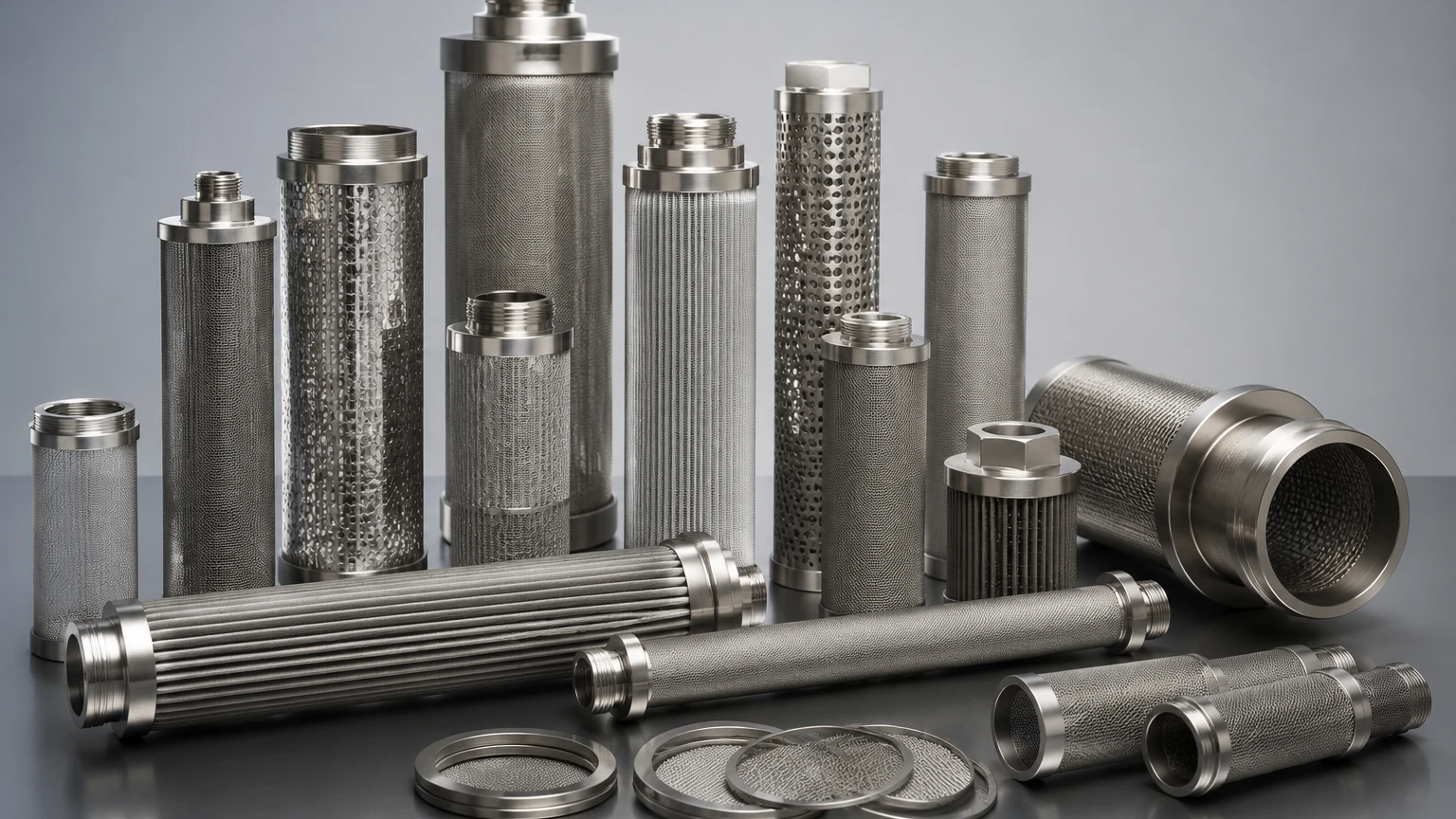
Customization for Specialized High Purity Applications
Standard off-the-shelf filters rarely meet the complex requirements of specialized industrial processes. Customization allows for the optimization of the filter’s geometry, connection types, and filtration layers to match specific process parameters.
Multi-Layer Sintered Mesh
For high purity gas filtration, a multi-layer sintered mesh structure is often employed. This design might include a fine filtration layer protected by coarser support layers on both sides. This configuration provides the necessary mechanical strength to withstand back-pulsing or high-pressure surges while maintaining sub-micron accuracy.
OEM and Precision Components
Original Equipment Manufacturers (OEMs) often require custom filter components that integrate seamlessly into larger systems, such as chromatography columns or analytical instruments. Customization options include specialized end-cap configurations (e.g., 222 or 226 O-ring styles), specific lengths, and unique diameters. Precision welding techniques, such as TIG or plasma welding, are used to ensure that these custom components maintain the high purity standards required by the application without introducing contaminants during the manufacturing process.
Maintenance and Longevity in Demanding Environments
The total cost of ownership (TCO) for a high purity filter is influenced heavily by its service life and cleanability. While polymer filters are often disposable, stainless steel high purity filters are designed for reuse, providing significant long-term cost savings and reducing environmental waste.
Cleaning Protocols
Metal filters can be cleaned using several methods depending on the nature of the contaminant:
1. Ultrasonic Cleaning: Uses high-frequency sound waves to create cavitation bubbles that dislodge particles from deep within the filter media.
2. Chemical Cleaning: Involves soaking the filter in acids, bases, or specialized solvents to dissolve organic or inorganic deposits.
3. Back-pulsing/Back-washing: Uses a reverse flow of fluid or gas to push contaminants out of the filter pores.
4. Burn-off/Pyrolysis: High-temperature treatment used to remove organic polymers or carbonized residues.
Monitoring Differential Pressure
The most effective way to determine when a filter needs cleaning or replacement is by monitoring the differential pressure. As the filter captures contaminants, the ΔP will gradually increase. Establishing a baseline "clean" pressure drop and a "terminal" pressure drop (at which point the filter must be serviced) is a standard practice in high purity process management.
Evaluating Total Cost of Ownership for Filtration Systems
When procuring a high purity filter, the initial purchase price is only one factor. Engineers must also consider the costs associated with downtime, replacement labor, and the potential risk of product loss due to filter failure.
Durability and Reliability
A robust stainless steel filter may have a higher upfront cost than a plastic alternative, but its ability to withstand thousands of sterilization cycles and its resistance to chemical attack often results in a lower TCO over a five-year period. Furthermore, the reliability of a metal filter reduces the risk of catastrophic failure, which in industries like pharmaceutical manufacturing, can result in the loss of an entire production batch worth millions of dollars.
Validation and Testing
High purity filters must be validated to ensure they meet their performance claims. Common tests include the Bubble Point Test, which measures the pressure required to force air through a liquid-saturated filter to determine the maximum pore size, and the Pressure Hold Test. Ensuring that your supplier provides full material traceability and certificates of conformance is essential for regulatory compliance in the food, beverage, and medical sectors.
To explore the full range of high-performance filtration solutions and to consult with our engineering team regarding specific application requirements, please visit our Main Page. By focusing on precision manufacturing and high-grade materials, we provide the filtration components necessary to maintain the highest levels of process purity and operational efficiency.
