


Stainless Steel Wedge Wire Screen
In industrial filtration and separation processes, the efficiency of a system often hinges on the structural integrity and precision of the filter media. The stainless steel wedge wire screen has emerged as a critical component for engineers seeking a balance between high flow rates, mechanical strength, and low maintenance requirements. Unlike traditional woven wire mesh or perforated plates, wedge wire offers a unique geometry that addresses the common challenge of "blinding" or clogging in demanding environments.
As a specialized manufacturer, Kaifil provides these precision-engineered components to sectors ranging from petrochemical processing to food production. Understanding the technical nuances of wedge wire—from its V-shaped profile to material grade selection—is essential for procurement teams and engineers tasked with optimizing filtration performance and total cost of ownership.
Understanding the Engineering Behind Wedge Wire Technology
The fundamental advantage of a stainless steel wedge wire screen lies in its geometric design. These screens are constructed by resistance-welding V-shaped profile wires onto support rods at each intersection. This method creates a continuous slot that widens inwardly, a design feature often referred to as the "V-wire" profile.
From a fluid dynamics perspective, this geometry is significant. When solid particles pass through the screen, they only make contact at two points on the narrowest part of the slot. If a particle manages to pass through this initial opening, the widening gap ensures it will continue through the screen without becoming lodged. This "self-cleaning" or non-clogging characteristic is the primary reason wedge wire is preferred over square mesh in high-solids applications. In woven mesh, particles often become trapped within the intersecting wires, leading to a rapid increase in pressure drop and requiring frequent backwashing or manual cleaning.
Furthermore, the resistance welding process ensures a rigid, single-piece structure. This eliminates the risk of wire shifting—a common failure mode in woven filters under high-pressure pulses—and provides the mechanical strength necessary to withstand significant differential pressures without deformation.
Material Selection: Grades and Corrosion Resistance
Selecting the appropriate alloy is perhaps the most critical decision in the specification process. While "stainless steel" is the broad category, the specific grade determines the screen's longevity in corrosive or high-temperature environments.
1. Grade 304 Stainless Steel: This is the standard choice for general industrial applications. It offers excellent strength and good corrosion resistance for water treatment, food processing, and architectural uses. However, it is susceptible to chloride-induced pitting, making it less suitable for marine or highly acidic environments.
2. Grade 316L Stainless Steel: For chemical processing, pharmaceutical manufacturing, and applications involving brackish water, 316L is the preferred material. The addition of molybdenum enhances its resistance to pitting and crevice corrosion. The "L" denotes low carbon content, which is vital for maintaining corrosion resistance in the heat-affected zones of the welds.
3. Duplex and Super Duplex: In extreme environments, such as oil and gas extraction or high-concentration chemical filtration, duplex stainless steels provide superior yield strength and exceptional resistance to stress corrosion cracking. These materials are often used when the screen must serve as a structural element in a high-pressure vessel.
Engineers must confirm the chemical composition of the process fluid, including pH levels and chloride concentration, before finalizing material specifications. Kaifil works closely with technical teams to ensure the selected material aligns with the expected service life of the filtration system.
Key Performance Indicators: Slot Accuracy and Open Area
The performance of a stainless steel wedge wire screen is measured primarily by its filtration accuracy and its impact on system pressure. These are determined by two factors: slot width and percentage of open area.
Slot Width Precision
Slot widths in wedge wire screens can range from as small as 20 microns to several millimeters. The precision of this slot is paramount. In applications like media retention (e.g., holding resin beads in an ion exchange column), a slot that is even slightly oversized can lead to catastrophic media loss. Advanced manufacturing processes allow for extremely tight tolerances, ensuring that the gap remains consistent across the entire surface of the screen.
Calculating Open Area
The open area is the ratio of the total slot area to the total screen surface area. A higher open area translates to a lower pressure drop and higher flow capacity. However, there is an engineering trade-off: increasing the open area usually requires using thinner profile wires or increasing the slot width, which can compromise the structural strength of the screen. Engineers must calculate the required flow velocity and compare it against the mechanical load requirements to find the optimal balance.
For more detailed technical specifications and to explore how these variables impact your specific application, you may visit the Main Page to review product options and application support.
Customization Options for Industrial Applications
One of the greatest strengths of wedge wire is its versatility in form. Because it is a fabricated product rather than a simple textile, it can be engineered into various configurations to suit specific equipment designs.
* Cylindrical Screens (Filter Cartridges): These can be designed for either "Flow Out-to-In" (FOTI) or "Flow In-to-Out" (FITO). In FOTI configurations, the flat side of the V-wire faces outward, creating a smooth exterior surface that is easy to clean with a scraper or backpulse. In FITO configurations, the V-wire is inverted so the smooth surface is on the interior, ideal for internal screw presses or centrifugal separators.
* Flat Panels and Sieve Bends: Used extensively in mining and wastewater treatment, these panels utilize the Coanda effect to separate liquids from solids. Sieve bends, in particular, use a curved profile to increase the capacity of the screen by utilizing centrifugal force.
* Support Structures: Depending on the pressure requirements, wedge wire screens can be reinforced with extra-heavy support rods, outer perforated shrouds, or internal reinforcement rings. This customization ensures the screen can function as a stand-alone structural component within a reactor or pressure vessel.
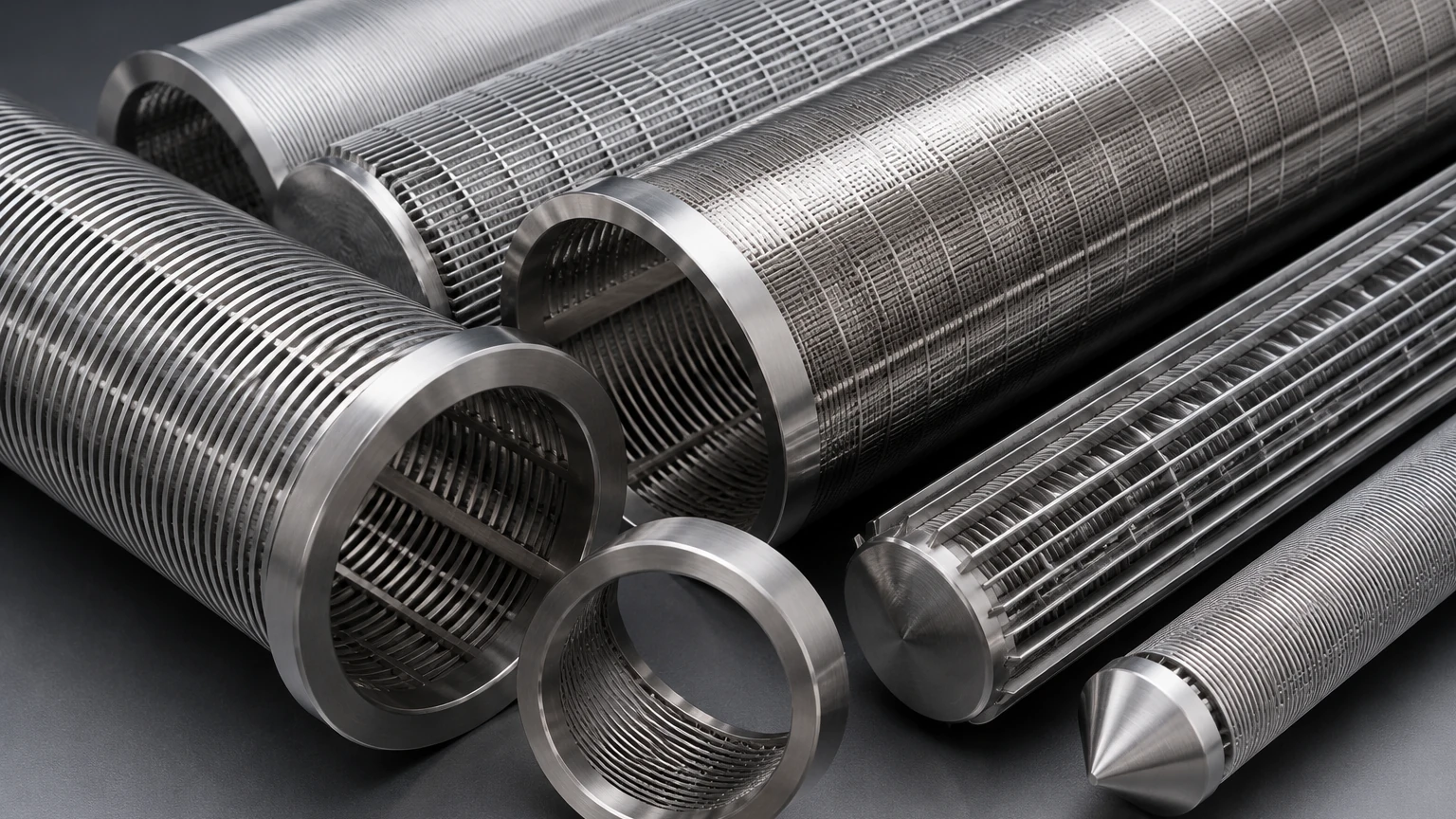
Structural Integrity and Support Configurations
Unlike many other filter media, a stainless steel wedge wire screen often doubles as a structural component. In large-scale water intake systems or reactor internals, the screen must support the weight of the filter media (such as sand, carbon, or catalyst) while resisting the hydraulic forces of the flow.
Engineers must consider the "collapse strength" and "burst strength" during the design phase. These are influenced by the spacing and diameter of the support rods. By decreasing the pitch (the distance between support rods), the screen's resistance to external pressure is significantly increased. In high-pressure hydraulic applications, the welding quality at each intersection becomes the most critical factor. A failure in a single weld can lead to a zipper effect, compromising the entire screen. Consequently, choosing a manufacturer with rigorous quality control and automated welding capabilities is essential to ensure consistent structural performance.
Operational Maintenance and Longevity
The total cost of ownership (TCO) of a filtration system is heavily influenced by maintenance cycles and the lifespan of the filter media. While the initial investment in a stainless steel wedge wire screen may be higher than that of disposable polymer filters or woven mesh, the long-term savings are often substantial.
Cleaning and Reusability
Wedge wire is inherently easier to clean. For automated systems, backwashing or back-pulsing is highly effective because the V-shaped slots prevent particles from becoming permanently trapped. In manual systems, the smooth surface of the screen allows for mechanical cleaning with brushes or scrapers without damaging the filter surface. This reusability eliminates the recurring costs of replacement filters and reduces the environmental impact of industrial waste.
Wear Resistance
In abrasive applications, such as mineral processing or pulp and paper manufacturing, the thickness of the profile wire provides a "wear allowance." As the surface of the wire slowly erodes due to the impact of abrasive particles, the slot width remains relatively stable for a longer period compared to thin-wire woven mesh. Furthermore, specialized surface treatments like electropolishing can be applied to further reduce friction and enhance corrosion resistance, extending the service life in aggressive chemical environments.
Procurement Considerations for Technical Teams
When sourcing stainless steel wedge wire screens, purchasing teams and engineers should confirm several technical details to ensure the product meets the application's demands. A failure to specify these details can lead to premature equipment failure or inefficient process performance.
1. Slot Tolerance: What is the maximum allowable deviation from the nominal slot size? For high-precision applications, this should be clearly defined.
2. Material Certification: Request Mill Test Reports (MTRs) to verify the alloy's chemical composition. This is especially important for 316L and Duplex grades where corrosion resistance is paramount.
3. Weld Integrity: Inquire about the manufacturer’s welding standards. Are the screens produced using automated resistance welding to ensure uniformity?
4. Flow Direction: Clearly specify whether the application requires Flow Out-to-In (FOTI) or Flow In-to-Out (FITO), as this dictates the orientation of the profile wires.
5. End Fittings: Customization often includes specialized end caps, flanges, or threaded connections. Ensure these are integrated into the design to facilitate easy installation into existing housing.
By addressing these factors during the procurement phase, technical teams can avoid the risks associated with "off-the-shelf" solutions that may not be rated for specific industrial pressures or chemical exposures.
Conclusion
The stainless steel wedge wire screen remains a cornerstone of industrial filtration due to its unique combination of precision, durability, and non-clogging performance. Whether it is used in a simple water intake system or a complex chemical reactor, the engineering behind the V-wire profile provides a level of reliability that other media cannot match.
For engineers and purchasing professionals, the key to success lies in detailed specification—matching the material grade, slot precision, and structural design to the specific rigors of the application. As a dedicated manufacturer of custom stainless steel filtration solutions, Kaifil provides the technical expertise and manufacturing precision required to meet these demanding standards. To explore our full range of capabilities and technical resources, visit the Main Page and connect with our engineering team for customized filtration support.
