


High Temp Filter
In industrial processing, the term "high temperature" is relative, yet for filtration systems, it typically marks the threshold where standard polymer-based media—such as polypropylene or polyester—fail due to thermal degradation, softening, or chemical instability. A high temp filter designed for industrial use must maintain structural integrity, precise pore geometry, and chemical resistance at temperatures often exceeding 250°C (482°F) and reaching as high as 1,000°C (1,832°F) in specialized applications. For engineers and procurement teams, selecting the correct filtration medium for these environments is not merely a matter of heat tolerance; it involves a complex evaluation of thermal expansion, mechanical fatigue, and fluid dynamics.
Stainless steel and specialized alloys serve as the primary materials for high-temperature filtration. These metallic solutions provide the necessary mechanical strength to withstand high differential pressures while offering the longevity required in continuous industrial cycles. This guide examines the technical considerations, material science, and engineering requirements for implementing effective high-temperature filtration solutions.
Material Science in High-Temperature Filtration
The performance of a high temp filter is fundamentally dictated by its metallurgy. When temperatures rise, the mechanical properties of metals, including yield strength and creep resistance, begin to shift. Selecting the appropriate alloy is the first step in ensuring the filter does not bypass or collapse under operational stress.
Stainless Steel 304 and 316L
Stainless steel remains the industry standard for moderate to high-temperature applications. Grade 304 offers excellent heat resistance up to approximately 800°C in intermittent service. However, for most industrial chemical processes, Grade 316L is preferred due to its molybdenum content, which enhances corrosion resistance, particularly against pitting in chloride-rich environments. 316L maintains its structural properties well into the 450°C to 500°C range, making it suitable for steam filtration and many chemical catalysts.
High-Nickel and Specialty Alloys
In environments where temperatures exceed 500°C or involve highly corrosive gases, standard stainless steels may suffer from rapid oxidation or sulfidation. In these instances, alloys such as Hastelloy®, Inconel®, and Monel® are utilized.
* Inconel 600/625: These alloys are specifically engineered for use at extreme temperatures, maintaining high tensile strength and resisting oxidation at temperatures up to 1,000°C. They are frequently found in aerospace, nuclear, and high-heat chemical reactors.
* Hastelloy C276: While often chosen for its peerless corrosion resistance, it also performs exceptionally well in high-temperature acidic environments where other metals would degrade.
The Role of Sintering in Structural Integrity
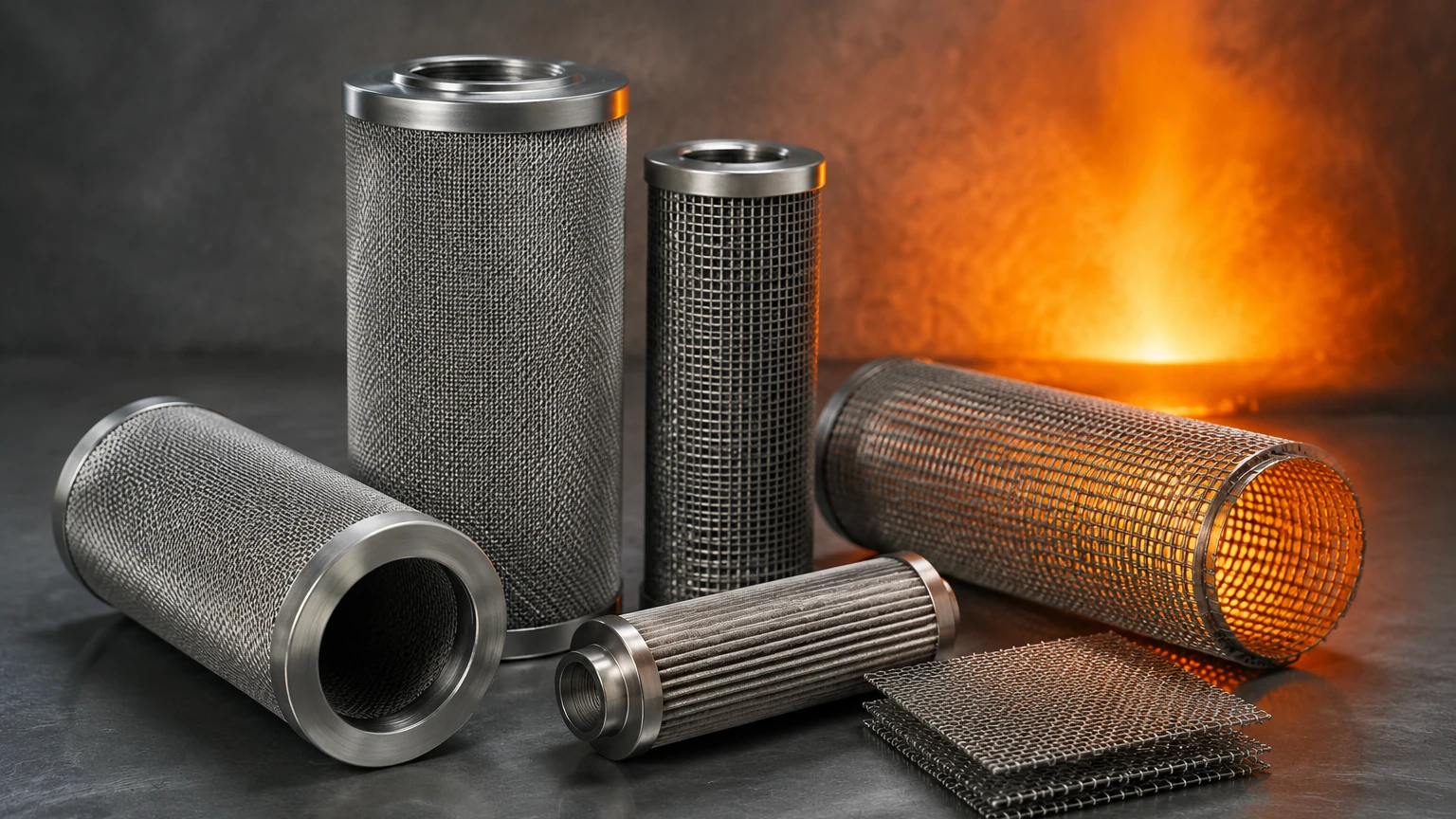
For a high temp filter to provide consistent micron ratings, the filter media must be stabilized. Traditional woven wire mesh can shift under thermal stress, leading to changes in pore size. To counteract this, industrial filters often utilize sintered metal technology.
Sintering is a process where multiple layers of wire mesh, or metal fibers (felt), are heated in a vacuum furnace to a temperature just below their melting point. This causes diffusion bonding at every contact point of the wire. The result is a single, integrated porous structure that is significantly more robust than individual mesh layers.
Sintered Wire Mesh vs. Sintered Metal Fiber Felt
Sintered wire mesh provides a predictable, uniform pore structure and is highly resistant to mechanical deformation. It is ideal for surface filtration where easy cleaning (backwashing) is required. Conversely, sintered metal fiber felt consists of non-woven metal fibers that are sintered together. This creates a depth filtration medium with high porosity (up to 80%). The high porosity of fiber felt allows for lower initial pressure drops and a much higher dirt-holding capacity, which is critical in high-temperature gas filtration where particulate loads may be high.
Engineering Considerations: Thermal Expansion and Fatigue
One of the most overlooked aspects of high-temperature filter design is the coefficient of thermal expansion (CTE). As the filter element heats up, the metal expands. If the filter is housed in a vessel made of a different material, or if the filter element is constrained by rigid supports, this expansion can lead to buckling, cracking of welds, or seal failure.
Thermal Cycling
Industrial processes are rarely perfectly static. Systems often cycle between ambient and operational temperatures during startup and shutdown. This thermal cycling induces mechanical stress. A well-engineered high temp filter must account for "thermal fatigue." Engineers must ensure that the pleating geometry and the welding techniques—typically TIG (Tungsten Inert Gas) or plasma welding—are executed to aerospace standards to prevent stress risers that could lead to premature failure.
Differential Pressure (Delta P) at Temperature
As temperature increases, the viscosity of gases decreases, but the viscosity of liquids typically decreases significantly. However, the mechanical strength of the filter medium also decreases. Engineers must calculate the maximum allowable differential pressure based on the "de-rated" strength of the metal at its peak operating temperature. A filter that can withstand 50 bar at room temperature might only be rated for 15 bar at 600°C.
Applications for High-Temperature Filtration
The necessity for a robust high temp filter spans across several critical industrial sectors where process fluids or gases must be purified without cooling the stream, which would result in energy loss or phase changes.
Chemical and Petrochemical Processing
In refinery operations, high-temperature filters are used for catalyst recovery. Catalysts are often expensive precious metals; capturing them from high-heat process streams is essential for economic viability. Furthermore, filtration of polymer melts requires temperatures high enough to keep the plastic in a liquid state, often requiring filters to operate between 200°C and 350°C under extreme pressures.
Steam Filtration
Steam is used for sterilization in pharmaceutical and food production (Culinary Steam). Filters used here must withstand the high temperature of saturated steam while ensuring that no particulates from the piping system contaminate the end product. Stainless steel sintered elements are the preferred choice here due to their ability to be cleaned and sterilized repeatedly.
Hot Gas Filtration
In power generation and waste-to-energy plants, hot flue gases must be cleaned of fly ash and particulates before reaching turbines or emission control systems. Using a metal high temp filter allows the gas to be filtered at temperatures above the acid dew point, preventing liquid condensation that could lead to severe corrosion of downstream components.
Maintenance, Cleaning, and Longevity
Unlike disposable polymer filters, metallic high-temperature filters represent a significant capital investment. Their value proposition lies in their ability to be cleaned and reused. Depending on the contaminant, several methods can be employed to restore the filter’s original pressure drop.
1. Backwashing/Backpulsing: This is the most common in-situ cleaning method. A reverse flow of clean fluid or gas is sent through the filter to dislodge surface cake.
2. Ultrasonic Cleaning: For deep-seated particulates in sintered felt, ultrasonic baths using specialized detergents can vibrate contaminants loose from the internal pore structure.
3. Chemical Cleaning: Using acids, alkalis, or solvents to dissolve specific chemical deposits without affecting the base metal of the filter.
4. Burn-off / Pyrolysis: In applications like polymer filtration, the filter elements can be placed in a controlled-atmosphere furnace to carbonize and remove organic residues.
It is vital for maintenance teams to track the "recovered" pressure drop after each cleaning cycle. Over time, some particulates may become permanently embedded (blinding the media), which will eventually necessitate replacement.
Selection Criteria for Procurement and Engineering
When specifying a high temp filter, providing vague parameters can lead to system underperformance or catastrophic failure. Engineers should confirm the following data points before finalizing a design:
* Operating and Peak Temperature: What is the continuous temperature, and what are the short-term excursions?
* Fluid Chemistry: Are there corrosive elements (chlorides, sulfides, acids) that become more reactive at high temperatures?
* Micron Rating: Is the requirement for "nominal" or "absolute" filtration? In high-temperature gas streams, Brownian motion may affect the capture efficiency of fine particles.
* Flow Rate and Viscosity: What is the fluid’s viscosity at the actual operating temperature?
* Cleaning Compatibility: Can the process tolerate the downtime required for cleaning, or is a duplex system (allowing for continuous flow during cleaning) required?
For a comprehensive overview of available specifications and custom engineering capabilities, engineers can visit the Main Page to review product options and application support. Choosing a filtration partner with experience in metallurgy and industrial fluid dynamics is essential for ensuring the longevity of the system.
Conclusion
High-temperature filtration is a specialized field where material science meets mechanical engineering. By moving away from disposable media and toward engineered metallic solutions like sintered wire mesh and fiber felt, industrial facilities can achieve higher purity levels, better energy efficiency, and lower long-term operational costs. Whether the application involves steam, hot gases, or aggressive chemical catalysts, the success of a high temp filter depends on a rigorous understanding of the thermal and mechanical stresses of the environment. Proper material selection, coupled with advanced manufacturing techniques like sintering, ensures that these components remain the reliable backbone of modern industrial processing.
